


There is a version of this conversation that parents across Kerala are having with increasing urgency — and often too late. A teenager whose grades have been slipping for months, whose social group has quietly changed, who comes home with eyes that look different, who has become unreachable in ways that feel qualitatively different from normal teenage distance. The conversation that should have happened months earlier — the one about substance abuse in teenagers — is happening in a crisis rather than in the preventive space where it might have made the most difference. Substance abuse in teenagers is one of the most rapidly evolving and most clinically urgent mental health challenges facing Indian families today — driven by a convergence of unprecedented social media exposure to glamourised substance use content, the pressures of an intensely competitive academic environment that makes escape feel necessary, the growing availability of substances across Kerala’s urban and semi-urban areas, and a cultural silence around early recognition and help-seeking that allows substance use to progress from experimentation to dependency in the space where early intervention should have occurred.
At NeuroHealthline, understanding substance abuse in teenagers — its neurological mechanisms, its clinical presentations, its relationship to the underlying mental health challenges most commonly driving it, and the most effective approach to supporting recovery — is an essential component of our commitment to the mental health of Kerala’s next generation.
Why Teenagers Are Neurologically Vulnerable to Substance Abuse
The neurological vulnerability of teenagers to substance abuse is not a moral failing of character or a reflection of inadequate parenting — it is a predictable consequence of the specific developmental stage of the adolescent brain. The teenage brain’s reward system — the dopaminergic circuits that govern motivation, pleasure-seeking, and reinforcement learning — is significantly more sensitive and more reactive than the adult brain’s reward system, while the prefrontal cortex that regulates impulse control, risk assessment, and the capacity to weigh long-term consequences against short-term rewards is not fully mature until the mid-twenties.
This developmental combination — a highly sensitive reward system with incompletely developed regulatory control — makes the adolescent brain specifically vulnerable to the immediate, intense dopaminergic reward that most substances deliver. The reinforcement learning that the adolescent brain performs so efficiently — designed in the ancestral environment to accelerate social and skill learning during the developmental window — applies equally effectively to the neurological lessons that substance use teaches: that this substance reliably produces a rapid, powerful reduction in the anxiety, boredom, social discomfort, or emotional pain that the teenager is experiencing. This learning occurs rapidly, consolidates powerfully, and is extraordinarily difficult to unlearn precisely because it was acquired during the developmental window when the brain is most receptive to reward learning.
Substance abuse in teenagers therefore begins with a brain that is neurologically primed for it — and is sustained by a learning process that is operating at maximum developmental efficiency. According to NCBI PubMed, adolescent substance use produces more rapid development of dependency, more severe neurological consequences, and more persistent long-term outcomes than equivalent substance use beginning in adulthood — making the prevention and early treatment of substance abuse in teenagers one of the highest-impact interventions available for population-level addiction medicine.
What Drives Substance Abuse in Teenagers — The Real Root Causes
Understanding the root causes of substance abuse in teenagers is essential for effective prevention and treatment — because the most common responses to teen substance use, which focus on the substance itself rather than the needs it is meeting, consistently fail to produce lasting change. The self-medication hypothesis — the recognition that a substantial proportion of adolescent substance use begins as an attempt to manage the symptoms of unaddressed mental health conditions — is one of the most clinically important frameworks for understanding substance abuse in teenagers.
The teenager with undiagnosed anxiety who discovers that cannabis reliably quiets the nervous system activation that makes social situations feel threatening. The student with unrecognised ADHD who discovers that stimulants — whether prescribed or recreational — finally produce the cognitive focus that has always eluded them. The trauma survivor whose unprocessed PTSD produces a level of emotional pain that substances temporarily but powerfully relieve. Each of these teenagers is using substances not for recreational excitement but for genuine relief from neurological and emotional experiences that they do not have the clinical support or the language to address in any other way.
Other significant drivers of substance abuse in teenagers include the social modelling of glamourised substance use through OTT content and social media — the connection to our blog on toxic shows and teenage mental health is direct; peer social dynamics in which substance use is associated with belonging, sophistication, and social identity; the academic pressure that makes escape into altered states feel urgently necessary during examination periods; and the boredom and purposelessness of adolescents whose developmentally appropriate need for stimulation, risk-taking, and identity exploration has not been met through positive channels.
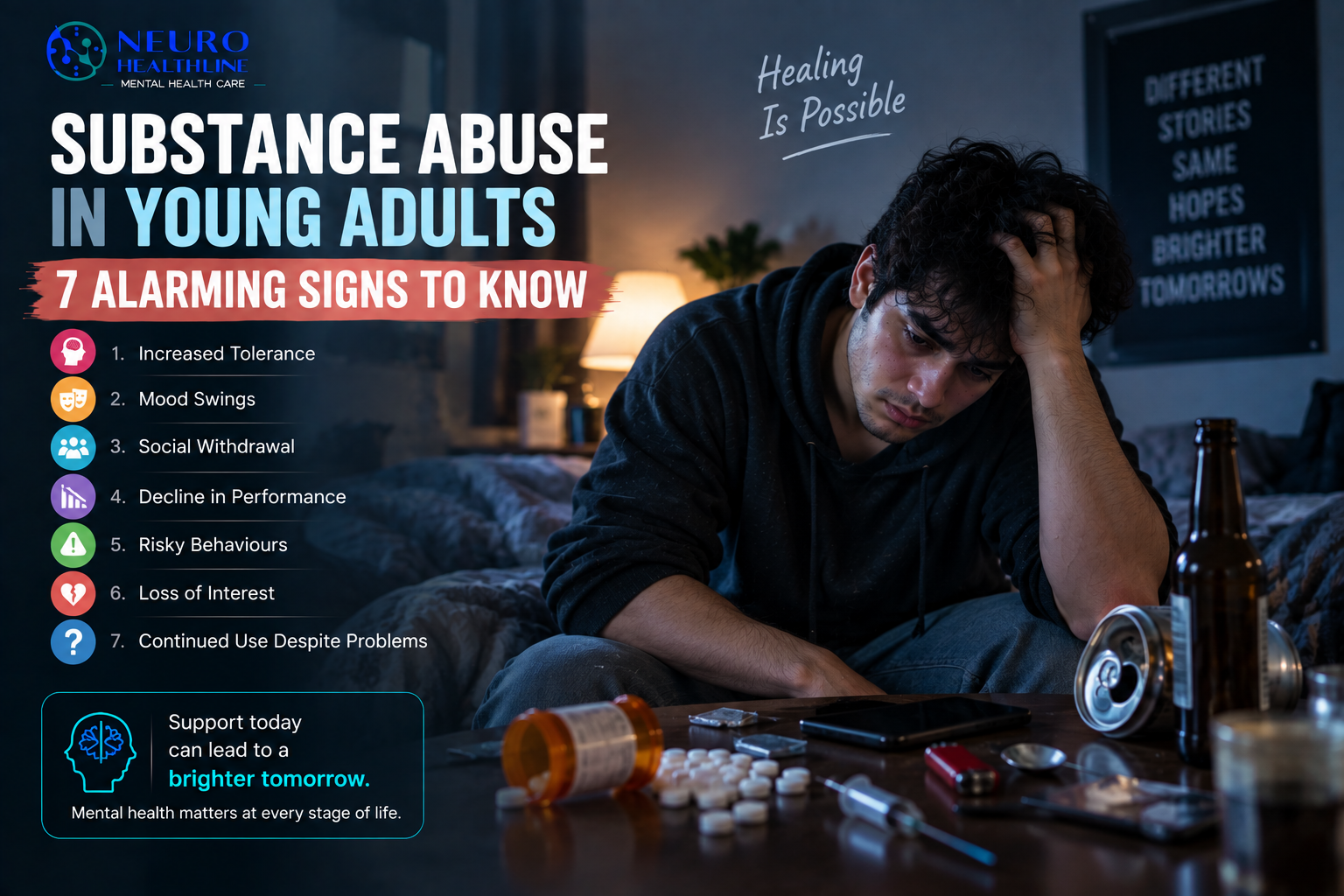
7 Alarming Signs of Substance Abuse in Teenagers
1. Sudden Change in Social Group
One of the earliest and most reliable signs of substance abuse in teenagers is a rapid, unexplained shift in peer group — the teenager who suddenly drops longstanding friendships and adopts a new social circle whose members may be older, less academically oriented, or associated with substance use contexts. This social transition often reflects the teenager’s discovery of a peer community in which their substance use is accepted and shared, and frequently precedes other more visible signs of substance abuse.
2. Dramatic Academic Performance Decline
The neurological consequences of substance abuse in teenagers — impaired prefrontal function, disrupted memory consolidation, reduced motivation — directly impair academic performance in ways that are measurable and typically dramatic. A teenager whose grades have declined sharply without a clear academic explanation, whose engagement with school has progressively reduced, and who appears to have lost the motivation they previously demonstrated warrants assessment for substance use alongside academic and mental health intervention.
3. Physical Signs and Appearance Changes
Physical indicators of substance abuse in teenagers vary by substance but commonly include bloodshot or glazed eyes, altered pupil size, unexplained weight changes, deteriorating personal hygiene, unusual smells on clothing or breath, and a general physical presentation that has shifted from the teenager’s baseline. These physical signs are often the first observable indicators of substance use that parents and teachers notice — and warrant open, compassionate conversation rather than accusation or confrontation.
4. Mood Swings and Emotional Dysregulation
The emotional volatility associated with substance abuse in teenagers — the cycling between elevated or unusually relaxed states following substance use and irritable, dysphoric, or withdrawn states during withdrawal — produces a pattern of emotional dysregulation that is qualitatively different from normal adolescent mood variation. The timing of mood shifts — notably improved affect followed by periods of particular irritability or low mood — can provide clinical clues about substance use patterns.
5. Secretive Behaviour and Lying
Substance abuse in teenagers is almost universally accompanied by escalating secretiveness — regarding whereabouts, social activities, phone use, and finances. The lying and secrecy that develop around substance use are not simply dishonesty — they reflect the teenager’s recognition that their substance use would not be accepted, and the progressive divergence between their visible public life and their private substance-using one.
6. Money and Valuable Items Going Missing
As substance abuse in teenagers progresses and financial costs escalate, missing money, valuables, or unexplained requests for cash are common indicators that warrant attention. This sign, appearing in conjunction with other behavioural changes, should be addressed with the seriousness it deserves — not as a theft problem but as a potential indicator of progressing substance dependency.
7. Loss of Interest in Previous Passions
The anhedonia that substance abuse in teenagers produces — the progressive incapacity to experience genuine pleasure from activities that previously brought enjoyment as the reward system is recalibrated toward substance-delivered rewards — results in the quiet abandonment of sports, hobbies, creative pursuits, and social activities that were previously central to the teenager’s identity. This progressive narrowing of engagement, often interpreted as normal teenage disengagement, is one of the most important early warning signs of developing substance dependency.
The Connection Between Substance Abuse in Teenagers and Mental Health
The relationship between substance abuse in teenagers and mental health is bidirectional and mutually reinforcing — precisely the dual diagnosis dynamic we explored in our blog on drug abuse and mental health. Unaddressed anxiety, depression, ADHD, and trauma drive substance use as self-medication. Substance use produces neurological changes that worsen anxiety, depression, and emotional regulation capacity. The resulting clinical presentation involves both the substance use disorder and the underlying mental health condition maintaining each other in a cycle that effective treatment must address simultaneously.
This is why NeuroHealthline’s approach to supporting teenagers affected by substance abuse focuses on the underlying mental health conditions driving the substance use — using HEG neurofeedback to address the anxiety, depression, and ADHD neurological patterns most commonly driving self-medication; HRV biofeedback therapy to rebuild the autonomic nervous system regulation that reduces the anxiety and stress reactivity most powerfully driving substance use; and compassion-focused neuropsychotherapy to address the identity, belonging, and emotional regulation needs that substance use has been meeting — within a clinical framework that works in coordination with specialist addiction medicine services.
Our anxiety in students in Kochi and teen depression treatment programs address the most common underlying conditions driving substance abuse in teenagers — recognising that treating the mental health conditions fuelling substance use is as essential to recovery as addressing the substance use itself. The World Health Organization recognises substance use disorders as healthcare conditions requiring evidence-based clinical treatment — and early intervention during the teenage years produces dramatically better long-term outcomes than any intervention applied after dependency has fully consolidated.
FAQ — Substance Abuse in Teenagers
At what age does substance abuse in teenagers typically begin?
Substance experimentation typically begins between 13 and 16 in India, with alcohol and cannabis most commonly the first substances used. The earlier experimentation begins, the higher the risk of developing dependency — with adolescent onset of regular use being one of the strongest predictors of adult substance use disorder
Is cannabis use by teenagers really harmful?
Yes. The adolescent brain is specifically vulnerable to cannabis’s effects on the dopamine system and prefrontal development — with regular teenage cannabis use associated with reduced IQ, increased risk of psychosis, impaired memory consolidation, and significantly higher rates of adult cannabis dependency than adult-onset use.
How should I approach my teenager if I suspect substance abuse?
With calm, compassion, and a genuine focus on their wellbeing rather than anger, accusation, or consequences. Express concern for what they might be going through rather than judgment about what they have been doing — creating the emotional safety that makes honest conversation possible and help-seeking feel less threatening.
Can substance abuse in teenagers be treated successfully?
Yes — particularly with early intervention that addresses both the substance use and the underlying mental health conditions driving it. Adolescent brains are neurologically more responsive to treatment than adult brains, and the neuroplasticity of the teenage years that makes adolescents vulnerable to addiction also makes them highly responsive to effective clinical intervention.
What role does social media play in substance abuse in teenagers?
Social media plays a significant role through the normalisation and glamourisation of substance use in the content most consumed by teenagers — particularly through influencer culture, music content, and the OTT series that present substance use as integral to attractive, sophisticated lifestyles. This content environment significantly reduces inhibitory thresholds around substance experimentation in adolescents with pre-existing vulnerability.