


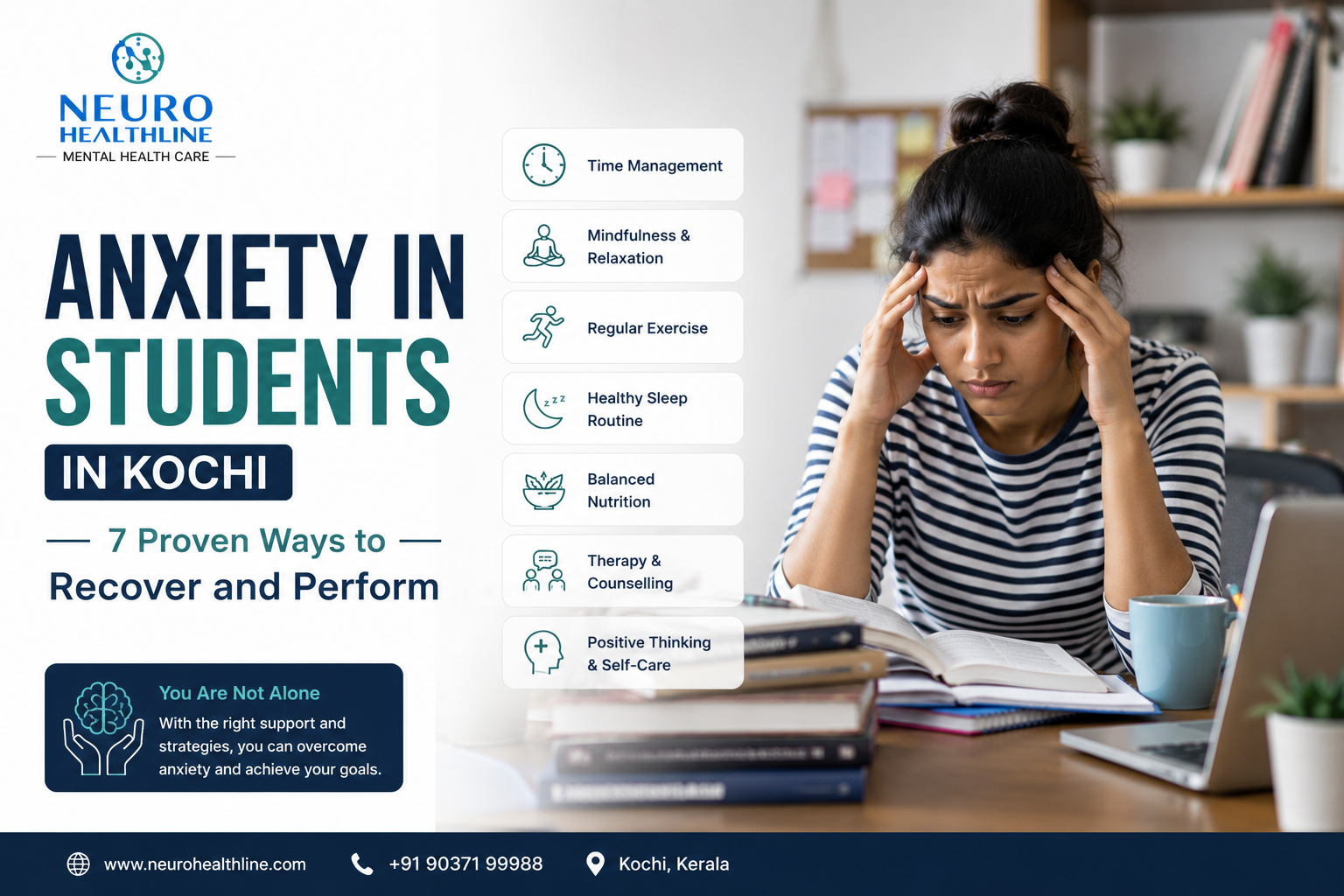
Kochi is one of Kerala’s most academically competitive cities — home to prestigious engineering colleges, medical institutions, management schools, and a large population of students preparing for some of India’s most demanding competitive examinations. While academic ambition is a strength, the pressure that accompanies it is producing a significant and growing mental health challenge. Anxiety in students in Kochi has reached levels that can no longer be attributed simply to pre-exam nerves or adjustment difficulties — it is a clinically significant condition affecting a substantial proportion of Kochi’s student population, quietly undermining academic performance, physical health, sleep, and the quality of what should be some of the most formative years of young people’s lives. At NeuroHealthline, anxiety in students in Kochi is addressed with the same clinical rigour and neuroscience-based precision we apply to every condition we treat — because students deserve more than stress management tips and reassurance.
Why Anxiety in Students in Kochi Is a Growing Clinical Concern
The academic environment in Kochi places extraordinary demands on students at precisely the stage of life when the brain is still completing its developmental trajectory. The prefrontal cortex — the brain region governing rational decision-making, emotional regulation, and the ability to manage pressure — does not fully mature until the mid-twenties, meaning students are navigating extreme academic and social demands with a regulatory system that is still under construction. This developmental reality makes anxiety in students in Kochi not simply a psychological response to pressure but a genuine neurological vulnerability that requires appropriate support rather than the expectation that students should simply “handle it.”
Compounding this developmental picture are the specific stressors that define student life in Kochi today — parental expectations around academic performance and career outcomes, intense competition for limited seats in preferred institutions, the social pressures of peer comparison in the age of social media, financial concerns about education costs and future prospects, and the profound uncertainty about career direction that many students carry. Each of these stressors activates the brain’s threat-detection system, and when multiple stressors converge — as they regularly do during examination periods — anxiety in students in Kochi can escalate rapidly from manageable pressure to genuinely debilitating clinical anxiety.
Research published on NCBI PubMed consistently identifies students as one of the highest-prevalence groups for anxiety disorders globally, with academic performance demands, social comparison, and career uncertainty as the primary contributing factors — all of which are acutely present in Kochi’s competitive academic environment.
How Anxiety in Students in Kochi Presents Differently
Anxiety in students in Kochi often presents with a distinctive pattern that reflects the specific stressors and developmental context of student life. Common presentations include intense examination anxiety that produces significant cognitive interference — blanking during tests, inability to retrieve information that was clearly learned, and prolonged post-examination rumination; chronic procrastination driven by perfectionism and fear of failure rather than laziness or lack of motivation; social anxiety within academic contexts — fear of speaking up in seminars, presenting assignments, or being evaluated by lecturers; physical symptoms including tension headaches, digestive disturbances, and sleep disruption that intensify during academic pressure periods; persistent worry about future career outcomes that intrudes on present-moment studying and learning; irritability and emotional reactivity that affects relationships with family and peers; and a progressive narrowing of life outside academics as anxiety drives increasing restriction of social activities, hobbies, and rest.
Many students and their families seeking help for anxiety in students in Kochi initially frame the problem as a performance issue — poor grades, inability to concentrate, or seeming unmotivated — without recognising the anxiety that is driving these academic difficulties from beneath the surface.
Specific Triggers of Anxiety in Students in Kochi
Understanding the specific triggers that drive anxiety in students in Kochi is essential for effective, targeted treatment. Key triggers include Kerala’s highly competitive examination culture — particularly for medical, engineering, and civil service pathways — where a single examination result can feel disproportionately consequential; parental and familial expectations that translate normal academic challenges into high-stakes threats; the pervasive social comparison enabled by social media, which creates a distorted picture of peers’ academic success and social lives; transitions between educational stages — school to college, college to postgraduate — which bring significant identity and social adjustment demands; part-time work pressures for students managing financial constraints alongside academic demands; and interpersonal relationship difficulties that, when compounded by academic pressure, can overwhelm a developing nervous system’s regulatory capacity.
At NeuroHealthline, our approach to anxiety in students in Kochi begins with mapping these specific triggers alongside the neurological and physiological patterns they have created, ensuring treatment is precisely tailored to each student’s individual presentation rather than applying a generic anxiety protocol.
7 Proven Solutions for Anxiety in Students in Kochi
1. QEEG Brain Mapping
Anxiety in students in Kochi at NeuroHealthline begins with a QEEG brain map identifying the specific neural patterns underlying each student’s anxiety — the particular combination of frontal overactivation, amygdala hyperreactivity, and prefrontal underregulation that drives their individual experience of exam anxiety, performance fear, or chronic worry.
2. HEG Neurofeedback for Academic Performance
HEG neurofeedback is uniquely valuable for anxiety in students in Kochi because it simultaneously reduces anxiety-driven neural overactivation and strengthens the prefrontal cortex function most critical for studying, recall, and examination performance — focus, working memory, cognitive flexibility, and emotional regulation under pressure. Students frequently report improvements in both anxiety levels and academic performance as neurofeedback training progresses.
3. HRV Biofeedback
HRV biofeedback therapy trains the autonomic nervous system to regulate efficiently under academic pressure, building a practical, portable skill that students can apply directly during examinations and high-stress academic situations. This is particularly valuable for students whose anxiety in students in Kochi manifests most acutely during examination conditions.
4. Cranioelectrical Stimulation (CES)
CES promotes calming brainwave activity and supports GABA and serotonin production, reducing the baseline level of nervous system activation that makes sustained studying and recall under pressure so difficult for students with anxiety in students in Kochi. Sessions are non-invasive and can be comfortably scheduled around academic commitments.
5. Sleep Optimisation
Sleep deprivation is both a cause and a consequence of anxiety in students in Kochi — anxious thoughts disrupt sleep, and insufficient sleep intensifies anxiety, impairs memory consolidation, and significantly reduces cognitive performance. Our sleep optimisation protocols including circadian realignment and CES-supported sleep restoration directly address this cycle, improving both anxiety and academic performance simultaneously.
6. Functional Nutrition for Brain Performance
Nutritional deficiencies in magnesium, B vitamins, omega-3 fatty acids, and iron are particularly prevalent in students and directly impair both anxiety regulation and cognitive performance. Our functional nutrition assessment identifies and corrects these deficiencies, providing the physiological foundation for both effective anxiety treatment and optimal academic brain function.
7. Neuropsychotherapy for Academic Confidence
Our neuropsychotherapy approach to anxiety in students in Kochi addresses the cognitive patterns most characteristic of student anxiety — perfectionism, catastrophising about failure, procrastination driven by performance fear, and social comparison — alongside practical strategies for study management, examination preparation, and sustainable academic performance.
Why Early Intervention for Anxiety in Students in Kochi Matters
The consequences of unaddressed anxiety in students in Kochi extend well beyond examination performance. Chronic anxiety during formative educational years shapes the nervous system’s baseline stress response in ways that can persist into adulthood — increasing vulnerability to burnout, workplace anxiety, and relationship difficulties later in life. Early, effective intervention during the student years not only improves immediate academic functioning but represents a genuinely preventive investment in long-term mental and physiological health.
At NeuroHealthline, we specifically emphasise the importance of early intervention for anxiety in students in Kochi — not waiting until anxiety has produced academic failure, social withdrawal, or physical health consequences before seeking support. Our broader anxiety treatment in Kochi program provides the clinical foundation within which our student-specific approach sits, while our social anxiety treatment program addresses the social dimensions of anxiety in students in Kochi that specifically affect classroom participation, peer relationships, and campus life.
The World Health Organization identifies adolescent and young adult mental health — including anxiety — as a global health priority, emphasising the critical importance of accessible, evidence-based support during these formative years.
Frequently Asked Questions About Anxiety in Students in Kochi
At what age is anxiety in students in Kochi typically treated at NeuroHealthline?
NeuroHealthline treats anxiety in students in Kochi from early adolescence through postgraduate study — typically from approximately 13 years of age through the mid-twenties. All programs are adapted to be age-appropriate, practically relevant, and sensitive to the specific academic context of each student.
Can anxiety in students in Kochi be treated without affecting study time?
Yes. Sessions are scheduled flexibly around academic commitments, and the improvements in focus, memory, and emotional regulation that accompany treatment typically produce a net positive effect on study quality — meaning treatment time is offset by improved academic efficiency.
Is anxiety in students in Kochi always related to examination pressure?
Not exclusively. While examination anxiety is among the most common presentations, anxiety in students in Kochi also frequently involves social anxiety, perfectionism, career uncertainty, and adjustment difficulties — all of which are addressed within our assessment and treatment framework.
Should parents be involved in treatment for anxiety in students in Kochi?
For younger adolescents, parental involvement in assessment and psychoeducation is often beneficial. For older students, involvement is guided by the individual student’s preference. Our clinical team advises on the most appropriate level of family involvement for each case.
Can anxiety in students in Kochi affect physical health as well as academic performance?
Yes. Anxiety in students in Kochi frequently produces physical symptoms including tension headaches, digestive disturbances, disrupted sleep, and chronic fatigue — all of which are addressed within our treatment program alongside the cognitive and emotional dimensions of student anxiety.