


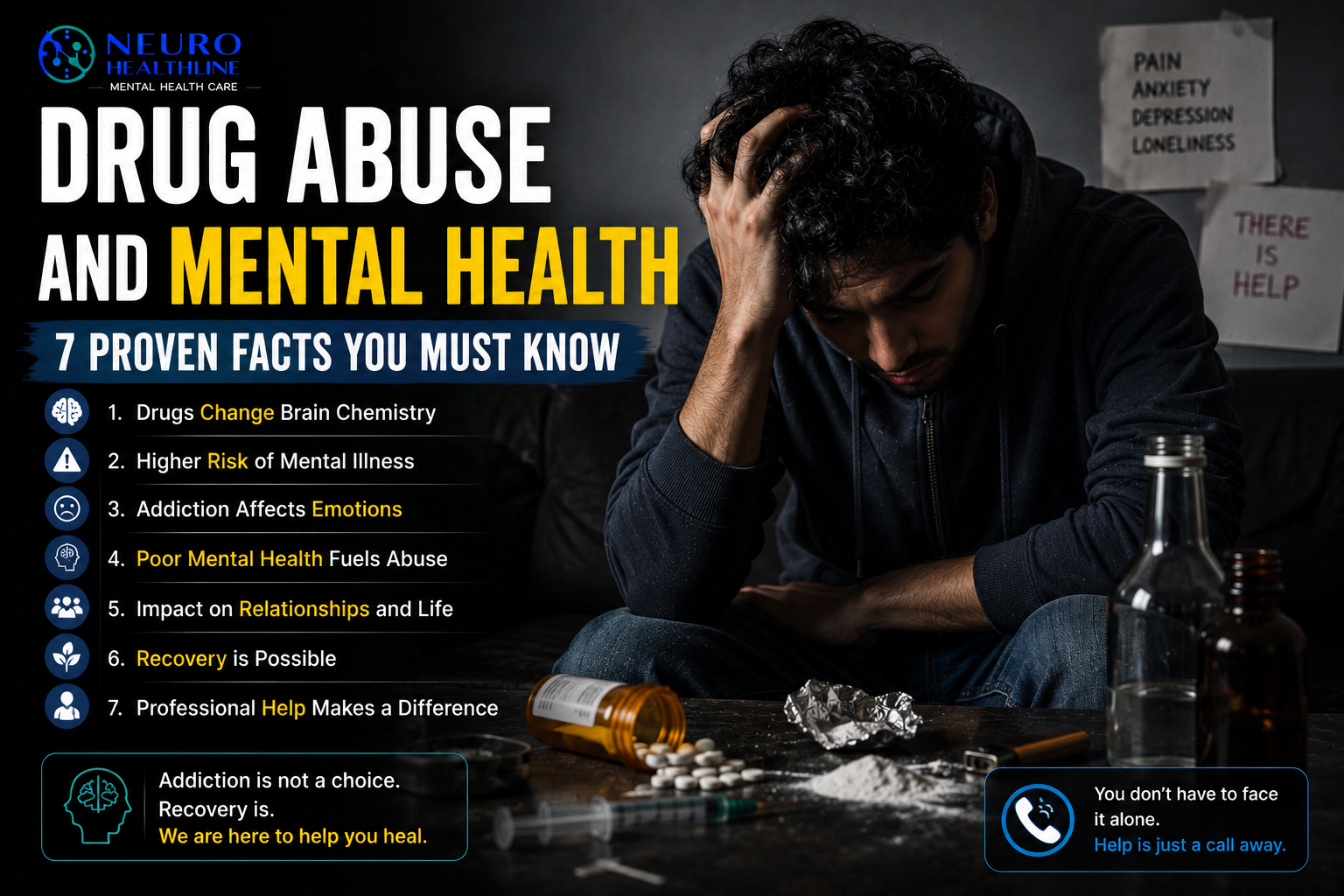
Drug abuse and mental health are two of the most stigmatised topics in Indian society — and two of the most urgently intertwined clinical realities in the lives of a growing number of young people, families, and professionals across Kerala today. The shame, secrecy, and moral judgment that surround both make it extraordinarily difficult for people caught in the intersection of drug abuse and mental health challenges to seek the help that could genuinely change the trajectory of their lives — and the lives of the people who love them. This blog exists to cut through that stigma with clinical honesty and compassion — to present the seven facts about drug abuse and mental health that every person in India needs to understand, whether they are personally affected, supporting someone who is, or simply trying to make sense of a public health reality that is touching more and more families across Kerala with every passing year. Understanding these facts is not simply educational — it is the first step toward destigmatising, seeking, and delivering the help that drug abuse and mental health recovery genuinely requires.
The Relationship Between Drug Abuse and Mental Health — A Two-Way Street
The most fundamental clinical fact about drug abuse and mental health is that the relationship between them flows in both directions — and understanding this bidirectionality is essential for effective treatment. Drug abuse causes mental health problems — the neurological consequences of sustained substance use include depression, anxiety, psychosis, and cognitive impairment that can persist long after substance use has ceased. And mental health problems cause drug abuse — the self-medication hypothesis, one of the most consistently supported frameworks in addiction research, proposes that a substantial proportion of substance use begins as an attempt to manage the symptoms of unaddressed anxiety, depression, trauma, ADHD, or other mental health conditions through the temporary relief that substances provide.
This bidirectional relationship creates the dual diagnosis reality — the clinical presentation of co-occurring substance use disorder and mental health condition — that characterises a large proportion of people struggling with drug abuse and mental health challenges in Kerala. Effective treatment must address both dimensions simultaneously — because treating substance use without addressing the underlying mental health condition that drove it leaves the person vulnerable to relapse driven by the original mental health symptom. And treating mental health without addressing the substance use that has now itself become a neurological problem leaves the brain in a chemically compromised state that undermines the effectiveness of every mental health intervention applied to it.
7 Proven Facts About Drug Abuse and Mental Health
1. Drug Abuse Changes the Brain — But the Brain Can Heal
The most important neuroscientific fact about drug abuse and mental health is that sustained substance use produces measurable changes in brain structure and function — including dopamine system dysregulation, prefrontal cortex volume reduction, altered reward circuit sensitivity, and impaired emotional regulation capacity. These changes are real, measurable, and clinically significant. They are also, in the majority of cases, reversible. The brain’s neuroplasticity — its capacity for structural and functional change in response to experience — is the neurological foundation of recovery from drug abuse and mental health consequences. This is not an optimistic claim — it is a well-established neuroscientific reality that research published on NCBI PubMed consistently confirms. The brain that addiction has changed is the same brain that recovery rebuilds — and neurologically targeted treatment accelerates this rebuilding process significantly.
2. Drug Abuse Is Often Self-Medication for Unaddressed Mental Health Conditions
One of the most clinically important and most misunderstood facts about drug abuse and mental health is that substance use frequently begins not as recreational experimentation that spirals out of control but as an attempt — often unconscious — to manage the symptoms of an undiagnosed or inadequately treated mental health condition. The teenager with unrecognised ADHD who discovers that cannabis reduces the uncomfortable noise of his inattentive brain. The young professional with undiagnosed anxiety who discovers that alcohol reliably quiets the nervous system activation that makes social and professional situations feel threatening. The trauma survivor who discovers that opioids temporarily quiet the hypervigilance and intrusive memories of PTSD. Each of these individuals is using substances not for recreation but for relief — and effective treatment requires addressing the mental health condition driving the self-medication, not simply removing the substance that was providing it.
3. Stigma Is the Single Biggest Barrier to Recovery
The relationship between drug abuse and mental health is significantly worsened by the stigma surrounding both — and in India, where both carry profound moral and social weight, this stigma represents the most significant structural barrier to effective treatment. Shame prevents people from acknowledging the problem to themselves or others. Fear of judgment prevents families from seeking help. Moral frameworks that position substance use as a character failing rather than a neurological condition prevent the compassionate, clinically grounded treatment that actually produces recovery. The most important thing any family, educator, or healthcare professional in Kerala can do for someone struggling with drug abuse and mental health challenges is replace judgment with understanding — because shame and secrecy are the conditions in which addiction flourishes, and safety and support are the conditions in which recovery becomes possible.
4. Kerala’s Youth Are Particularly Vulnerable
Kerala has one of the highest rates of substance use in India — a public health reality that intersects directly with the depression among youngsters crisis, the academic pressure that drives substance use as a coping strategy in Kerala’s competitive educational environment, and the sophisticated availability of substances across the state. Drug abuse and mental health co-occurrence is particularly prevalent among Kerala’s 15 to 30 age group — the same demographic most acutely affected by the social media anxiety, academic stress, and identity uncertainty that increase mental health vulnerability and therefore substance use risk simultaneously.
5. Addiction Is a Brain Disorder — Not a Moral Failing
The most clinically and socially important fact about drug abuse and mental health is that addiction is a chronic brain disorder characterised by compulsive substance use despite negative consequences — not a moral failing, a character weakness, or a choice that the addicted individual is simply failing to unmake. The compulsive nature of addiction reflects genuine neurological changes in the reward system, the prefrontal control circuits, and the stress response system — changes that make voluntary cessation extraordinarily difficult without clinical support, in the same way that voluntary management of any other chronic brain disorder without clinical support is extraordinarily difficult. The World Health Organization classifies drug use disorders as healthcare conditions requiring medical treatment — the clinical framework that should replace moral judgment in every conversation about drug abuse and mental health in India.
6. Recovery Requires Treating the Whole Brain-Body System
Effective recovery from drug abuse and mental health co-occurrence requires treating the whole brain-body system rather than focusing narrowly on substance cessation. The nutritional depletion that sustained substance use produces — depleting dopamine and serotonin precursors, B vitamins, omega-3 fatty acids, and zinc — directly undermines the neurochemical recovery that mental health restoration requires. The sleep disruption that substance use and withdrawal produce impairs the neuroplasticity and emotional processing that recovery depends on. The trauma, anxiety, and depression that either drove the substance use or developed as its consequence must be directly addressed if lasting recovery is to be achieved. NeuroHealthline’s brain-body approach to supporting dual diagnosis presentations — using neurofeedback, biofeedback, functional nutrition, and neuropsychotherapy alongside specialist addiction treatment — addresses all of these dimensions within an integrated, whole-system recovery framework.
7. Early Intervention Produces Dramatically Better Outcomes
The final and most practically urgent fact about drug abuse and mental health is that early intervention — seeking clinical support at the earliest recognition that substance use has developed from experimentation into dependency — produces dramatically better neurological, psychological, and social outcomes than delayed intervention when the consequences have already become severe. The neuroplasticity that makes recovery possible is greatest early in the addiction trajectory — and the social, occupational, and relational consequences that accumulate over years of untreated dual diagnosis are those most difficult to reverse once the substance use has been addressed. If you recognise drug abuse and mental health challenges in yourself or someone you care about, the most important action is the earliest possible one.
How NeuroHealthline Supports Drug Abuse and Mental Health Recovery
NeuroHealthline does not provide primary addiction medicine or detoxification services — these require specialist addiction medicine programs. What we provide is the neuroscience-based, whole-system mental health support that complements and significantly enhances addiction treatment outcomes — addressing the specific neurological, physiological, and psychological dimensions of drug abuse and mental health co-occurrence that specialist addiction treatment alone does not comprehensively address.
Our programs for individuals in recovery from substance use include HEG neurofeedback to directly restore the prefrontal cortex function and reward circuit regulation that substance use has compromised; HRV biofeedback therapy to rebuild the autonomic nervous system resilience that reduces the anxiety and stress reactivity most powerfully driving relapse risk; functional nutrition to correct the specific nutritional depletions that substance use produces and that undermine neurochemical recovery; treatment for the underlying anxiety, depression, or trauma that drove the self-medication pattern — through our dedicated anxiety treatment, depression treatment in Kochi, and PTSD treatment programs; and neuropsychotherapy specifically addressing the identity, meaning, and coping skill development that long-term recovery from drug abuse and mental health co-occurrence requires.
FAQ — Drug Abuse and Mental Health
Can mental health treatment help with drug abuse recovery?
Yes. Addressing the underlying mental health conditions driving substance use — anxiety, depression, PTSD, ADHD — is one of the most powerful levers available for supporting lasting recovery. Treatment that addresses both the substance use and the mental health condition simultaneously consistently produces better outcomes than either alon
Is drug abuse and mental health co-occurrence common?
Very. Research suggests that more than 50% of people with a substance use disorder also meet criteria for at least one other mental health condition — making dual diagnosis the rule rather than the exception in clinical practice.
Can neurofeedback help with drug abuse recovery?
Yes. Neurofeedback has demonstrated clinical evidence for reducing craving intensity, restoring prefrontal regulatory function, and improving emotional regulation in substance use recovery — addressing the neurological dysregulation that conventional addiction treatment alone does not directly target.
How should I approach a family member struggling with drug abuse and mental health challenges?
With compassion, curiosity, and a complete absence of moral judgment. Express concern for their wellbeing rather than anger at their behaviour, offer practical support for accessing professional help rather than ultimatums, and educate yourself about the neuroscience of addiction — which will help you understand their experience as a brain condition rather than a choice.
Where can someone in Kerala seek help for drug abuse and mental health challenges?
Kerala has dedicated de-addiction centres through the government health system, specialist private addiction medicine facilities, and complementary neuroscience-based mental health support through NeuroHealthline — whose programs address the underlying mental health conditions driving substance use alongside the neurological restoration that recovery requires.