


The social media detox has become one of the most discussed digital wellness concepts of the past five years — simultaneously one of the most genuinely beneficial things a chronically over-connected person can do for their mental health and one of the most misunderstood in terms of what it actually involves, what it actually produces, and why it works when it does and fails when it doesn’t. Social media detox mental health benefits are not simply the absence of the harms that social media causes — they are specific, measurable, neurologically grounded improvements that occur in the brain and nervous system when the chronic overstimulation of social media engagement is reduced or removed for a sufficient period. Understanding what these benefits actually are — and why they occur — is the foundation for pursuing a social media detox that is genuinely clinically meaningful rather than a well-intentioned holiday from a habit that resumes unchanged on day eight.
This blog is not an argument for permanent social media elimination — which is neither realistic nor necessary for most people in Kerala’s digitally connected social and professional environment. It is a clinically grounded account of what actually happens to your brain and mental health when you deliberately, significantly reduce social media consumption — based on what the neuroscience of social media, digital addiction, and nervous system regulation reveals about the mechanisms through which social media harms mental health and through which its reduction restores it.
What Happens to Your Brain During a Social Media Detox?
The neurological changes that social media detox mental health benefits reflect begin within the first 24 to 48 hours of significantly reduced social media engagement — not because the brain changes that quickly but because the absence of chronic overstimulation creates the conditions in which the brain’s self-regulatory processes can begin operating without the continuous interference that social media engagement generates. The dopaminergic reward system — which has been operating in a state of chronic variable-reward activation through the anticipation cycle of social media checking — begins to recalibrate toward its natural sensitivity baseline as the frequency of dopaminergic triggers reduces. This recalibration is initially uncomfortable — producing the restlessness, boredom, and mild anxiety that most people experience in the first days of a social media detox and that reflects genuine withdrawal from a habitual reward pattern.
As the detox continues beyond the first several days, the default mode network — the brain’s internally focused processing system that social media engagement chronically displaces — begins reactivating with greater frequency and depth. The creative thinking, self-reflection, and spontaneous mental wandering that the default mode network generates and that are the source of many of the most valued aspects of human mental life — creative insight, genuine self-knowledge, the generation of meaning and narrative — progressively return as the attentional system is freed from the external stimulation management that social media demands. Social media detox mental health research published on NCBI PubMed confirms that even brief periods of reduced social media engagement — one week in some studies — produce measurable improvements in wellbeing, mood, anxiety, and life satisfaction across diverse populations.
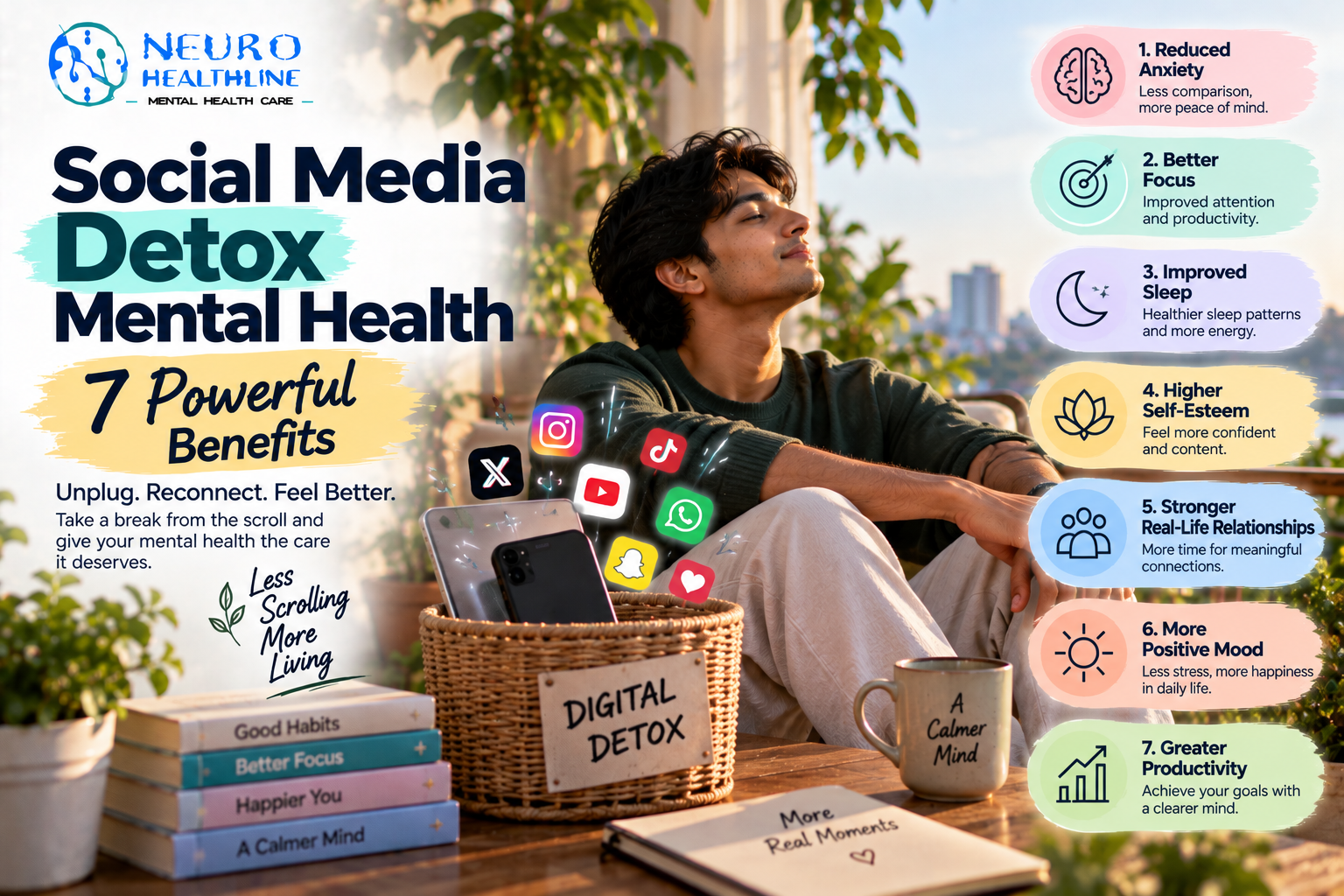
7 Powerful Social Media Detox Mental Health Benefits
1. Anxiety Reduction — Often Within Days
The most immediately noticeable social media detox mental health benefit for the majority of people who undertake one is a measurable reduction in baseline anxiety — often apparent within 3 to 5 days of significant social media reduction. The chronic low-level sympathetic nervous system activation that social media’s threat-detection triggering, social comparison distress, and notification monitoring maintain begins to reduce as these activating inputs are removed — allowing the autonomic nervous system to shift toward a more genuinely regulated baseline that most chronically connected people have not experienced since before smartphones became central to their daily life.
2. Sleep Quality Improvement
Social media detox mental health benefits for sleep are among the most consistently and most rapidly reported — with the elimination of late-night social media use producing immediate improvements in sleep onset time, melatonin production, and the depth of early sleep stages through the combined effects of reduced blue light exposure and the psychological deactivation that absence of social media’s arousing content allows. For many people in Kerala whose sleep has been degraded for years by habitual late-night social media use, the sleep improvements produced by a genuine detox represent one of the most tangible and most health-significant benefits available.
3. Improved Attention and Focus
Social media detox mental health benefits for attentional capacity develop more gradually than anxiety and sleep improvements — because the attentional fragmentation that habitual social media use produces reflects genuine neural adaptation that takes longer to reverse than the acute physiological arousal that daily social media triggers. Most people undertaking extended social media detoxes — two weeks or longer — report progressive improvements in their capacity for sustained focus on demanding tasks, with many describing the recovery of attentional abilities they had not recognised as lost until their return.
4. Reduced Social Comparison and Improved Self-Worth
The elimination of the continuous social comparison stream that social media provides produces measurable improvements in self-reported self-worth, life satisfaction, and body image within relatively short detox periods — reflecting the brain’s rapid adjustment of its social comparison baseline when the algorithmically curated comparison content that has been distorting it is removed. Social media detox mental health benefits in this domain are particularly significant for teenagers and young women whose body image and self-worth have been most significantly affected by social media comparison content — connecting directly to our detailed explorations of eating disorders and social media and body image and mental health.
5. Relationship Quality Improvement
The restoration of genuine presence in face-to-face interactions that social media detox produces — the ability to engage with the person in front of you without the divided attention of notification monitoring and the psychological absence of social media preoccupation — consistently produces reported improvements in relationship quality, intimacy, and social satisfaction that the people around the detoxing individual notice as clearly as the individual themselves. Social media detox mental health benefits for relationships reflect the most fundamental exchange social media addiction produces — the substitution of genuine human presence for digital social performance — and their restoration when social media is reduced is among the most meaningful quality-of-life changes the detox produces.
6. Restored Capacity for Boredom and Creativity
One of the most intellectually significant social media detox mental health benefits is the gradual restoration of the boredom tolerance and creative default mode network activity that habitual social media use systematically prevents. As the detox extends beyond the initial uncomfortable restlessness of social media withdrawal, most people begin reporting the return of spontaneous creative thinking, daydreaming, and the kind of internally generated entertainment that screen-free generations experienced naturally and that high screen time has progressively eliminated from contemporary adult mental life. This restoration of internal mental life is among the most personally transformative social media detox mental health benefits available — and among the least discussed.
7. Genuine Autonomy Over Your Own Attention
The most profound and most lasting social media detox mental health benefit is not any specific improvement in anxiety, sleep, or mood — it is the restoration of genuine voluntary control over what you pay attention to, for how long, and for what purpose. The social media-addicted brain has progressively surrendered this control to algorithms engineered to capture and hold attention without the user’s deliberate consent — and recovering it is both the most fundamental and the most empowering change that a genuine social media detox produces. As we explored in depth in our Instagram addiction and mental health and TikTok addiction mental health blogs, the platforms are specifically engineered to make voluntary disengagement difficult — making the deliberate recovery of attentional autonomy through a genuine detox one of the most important acts of self-determination available in contemporary digital life.
Making a Social Media Detox Actually Work — The Clinical Framework
The most common reason social media detoxes fail to produce lasting social media detox mental health benefits is that they address the behaviour without addressing the neurological and psychological drivers maintaining it. A one-week phone-free holiday produces the improvements listed above — and then, upon return to normal social media access, the pre-detox patterns typically re-establish within days because the underlying reward circuit dysregulation, anxiety-driven checking behaviour, and emotional regulation deficit that social media was meeting have not been clinically addressed.
Lasting social media detox mental health benefits require the same integrated approach we apply to all digital addiction presentations at NeuroHealthline — HEG neurofeedback to restore the prefrontal regulatory capacity that makes voluntary engagement choice neurologically possible; HRV biofeedback therapy to rebuild the autonomic nervous system regulation that reduces the anxiety and boredom states most powerfully driving automatic social media return; functional nutrition to support dopamine system restoration; sleep restoration to rebuild the recovery architecture that social media has disrupted; and neuropsychotherapy to address the identity, connection, and emotional regulation needs that social media has been meeting — helping clients build the offline sources of genuine reward that make digital substitutes progressively less compelling.
Our social media addiction treatment program provides the comprehensive clinical delivery for individuals whose social media use has progressed beyond what a self-directed detox can adequately address — while this blog provides the foundation of understanding that makes any social media detox more effective by clarifying what it is actually doing in the brain. The World Health Organization recognises the importance of healthy digital boundaries for mental wellbeing globally — and NeuroHealthline’s clinical approach to social media detox mental health is built to make those boundaries neurologically sustainable rather than purely effortful.
FAQ — Social Media Detox Mental Health
Can a social media detox help with clinical anxiety or depression?
As a component of comprehensive treatment — yes. Social media detox mental health benefits for anxiety and depression are meaningful but most clinically significant when combined with neurofeedback, biofeedback, and neuropsychotherapy that address the neurological and psychological dimensions of the conditions simultaneously.
How long should a social media detox last to produce meaningful mental health benefits?
Research suggests that even one week of significant social media reduction produces measurable improvements in mood, anxiety, and life satisfaction. More comprehensive neurological benefits — particularly attentional restoration and dopamine system recalibration — typically require 3 to 4 weeks of sustained reduction to become clearly apparent.
Does a social media detox mean deleting all accounts permanently?
No. A social media detox is a deliberate period of significantly reduced or eliminated social media use — typically one week to several months — with the goal of neurological recalibration and behaviour pattern restructuring. The objective is reestablishing voluntary, deliberate social media use rather than permanent elimination.
What should I do during a social media detox to get the most mental health benefit?
Actively investing in the activities most directly displaced by social media use — face-to-face social engagement, physical activity, creative pursuits, reading, and time in natural environments — significantly amplifies social media detox mental health benefits by providing the genuine rewards that support dopamine system restoration and make the detox neurologically meaningful rather than simply restrictive.
Is it normal to feel worse before feeling better during a social media detox?
Yes — the first 3 to 5 days typically involve the discomfort of withdrawal from habitual reward patterns, including restlessness, boredom, and mild anxiety. This is a neurologically normal part of the recalibration process and resolves as the brain adjusts to its natural reward baseline.