


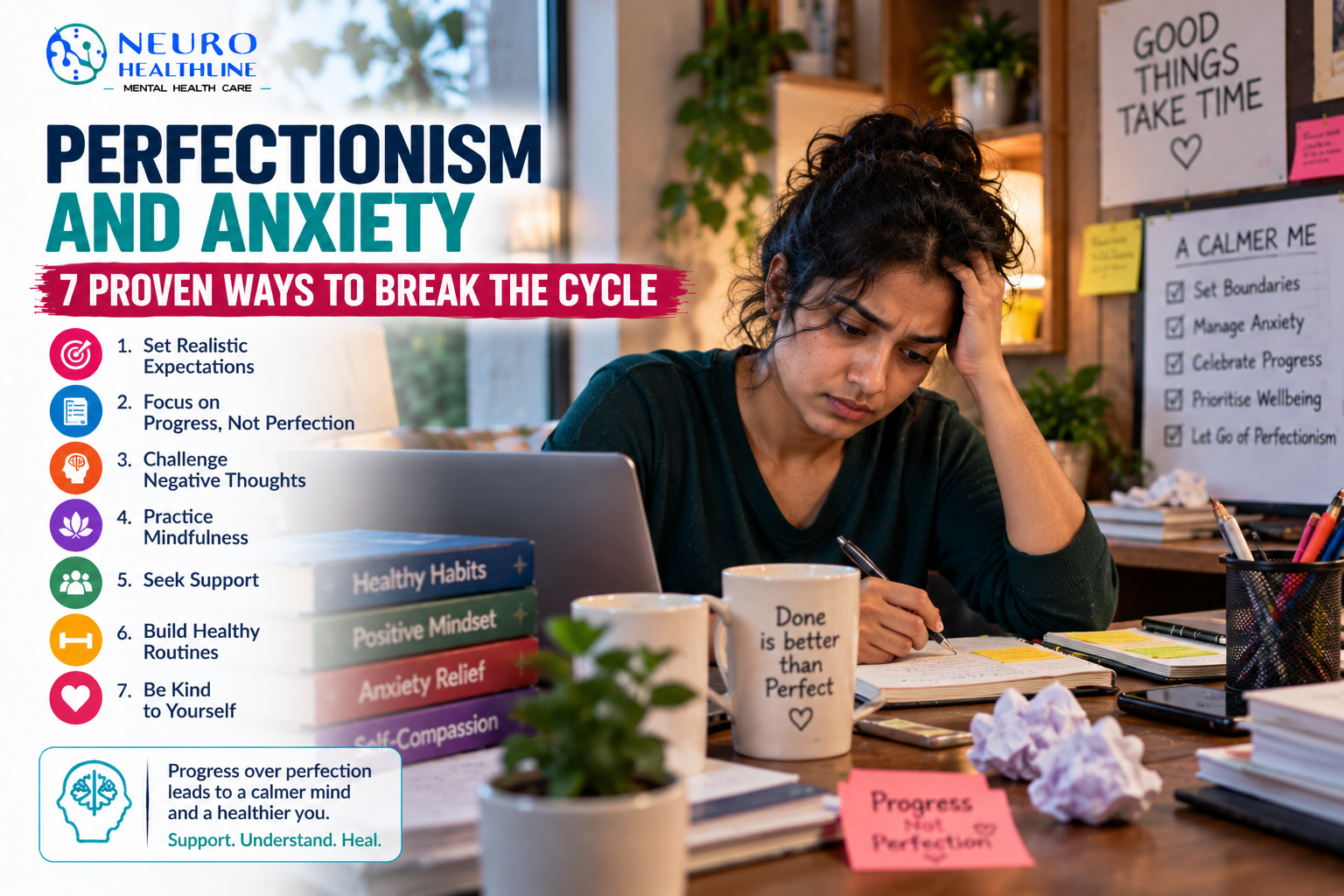
If you have ever spent three hours perfecting a report that was due in two, missed a deadline because you could not submit something you were not satisfied with, felt genuinely distressed by a 96 when you expected 100, or found that the relief of completing a task lasts approximately thirty seconds before the anxiety about the next one begins — you are living inside the perfectionism and anxiety cycle. And you are not alone. Perfectionism and anxiety are among the most prevalent and most mutually reinforcing experiences affecting high-achieving students and professionals across Kerala — where a cultural context that places extraordinary value on academic and professional excellence creates the ideal conditions for perfectionism to develop from a useful drive for quality into a genuinely debilitating neurological trap.
The cruel paradox at the heart of perfectionism and anxiety is that the perfectionism meant to ensure excellent outcomes — through higher standards, greater care, and more sustained effort — progressively produces worse outcomes through the procrastination, paralysis, and cognitive impairment that the anxiety it generates reliably delivers. At NeuroHealthline, perfectionism and anxiety is understood not as a character virtue taken slightly too far but as a measurable neurological condition involving specific overactivation of threat-detection and error-monitoring circuits that requires targeted clinical treatment to resolve — not simply motivational reframing or the advice to lower your standards.
The Neuroscience of Perfectionism and Anxiety
Perfectionism and anxiety share a common neurological foundation that explains both their frequent co-occurrence and the difficulty of addressing either without addressing both. At the centre of this shared foundation is the anterior cingulate cortex — the brain region responsible for error detection, conflict monitoring, and the signalling of discrepancy between current performance and expected standards. In the perfectionist brain, the anterior cingulate cortex is chronically overactivated — generating persistent error signals even when performance is objectively excellent, producing the subjective experience of never being quite good enough regardless of external outcomes.
This overactivated error-monitoring system maintains the amygdala’s threat-detection response in a state of chronic activation — because the brain that is continuously detecting performance inadequacy is continuously generating threat responses to the social consequences of that inadequacy. The result is the characteristic perfectionism and anxiety experience: a nervous system that can never rest in the satisfaction of achievement because the error-monitoring system is already identifying the next inadequacy to address, and a threat-detection system that treats every performance demand as a genuine danger to social standing and self-worth.
Research published on NCBI PubMed confirms that perfectionism is associated with measurable hyperactivation of the anterior cingulate cortex and elevated anxiety sensitivity — with maladaptive perfectionism specifically (as distinct from healthy high standards) predicting anxiety disorder development, depression, burnout, and procrastination at rates significantly exceeding those of their non-perfectionist peers.
Perfectionism and Anxiety in Kerala’s Achievement Culture
The relationship between perfectionism and anxiety is particularly acute in Kerala’s educational and professional culture — where the extraordinary social weight attached to academic and career achievement creates an environment in which perfectionism is not only rewarded but expected, modelled by parents, reinforced by teachers, and embedded in the examination system as a structural feature. The NEET aspirant who believes that anything less than a perfect score represents failure. The IT professional who cannot submit code without three additional review cycles. The parent who cannot send their child to school without the tiffin box being perfectly arranged. Each is expressing perfectionism and anxiety that Kerala’s achievement culture has cultivated, rewarded, and normalised to such a degree that it feels not like a clinical condition but like the appropriate response to genuinely high stakes.
This cultural reinforcement makes perfectionism and anxiety in Kerala particularly resistant to simple reframing strategies — because the perfectionist’s anxiety is not simply irrational catastrophising but reflects a real social environment in which the consequences of academic and professional underperformance are genuinely significant. Effective treatment must acknowledge this reality while directly addressing the neurological patterns that convert legitimate ambition into a self-defeating, wellbeing-destroying cycle. The connection to our exploration of anxiety and academic performance and exam stress in students Kerala is direct — perfectionism is frequently the central psychological mechanism through which academic pressure produces its most clinically significant mental health consequences.
7 Proven Ways NeuroHealthline Breaks the Perfectionism and Anxiety Cycle
1. Anterior Cingulate Cortex Regulation Through Neurofeedback
HEG neurofeedback directly addresses the overactivated anterior cingulate cortex error-monitoring that drives perfectionism and anxiety — progressively reducing the chronically elevated error-detection sensitivity that maintains both the perfectionist’s subjective experience of inadequacy and the amygdala’s anxiety response to perceived performance gaps.
2. HRV Biofeedback for Performance State Regulation
HRV biofeedback therapy teaches perfectionists a practical nervous system regulation skill that directly reduces the physiological anxiety response during performance situations — creating the regulated nervous system state in which genuine high performance is accessible, rather than the anxiously activated state in which perfectionism progressively impairs the very performance it is attempting to guarantee.
3. Cognitive Defusion From Perfectionist Narratives
Perfectionism and anxiety is maintained by powerful internal narratives — “if I am not perfect I am inadequate,” “my worth depends on my performance,” “mistakes are unacceptable” — that feel like facts rather than thoughts. Our neuropsychotherapy approach uses cognitive defusion techniques to progressively separate the perfectionist from their narrative, creating the psychological distance from which genuinely evaluating these beliefs becomes possible.
4. Self-Compassion as a Neurological Intervention
Self-compassion is not simply an emotional attitude — it is a neurological intervention that activates the brain’s caregiving systems, reduces the cortisol response to perceived failure, and directly counteracts the shame response that perfectionism and anxiety generate. Teaching perfectionists to respond to their own mistakes and inadequacies with the same warmth they would extend to a struggling friend produces measurable reductions in both perfectionism and anxiety severity over time.
5. Anxiety Treatment for the Underlying Disorder
For many individuals, perfectionism and anxiety have progressed to clinical anxiety disorder — generalised anxiety, social anxiety, or health anxiety that requires dedicated clinical treatment alongside the perfectionism-specific work. Our anxiety treatment in Kochi program provides the neurological foundation for perfectionism and anxiety recovery in clients whose anxiety has become clinically significant.
6. Procrastination Resolution
Perfectionism-driven procrastination — the inability to begin or complete tasks because imperfect completion feels worse than non-completion — is one of the most practically impairing consequences of perfectionism and anxiety, and one that requires specific clinical attention alongside the anxiety work. Our neuropsychotherapy approach addresses the procrastination cycle directly — building the capacity for “good enough” task initiation and completion that perfectionism has made neurologically unavailable.
7. Values Clarification and Identity Beyond Performance
The deepest clinical work in perfectionism and anxiety treatment involves the gradual, clinically supported development of a stable sense of self-worth that is not contingent on performance outcomes — an identity that can maintain its integrity regardless of whether the examination result is 96 or 100, the report is submitted at 5 PM or 5:30 PM, or the project achieves 95% or 100% of its goals. This identity development is ultimately what distinguishes permanent recovery from perfectionism and anxiety from temporary symptom relief.
A Note to Kerala’s High Achievers
The highest achievers in Kerala’s educational and professional environments are disproportionately represented among those experiencing the most severe perfectionism and anxiety — because the same drive, conscientiousness, and commitment to excellence that produces genuine achievement also creates the conditions in which perfectionism flourishes. If you are reading this because you recognise yourself in this description — because the achievement that looks like success from the outside feels like a relentless, exhausting, joyless treadmill from the inside — the most important thing to understand is that your standards and your ambition are not the problem. The neurological pattern through which those standards have been entangled with threat, shame, and anxiety is the problem. And that pattern is directly, measurably, and genuinely treatable. Our generalised anxiety disorder treatment and burnout treatment in Kochi programs address the downstream conditions that perfectionism and anxiety most commonly produce — while this program addresses the root pattern from which they emerge. The World Health Organization recognises maladaptive perfectionism as a clinically significant contributor to anxiety, depression, and burnout — and NeuroHealthline’s treatment of perfectionism and anxiety is built to address it with the neurological precision and clinical depth that genuinely high-functioning, genuinely suffering people deserve.
FAQ — Perfectionism and Anxiety
Is perfectionism always harmful to mental health?
No. Healthy perfectionism — high standards combined with flexibility, self-compassion, and the ability to find genuine satisfaction in achievement — is associated with positive outcomes. Maladaptive perfectionism — high standards combined with harsh self-criticism, inability to tolerate imperfection, and contingent self-worth — is the form associated with anxiety, depression, and burnout.
Can perfectionism and anxiety be fully treated?
Yes. The neurological patterns underlying maladaptive perfectionism — anterior cingulate overactivation, amygdala hyperreactivity to performance threat, and self-worth contingency — are directly addressable through neurofeedback, biofeedback, and neuropsychotherapy. Full recovery is achievable, not simply symptom management.
Is perfectionism more common in certain professions in Kerala?
Healthcare, engineering, IT, law, and academic professions show the highest rates of maladaptive perfectionism in Kerala — reflecting both the genuine high-stakes nature of these fields and the selection effect of professional training systems that reward perfectionist traits while rarely addressing the anxiety they generate.
Can children develop perfectionism and anxiety?
Yes — and the earlier it develops, the more entrenched and more consequential it becomes. Children as young as 8 to 10 can demonstrate clinically significant perfectionism, particularly in Kerala’s competitive academic environment and in families where parental achievement expectations are high.
How long does treatment for perfectionism and anxiety typically take?
The neurological changes most directly relevant to perfectionism — anterior cingulate regulation and amygdala threat threshold adjustment — typically show meaningful improvement within 8 to 12 weeks of consistent neurofeedback. The identity and self-worth work that produces lasting recovery from perfectionism and anxiety typically consolidates over 4 to 8 months.