


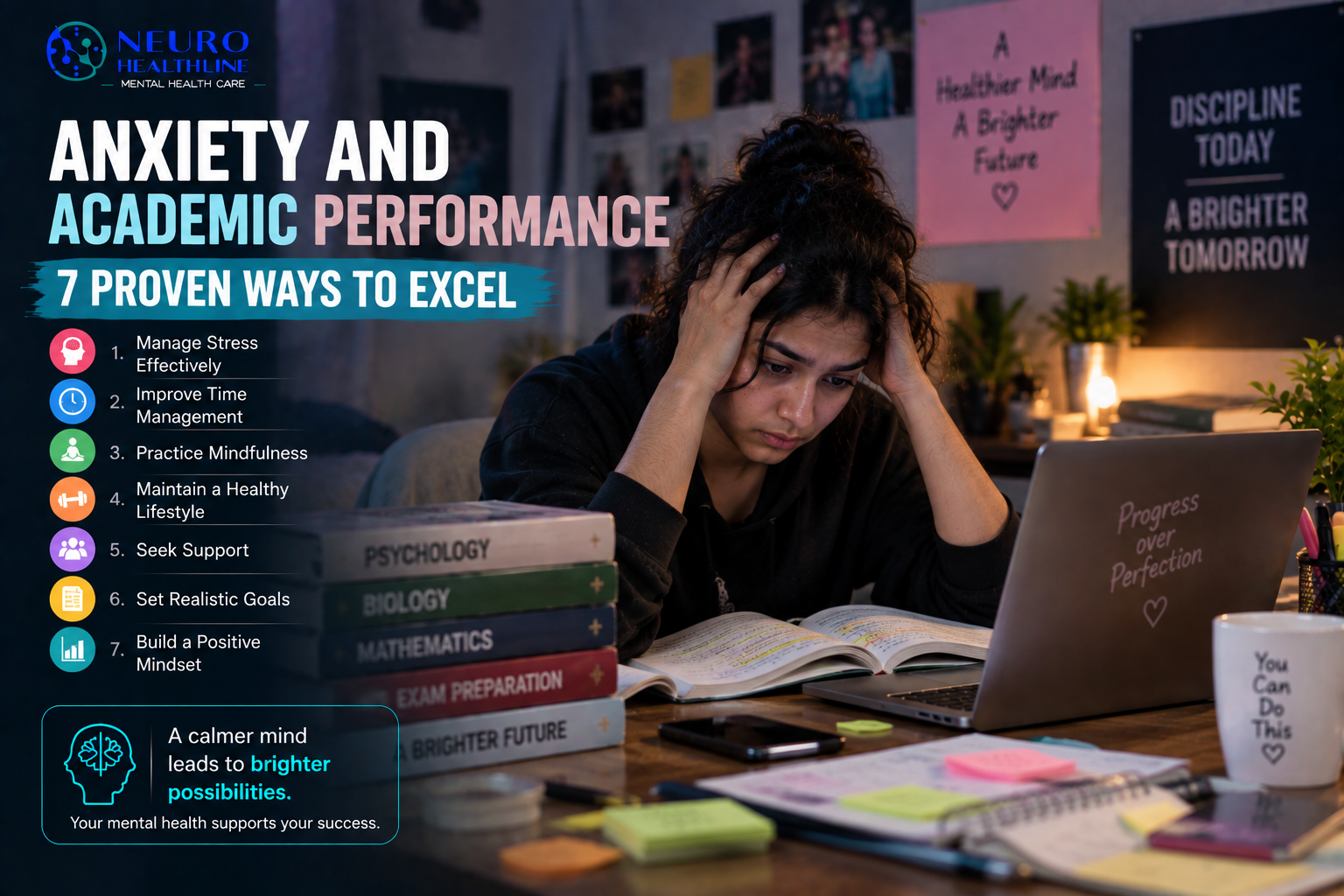
Here is the paradox that thousands of students across Kerala live with every examination season: the students who care most about performing well are often the ones whose performance is most severely impaired by anxiety — while their less anxious peers, who may have prepared less thoroughly, perform more accurately in examination conditions because their nervous systems are not working against them. Anxiety and academic performance are related in a way that feels profoundly unfair to the students caught in it — and that remains poorly understood by the parents, teachers, and educational systems that observe its consequences without always understanding its cause. The relationship between anxiety and academic performance is not simply about stress making students feel bad during examinations. It is about specific, measurable neurological processes through which anxiety directly impairs the cognitive functions — memory retrieval, working memory capacity, cognitive flexibility, and sustained attention — that academic performance most critically depends on. Understanding this relationship clearly is the first step toward addressing it effectively — both for students experiencing it and for the adults who support them.
The Neuroscience of Anxiety and Academic Performance
The relationship between anxiety and academic performance is mediated through several specific neurological mechanisms that operate simultaneously during examination conditions. The Yerkes-Dodson curve — one of the most important frameworks in performance psychology — describes the relationship between arousal and performance as an inverted U: at low arousal, performance is poor because insufficient motivation and activation impair engagement; at moderate arousal, performance is optimal; and at high arousal — the anxiety state — performance deteriorates as the physiological stress response impairs the cognitive functions most critical for academic performance.
Anxiety activates the amygdala’s threat-detection response — triggering a cortisol and adrenaline release that, in an acute physical threat, appropriately redirects cognitive resources toward survival-relevant processing and away from complex reasoning. In an examination hall, this same response redirects cognitive resources away from the memory retrieval, working memory operations, and executive reasoning that examination performance requires — and toward the threat monitoring and escape planning that the amygdala has assessed as the priority. The result is the characteristic examination anxiety experience: the well-prepared student who cannot access what they know, who blanks on familiar material, who cannot concentrate on the questions in front of them, who writes less than they are capable of — not because they lack knowledge or preparation but because their amygdala has classified the examination environment as a survival threat and appropriated the cognitive resources that examination performance requires.
According to NCBI PubMed, examination anxiety is associated with measurable impairment in working memory capacity, retrieval efficiency, and cognitive flexibility — with the degree of impairment being positively correlated with anxiety severity, confirming that the relationship between anxiety and academic performance is neurologically real rather than simply subjectively experienced.
How Anxiety Damages Academic Performance Beyond the Examination Hall
The most immediately visible intersection of anxiety and academic performance is the examination hall experience of blanking, freezing, and underperforming relative to preparation. But the relationship between anxiety and academic performance extends throughout the entire academic cycle — not just at the point of assessment.
Chronic study-related anxiety impairs the learning process itself — reducing the working memory capacity available for new learning, impairing the integration of new information with existing knowledge structures, and generating the rumination and distraction that prevent the deep processing that effective learning requires. Sleep deprivation produced by anxiety-driven insomnia removes the memory consolidation that deep sleep provides — effectively deleting a proportion of each night’s learning from the accessible memory stores that examination performance depends on. Chronic avoidance of anxiety-provoking academic tasks — the procrastination that anxiety so reliably produces — creates a progressive backlog of unstudied material that compounds the anxiety further in a vicious cycle. And the self-critical, catastrophising inner dialogue that academic anxiety generates — the relentless voice that predicts failure, compares unfavourably with peers, and interprets every academic difficulty as evidence of fundamental inadequacy — directly undermines the confidence and growth mindset that sustained academic progress requires.
The relationship between anxiety and academic performance is therefore not limited to a single examination day — it shapes the entire learning journey, from the quality of daily study engagement through to the examination hall experience and the self-evaluation that follows it.
Who Is Most Affected by Anxiety and Academic Performance Challenges in Kerala?
The relationship between anxiety and academic performance is particularly acute in Kerala’s educational context — where the intersection of an intensely competitive academic culture, high parental investment in educational outcomes, and the specific examination systems that determine access to the most valued professional pathways creates a uniquely high-stakes academic environment. Students preparing for NEET, JEE, and KEAM face years of intensive preparation in which the relationship between anxiety and academic performance is lived daily — with the stakes attached to the final examination producing anxiety levels that, for a significant proportion of students, cross the threshold from motivating to impairing long before the examination date arrives.
Students with existing anxiety disorders — including generalised anxiety disorder, social anxiety, and ADHD — are particularly significantly affected by the intersection of anxiety and academic performance, as their underlying neurological patterns interact with the academic anxiety dimension to produce compounded cognitive impairment during both learning and assessment. The exam stress in students Kerala dimension of this relationship is explored in depth in our dedicated blog — but the anxiety and academic performance relationship extends to every academic context, not only examination preparation.
7 Proven Ways NeuroHealthline Addresses Anxiety and Academic Performance
1. Academic Anxiety Profiling
Treatment for anxiety and academic performance challenges begins with a comprehensive assessment mapping the specific anxiety patterns — whether generalised, performance-specific, or socially driven — alongside the QEEG neural patterns and HRV autonomic profile characterising each student’s anxiety presentation. This individual mapping ensures that intervention is precisely targeted rather than applying a generic academic anxiety protocol.
2. HEG Neurofeedback for Examination Performance
HEG neurofeedback directly trains the prefrontal cortex to maintain activation and regulatory control under the anxiety conditions that academic assessment generates — producing measurable improvements in working memory capacity, attention stability, and recall accuracy under pressure. Students consistently report improved access to their prepared knowledge in examination conditions following HEG neurofeedback training for anxiety and academic performance.
3. HRV Biofeedback for In-Examination Regulation
HRV biofeedback therapy teaches a breathing-based nervous system regulation skill that students can apply directly in examination conditions — preventing the acute amygdala activation that produces mind-blanking and cognitive shutdown, and maintaining the optimal moderate arousal state in which academic performance peaks rather than deteriorates.
4. Sleep Optimisation for Memory Consolidation
Given the central role of sleep-based memory consolidation in academic performance — and the systematic disruption that anxiety and academic performance pressure together produce in sleep architecture — comprehensive sleep restoration is a core component of treatment, directly rebuilding the memory consolidation capacity that anxiety-driven insomnia has been progressively eroding.
5. Procrastination and Avoidance Reduction
The avoidance patterns that anxiety and academic performance anxiety generate — the procrastination, task avoidance, and study avoidance that create the preparation deficit that further amplifies anxiety — are directly addressed through our neuropsychotherapy approach, using graduated exposure and neurologically supported approach behaviour to progressively replace avoidance with genuine engagement.
6. Functional Nutrition for Academic Brain Performance
Targeted nutritional support for anxiety and academic performance challenges addresses the specific deficiencies — omega-3 fatty acids, magnesium, B vitamins, and iron — that most directly impair both anxiety regulation and the cognitive performance functions that academic success requires, providing the biochemical substrate for both anxiety treatment and cognitive performance optimisation simultaneously.
7. Self-Worth Decoupling From Academic Outcomes
One of the most important and most clinically powerful interventions for anxiety and academic performance is the therapeutic decoupling of self-worth from examination outcomes — the neuropsychotherapy work that helps students develop a stable, internally anchored sense of personal value that does not fluctuate with academic results. This is not about lowering ambition or reducing effort — it is about removing the existential stakes from academic performance that generate the most debilitating levels of examination anxiety. Our anxiety in students in Kochi program provides dedicated clinical support for students whose anxiety and academic performance relationship requires comprehensive clinical treatment.
A Message to Kerala’s Students and Parents
To the student reading this who knows they can do better than their examinations are reflecting: your examination results are not an accurate measure of your knowledge or your capability — they are a measure of how effectively your nervous system can perform under the specific conditions of academic assessment. And that is something that can be directly, measurably, and significantly improved through appropriate clinical support. The relationship between anxiety and academic performance does not have to define your academic story. The World Health Organization recognises academic stress as a significant global health concern for young people — and NeuroHealthline’s approach to anxiety and academic performance is built to address it with the clinical precision and genuine compassion that Kerala’s students deserve.
FAQ — Anxiety and Academic Performance
Does some anxiety actually help academic performance?
Yes — but only up to a specific threshold. Mild to moderate anxiety produces the arousal and motivation that can enhance academic engagement and examination preparation. Beyond that threshold, anxiety impairs the cognitive functions most critical for academic performance — making the relationship between anxiety and academic performance an inverted U rather than a linear positive relationship.
Can anxiety explain why intelligent students underperform in examinations?
Yes. The most clinically clear expression of the anxiety and academic performance relationship is the intelligent, well-prepared student who consistently underperforms in examination conditions due to amygdala-driven cognitive impairment — a pattern that neurological treatment addresses more effectively than additional study preparation.
Can medication help with anxiety and academic performance?
Some students use medication for examination anxiety with varying degrees of success. NeuroHealthline’s approach uses non-pharmacological interventions — neurofeedback, biofeedback, and neuropsychotherapy — to address anxiety and academic performance at the neurological level, producing changes that are self-sustaining rather than dependent on continued medication.
How quickly can HRV biofeedback improve examination performance?
Most students report noticeable improvements in their capacity to regulate anxiety during examination conditions within 8 to 12 biofeedback sessions — typically over 4 to 6 weeks — with more comprehensive neurological change consolidating over a full program of 3 to 5 months.
Is treatment for anxiety and academic performance available in Kochi?
Yes. NeuroHealthline’s dedicated programs for anxiety and academic performance — including our anxiety in students and exam stress programs — are available at our Kochi centre, with flexible scheduling specifically designed to accommodate active academic timetables.