


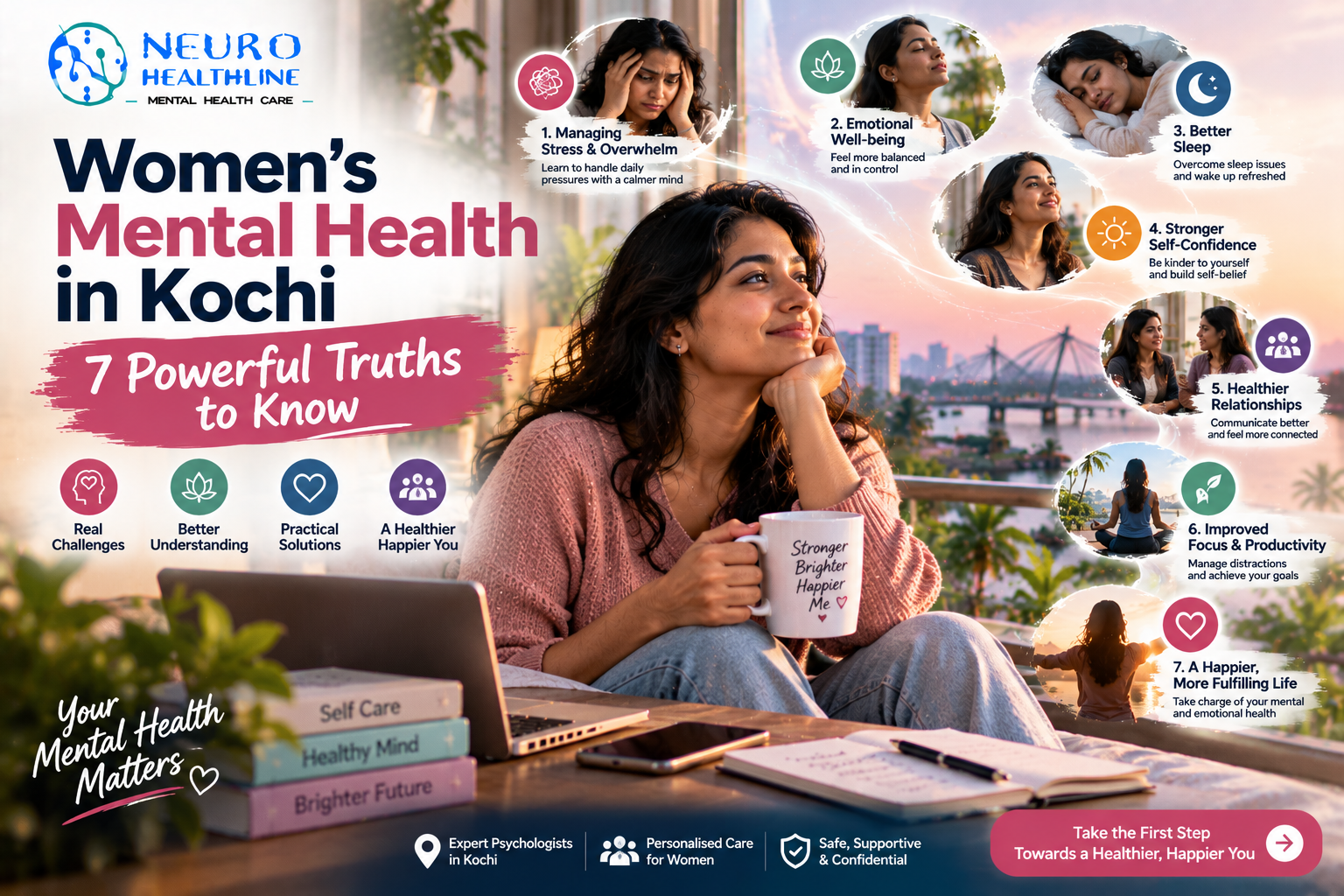
Women’s mental health in Kochi sits at a profound and painful paradox. Kerala’s women are among the most educated, most literate, and most professionally active in India — and yet they carry a mental health burden that the healthcare system, the cultural framework, and the social environment around them have consistently underserved, minimised, and sometimes actively prevented from being acknowledged. Women in Kerala experience depression at approximately twice the rate of men, anxiety disorders at significantly elevated rates, and a spectrum of stress-related physical and psychological conditions that are driven by the specific convergence of hormonal biology, social expectation, cultural constraint, and structural inequality that defines women’s experience in contemporary Kerala. And they seek treatment at rates that fall dramatically short of the genuine prevalence of their need — because the cultural frameworks that generate their mental health challenges simultaneously make acknowledging those challenges feel like a luxury, a weakness, or an act of disloyalty to the family and community whose needs are supposed to come first.
Women’s mental health in Kochi at NeuroHealthline is a clinical commitment — not simply a service category. Every program we offer is designed with full recognition of the specific neurological, hormonal, relational, and cultural dimensions that make women’s mental health experiences distinct — and full commitment to delivering the clinical depth, cultural sensitivity, and genuine respect that every woman seeking help in Kochi deserves.
Why Women’s Mental Health in Kochi Requires a Dedicated Clinical Framework
Women’s mental health is not simply mental health in a female body — it involves distinct neurobiological mechanisms, specific hormonal drivers, and a social and cultural context that creates mental health challenges unique in their nature, presentation, and clinical requirements. The hormonal dimension alone represents a clinical landscape that conventional mental health frameworks — largely developed on male or gender-undifferentiated research populations — have historically addressed with inadequate specificity. Oestrogen and progesterone directly modulate the serotonin, GABA, and dopaminergic systems most critical for mood regulation — creating the menstrual cycle-related mood fluctuations, the postpartum neurobiological transition, and the perimenopausal hormonal volatility that represent the most specific and most clinically significant drivers of women’s mental health challenges across the reproductive lifespan.
The social and relational dimension of women’s mental health in Kochi is equally distinctive. The emotional labour burden — the disproportionate responsibility for maintaining the emotional climate, social relationships, and care infrastructure of families and communities that cultural expectations place on women — creates a chronic cognitive and emotional load that directly depletes the neurochemical resources most critical for mood regulation. The suppression of women’s own emotional needs and expressions in service of others’ wellbeing — a pattern that Kerala’s cultural frameworks of feminine selflessness reward and reinforce — progressively erodes the authentic self-connection that psychological health requires. And the specific stressors of women’s contemporary experience in Kochi — career-family conflict, marital pressure, body image and appearance expectation, safety concerns, and the particular loneliness of social media comparison culture — create a mental health risk environment that generic clinical frameworks consistently fail to address with adequate specificity or sensitivity.
The Most Significant Women’s Mental Health Challenges in Kochi
Women’s mental health in Kochi encompasses a broad and interconnected spectrum of clinical presentations — each shaped by the specific biological, social, and cultural dimensions outlined above. Depression is the most prevalent — affecting Kerala’s women at approximately twice the rate of men across all age groups, driven by the combination of hormonal vulnerability, emotional labour burden, and the suppression of needs and expression that cultural femininity frameworks require. Anxiety disorders — including generalised anxiety, social anxiety, and the specific anxiety of health, relationship, and parenting concerns that women disproportionately carry — are the second most prevalent cluster, often co-occurring with depression in the complex, multi-layered presentations that characterise so much of women’s mental health in Kochi.
Perinatal mental health challenges — including prenatal anxiety, postpartum depression, and the identity disruption of early motherhood — represent a specific and critically underserved dimension of women’s mental health in Kochi, affecting approximately 15 to 20% of new mothers in Kerala while remaining dramatically undertreated due to the cultural silencing of maternal distress. Burnout and chronic stress — driven by the working mother’s dual burden and amplified by the impossible standard of effortless excellence in both roles that social media’s curated motherhood culture promotes — are among the most rapidly growing presentations. And the hormonal mental health challenges of perimenopause — too frequently dismissed as simply ageing or medically managed without psychological support — represent a growing clinical need as Kochi’s professional female population reaches the perimenopausal transition carrying decades of accumulated stress load into a period of significant neurobiological vulnerability. Our depression treatment for women in Kochi and anxiety in working mothers Kerala programs address the most prevalent specific presentations within the broader women’s mental health in Kochi framework.
7 Powerful Truths About Women’s Mental Health in Kochi
1. Your Hormones Are Not a Weakness — They Are a Clinical Variable
One of the most important and most empowering truths about women’s mental health in Kochi is that the mood variability, emotional sensitivity, and mental health vulnerability that hormonal fluctuation produces are not character weaknesses, oversensitivity, or failures of emotional management. They are measurable neurobiological consequences of reproductive hormone cycles that directly modulate the neurotransmitter systems governing mood — and they are fully addressable through clinical approaches that take hormonal biology seriously rather than dismissing it as incidental.
2. Emotional Labour Is a Clinical Risk Factor
The chronic emotional labour that most women in Kochi carry — the invisible work of managing others’ emotional states, anticipating needs, maintaining relationships, and providing the care infrastructure that families depend on — is not simply tiring. It is a measurable chronic stress that directly depletes the serotonin, dopamine, and cortisol regulation that mood stability requires. Acknowledging emotional labour as a genuine clinical risk factor — rather than a social expectation to be better managed — is one of the most important shifts in how women’s mental health in Kochi is understood and treated.
3. Depression in Women Often Looks Different
Women’s depression frequently presents through anxiety, irritability, physical complaints, and relentless self-criticism more prominently than through the sadness and tearfulness that the standard clinical picture depicts — making it both harder to recognise and more likely to be misattributed to personality, hormones, or life circumstances rather than identified as the treatable neurological condition it genuinely is. According to NCBI PubMed, women with depression are significantly more likely than men to present with comorbid anxiety and somatic symptoms — a clinical reality that effective women’s mental health in Kochi assessment must account for.
4. Seeking Help Is Not Selfish
The cultural framework that positions women’s self-care as a lesser priority than family care has produced a generation of women in Kochi who have postponed their own mental health treatment for years — until the accumulated burden produces a clinical crisis that affects not only themselves but the family whose wellbeing they were prioritising. The truth is that a mentally healthy woman provides incomparably better care, presence, and love to her family than a chronically depleted, anxious, or depressed one. Seeking help for women’s mental health in Kochi is not selfishness — it is the most responsible and most loving choice a woman can make for the people whose wellbeing she cares most about.
5. Non-Pharmacological Treatment Produces Lasting Results
Women’s mental health in Kochi has historically been treated primarily through medication — antidepressants and anxiolytics that provide symptomatic relief without addressing the hormonal, physiological, and relational drivers maintaining the mental health challenges they are meant to resolve. NeuroHealthline’s non-pharmacological approach — combining HEG neurofeedback, HRV biofeedback therapy, hormonal functional support, and women-centred neuropsychotherapy — produces genuine neurological and physiological recovery rather than ongoing symptom management, without the side effects or long-term dependency that medication-only approaches carry.
6. Your Mental Health Affects the Next Generation
Maternal mental health is one of the most powerful determinants of children’s neurological development and long-term mental health — with maternal anxiety and depression producing measurable effects on children’s stress response systems, attachment security, and emotional regulation capacity through the neurobiological attunement between mothers and children during the critical developmental years. Investing in women’s mental health in Kochi is therefore not simply an individual health intervention — it is an intergenerational one whose benefits extend to the children, families, and communities that women’s wellbeing shapes.
7. Recovery Is Possible — And It Changes Everything
Women who receive effective treatment for their mental health challenges — who experience genuine neurological recovery rather than ongoing management — consistently describe the change as life-altering rather than simply symptomatic. The energy, clarity, emotional availability, and sense of personal agency that return with genuine mental health recovery create a qualitative shift in every dimension of life — professional, relational, parental, and personal — that no amount of coping, managing, or pushing through can approach.
How NeuroHealthline Supports Women’s Mental Health in Kochi
NeuroHealthline’s comprehensive approach to women’s mental health in Kochi integrates neurological assessment, hormonal functional medicine, evidence-based neurofeedback and biofeedback, and women-centred neuropsychotherapy within a clinical environment that is explicitly, completely, and unconditionally stigma-free. Our QEEG brain mapping provides the objective neurological baseline that grounds every treatment decision in measurable brain science rather than symptom checklist. Our hormonal functional assessment identifies and addresses the oestrogen, progesterone, cortisol, and thyroid dysregulations most commonly driving female mental health presentations. And our neuropsychotherapy approach specifically engages with the identity, relational, and cultural dimensions that make women’s mental health in Kochi so frequently more complex than its neurological dimensions alone can explain.
The complete clinical pathway for women’s mental health in Kochi at NeuroHealthline includes: depression treatment for women in Kochi for the most prevalent female mental health presentation; anxiety in working mothers Kerala for the working mother demographic; stress and hormones in Kochi for hormonal stress-related presentations; burnout treatment in Kochi for the progressive depletion that emotional labour produces; and our broader counseling centers in Kochi framework for therapeutic support. The World Health Organization identifies depression as the most significant cause of disability in women globally — and NeuroHealthline’s women’s mental health in Kochi programs are built to meet this recognition with the clinical excellence and genuine compassion that Kerala’s women deserve.
FAQ — Women’s Mental Health in Kochi
Is women’s mental health treatment in Kochi available for all life stages?
Yes. NeuroHealthline’s programs address women’s mental health across all stages — from adolescent girls navigating academic pressure and social media anxiety, through the working and parenting years of early and mid-adulthood, to the perimenopausal and post-menopausal transitions that represent specific and significant neurobiological vulnerability windows.
How does hormonal assessment improve women’s mental health treatment outcomes?
By identifying the specific hormonal dysregulations — oestrogen, progesterone, cortisol, thyroid — most directly contributing to each woman’s mental health presentation, hormonal assessment allows targeted functional support that addresses physiological drivers that psychological and neurological intervention alone cannot fully reach.
Is women’s mental health treatment in Kochi suitable for postpartum depression?
Yes. Postpartum mental health is one of the most urgently supported presentations at NeuroHealthline — with our program specifically adapted to the hormonal, sleep, and relational context of the postpartum period, including guidance for partners and family members on how best to support a new mother experiencing postpartum mental health challenges.
Can women’s mental health treatment in Kochi be conducted alongside professional and family commitments?
Yes. All programs are specifically designed for the scheduling constraints of women managing simultaneous professional and family responsibilities — with flexible session timing, practical home-based practice components, and treatment approaches that produce improvements in energy, regulation, and cognitive function that make the demands of daily life more manageable, not less.
How does NeuroHealthline approach women’s mental health differently from conventional clinics?
By treating women’s mental health as a distinct neurobiological and social experience requiring gender-specific clinical frameworks — rather than applying generic mental health protocols to female presentations. Hormonal assessment, women-centred neuropsychotherapy, and explicit recognition of emotional labour, relational dynamics, and cultural context distinguish our approach from conventional treatment models.