


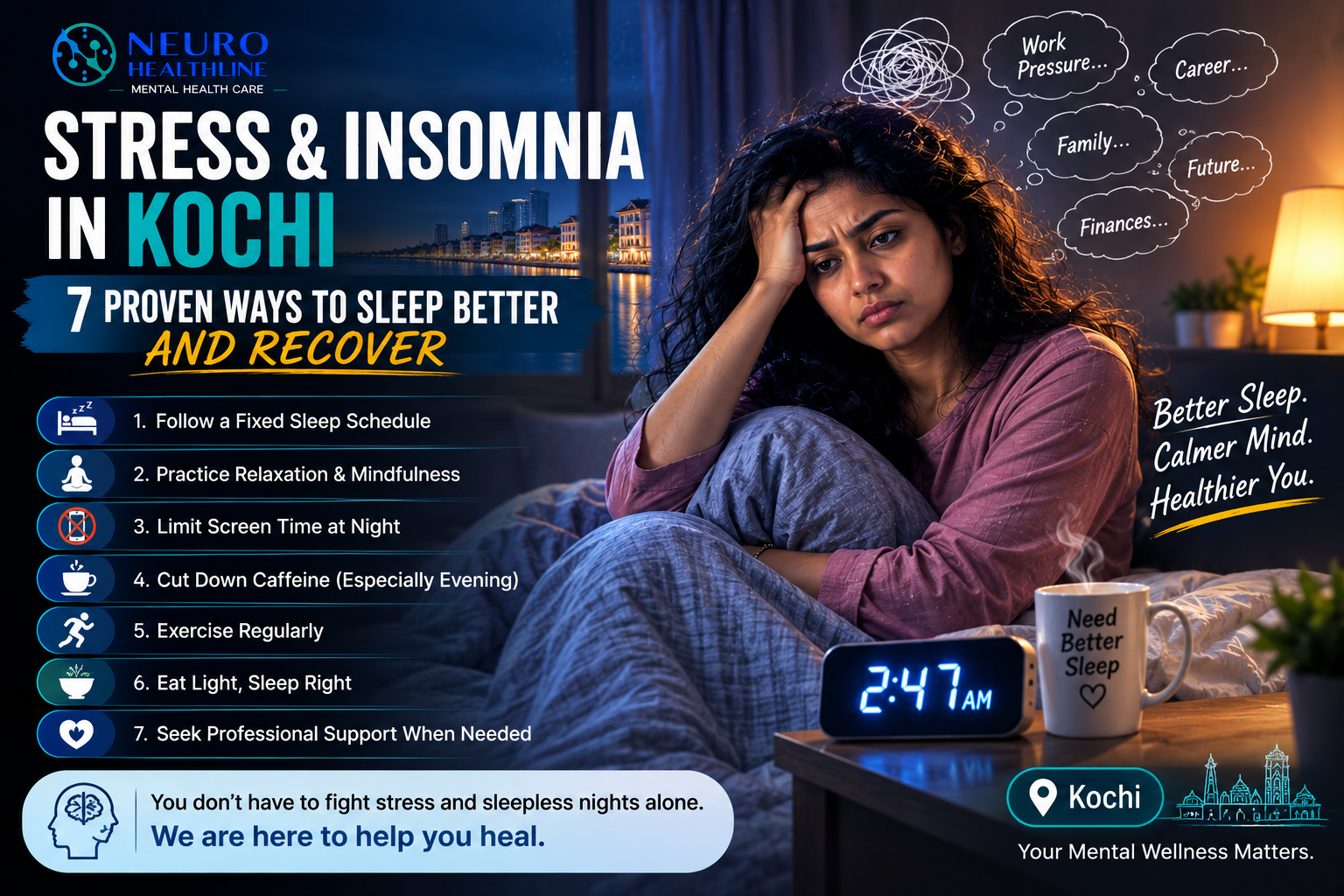
There is a cruel irony at the heart of stress and insomnia in Kochi that thousands of professionals, students, and parents experience every night. The more stressed you are — the more your brain and body genuinely need deep, restorative sleep — the more completely stress prevents you from getting it. You lie awake with a racing mind, rehearsing tomorrow’s meetings, replaying today’s conversations, calculating next month’s finances, and catastrophising about problems that feel unsolvable at midnight in a way they never quite do in daylight. Hours pass. The alarm gets closer. The anxiety about not sleeping adds its own layer to the anxiety that prevented sleep in the first place. And when morning finally comes, you face the day with a depleted nervous system, impaired cognitive function, and a stress load that is now heavier than it was yesterday — because the sleep that would have partially restored your capacity to manage it never came. Stress and insomnia in Kochi is one of the most self-reinforcing clinical presentations we see at NeuroHealthline — a vicious cycle in which stress destroys sleep and sleep deprivation intensifies stress, progressively depleting the brain and body’s resilience until clinical intervention is the only way to break the loop.
The Neuroscience of Stress and Insomnia — Why They Are Inseparable
Understanding stress and insomnia in Kochi requires understanding the specific neurological mechanisms through which stress prevents sleep — because this is not simply a matter of having too many thoughts. Stress activates the HPA axis, producing sustained cortisol elevation that directly suppresses the melatonin production and parasympathetic nervous system shift that sleep onset requires. Stress maintains the sympathetic nervous system in a state of partial activation — keeping heart rate elevated, muscles partially tensed, and the brain’s threat-monitoring systems alert — precisely the physiological opposite of the parasympathetic state that sleep requires. Stress overactivates the amygdala and prefrontal rumination circuits — generating the intrusive thoughts, worry loops, and hyperactivated cognitive processing that make lying still with a quiet mind neurologically impossible for the stressed individual.
The result is that stress and insomnia in Kochi are not two separate problems that happen to co-occur — they are two dimensions of a single, mutually reinforcing neurological state that must be addressed together rather than separately. Treating insomnia without addressing the stress that is generating it produces temporary relief at best. Treating stress without addressing the sleep deprivation that is amplifying it leaves the physiological foundation of stress recovery unavailable. This is the clinical reality that shapes NeuroHealthline’s integrated approach to stress and insomnia in Kochi — and explains why our outcomes consistently exceed those of programs that address either sleep or stress in isolation.
How Stress Destroys Sleep Quality in Kochi’s Professional Population
For Kochi’s working professionals, the relationship between stress and insomnia follows a highly specific pattern shaped by the particular demands of the city’s professional culture. The boundary erosion between work and personal time — driven by always-on connectivity, the expectation of after-hours responsiveness, and the psychological difficulty of genuinely disengaging from professional identity — means that the cognitive and emotional activation of work extends seamlessly into the hours that should be transitioning toward sleep. The sympathetic nervous system activation maintained by deadline pressure, client accountability, and professional uncertainty does not automatically deactivate when the laptop closes or the office is left behind — it persists physiologically through the evening, preventing the gradual parasympathetic shift that healthy sleep preparation requires.
The blue light exposure of evening screen use compounds this physiological barrier — suppressing melatonin precisely during the window when the circadian clock requires its natural rise. And the cognitive hyperactivation of professional stress — the problem-solving, planning, and threat-monitoring that professional demands generate — finds its most uninterrupted expression during the quiet, stimulus-free environment of the bedroom at night, where the absence of external demands leaves the stressed brain with nothing to do but run its worry circuits at full intensity. According to NCBI PubMed, occupational stress is one of the strongest predictors of chronic insomnia — with the relationship being bidirectional, dose-dependent, and significantly amplified by always-on connectivity culture.
The Consequences of Unaddressed Stress and Insomnia in Kochi
The professional and health consequences of untreated stress and insomnia in Kochi accumulate progressively — and are significantly more serious than the immediate impairment of tiredness and reduced concentration that most people focus on. Cognitively, chronic sleep deprivation produces the same degree of impairment as alcohol intoxication on measures of decision-making quality, reaction time, and working memory — impairment that stressed professionals in Kochi are typically unaware of because the subjective sense of performance impairment also diminishes as sleep deprivation accumulates. Emotionally, sleep deprivation dramatically reduces the prefrontal cortex’s regulatory capacity over the amygdala — producing the emotional reactivity, reduced frustration tolerance, and heightened irritability that characterise the chronically sleep-deprived stressed professional and progressively damage the workplace relationships and family functioning that professional and personal life depend on.
Physically, chronic stress and insomnia in Kochi accelerates immune dysfunction — increasing vulnerability to viral illness and inflammatory conditions — disrupts metabolic regulation, elevates cardiovascular risk markers, and impairs the HPA axis’s cortisol rhythm in ways that compound the stress physiology already driving the insomnia. And the progressive mental health consequences — the anxiety that deepens as sleep deprivation amplifies threat-detection sensitivity, and the depression that develops as sleep deprivation impairs the neurogenesis and emotional processing that mood regulation requires — represent the most serious long-term consequences of the stress and insomnia cycle that so many professionals in Kochi are currently caught in.
7 Proven Solutions for Stress and Insomnia in Kochi
1. Integrated Stress and Sleep Assessment
Treatment for stress and insomnia in Kochi begins with a comprehensive assessment mapping both dimensions simultaneously — HRV profiling to characterise autonomic nervous system dysregulation, QEEG brain mapping to identify the specific neural overactivation patterns preventing sleep onset, cortisol rhythm assessment to map HPA axis dysregulation, and a detailed clinical history capturing the specific stress context and sleep pattern characterising each individual’s presentation.
2. HRV Biofeedback for Pre-Sleep Nervous System Regulation
HRV biofeedback therapy is the most directly applicable intervention for stress and insomnia in Kochi — training the autonomic nervous system to shift efficiently from the sympathetic activation of professional stress into the parasympathetic state required for sleep onset. Clients learn a breathing-based self-regulation skill that can be applied as a structured pre-sleep practice — actively creating the physiological conditions for sleep rather than lying passively in a sympathetically activated state hoping sleep will arrive.
3. HEG Neurofeedback for Cognitive Hyperactivation
The racing thoughts, worry loops, and cognitive hyperactivation that stress and insomnia in Kochi produces are driven by specific overactive neural circuits — particularly the prefrontal rumination networks and the amygdala-generated threat-monitoring that maintains vigilance at night. HEG neurofeedback directly reduces this overactivation, progressively quieting the cognitive hyperactivity that prevents sleep onset and produces the disturbing dreams and frequent waking that characterise stress-driven insomnia.
4. Cranioelectrical Stimulation for Sleep Architecture Restoration
CES promotes the slow-wave and delta brainwave activity associated with deep, restorative sleep — directly addressing the sleep architecture disruption that chronic stress produces. For professionals with stress and insomnia in Kochi who have been in disrupted sleep patterns for months or years, CES helps restore the deep sleep stages that stress-driven insomnia most significantly depletes.
5. Cortisol Rhythm Realignment
The cortisol dysrhythmia produced by chronic stress — elevated evening cortisol when it should be falling, disrupted morning cortisol rise — is one of the most direct physiological mechanisms driving stress and insomnia in Kochi. Our functional assessment identifies the specific cortisol rhythm disruption in each client, and targeted nutritional, light exposure, and lifestyle protocols specifically correct the timing misalignment that is preventing the natural cortisol decline that sleep onset requires.
6. Digital Sunset Protocol
Given the central role of evening screen use in compounding the stress-driven insomnia cycle, our treatment for stress and insomnia in Kochi includes a structured digital sunset protocol — a specifically designed sequence of evening practices that reduce blue light exposure, create psychological work disengagement, and support the gradual parasympathetic shift that healthy sleep preparation requires. This is not a generic “put your phone away” recommendation — it is a neurologically grounded evening protocol designed specifically around the professional stress and connectivity demands of Kochi’s working population.
7. Functional Nutrition for Sleep Neurochemistry
The neurochemical requirements of healthy sleep — adequate melatonin precursors, GABA support, cortisol regulation cofactors, and anti-inflammatory nutrients that reduce the neuroinflammatory burden chronic stress produces on sleep architecture — are directly addressable through targeted functional nutrition. Our treatment for stress and insomnia in Kochi includes a comprehensive nutritional assessment identifying specific deficiencies in magnesium glycinate, L-tryptophan, B6, zinc, and adaptogenic nutrients — correcting the nutritional gaps that compound both the stress and the insomnia simultaneously.
Why Choose NeuroHealthline for Stress and Insomnia in Kochi?
NeuroHealthline’s approach to stress and insomnia in Kochi addresses the full neurological, physiological, and behavioural complexity of this self-reinforcing cycle — rather than offering sleep hygiene advice that fails to engage with the clinical depth of a presentation driven by genuine HPA axis dysregulation, autonomic nervous system imbalance, and neural overactivation. Our stress treatment in Kochi and sleep labs in Kochi programs provide the clinical frameworks within which stress and insomnia treatment sits — recognising that for the majority of clients, sleep and stress are inseparable dimensions of the same underlying neurological condition. Our chronic stress treatment program addresses the sustained stress physiology that most commonly drives the insomnia, while our occupational stress treatment program targets the professional context within which stress and insomnia in Kochi most frequently originates. The World Health Organization identifies chronic insomnia as a significant global health priority — and NeuroHealthline’s integrated approach to stress and insomnia in Kochi is built to meet this priority with the clinical depth and neurological precision it demands.
FAQ — Stress and Insomnia in Kochi
How long does it take to break the stress and insomnia cycle in Kochi?
Most clients report noticeable improvements in sleep onset time and sleep quality within 3 to 6 weeks of beginning treatment, with more comprehensive sleep architecture restoration and stress system recovery typically consolidating over 3 to 5 months.
Is sleeping medication an effective solution for stress and insomnia in Kochi?
Sleeping medication provides temporary symptomatic relief without addressing the stress physiology driving the insomnia — meaning insomnia typically returns when medication is discontinued. Our program provides lasting sleep restoration by addressing the neurological and physiological root causes directly.
Can stress and insomnia in Kochi cause long-term health problems?
Yes. Chronic stress and insomnia together significantly elevate risk for cardiovascular disease, metabolic disorders, immune dysfunction, and psychiatric conditions including depression and anxiety — making early, effective treatment genuinely important for long-term health.
Will stress and insomnia treatment in Kochi require time off work?
No. Sessions are scheduled flexibly around professional commitments, and many clients find that early improvements in sleep quality produce immediate positive effects on daytime professional performance.
Can stress and insomnia in Kochi be treated without sleeping medication?
Yes. Every component of NeuroHealthline’s treatment program is non-pharmacological — producing lasting neurological and physiological sleep restoration without the dependency risk or withdrawal challenges that sleeping medication carries.