


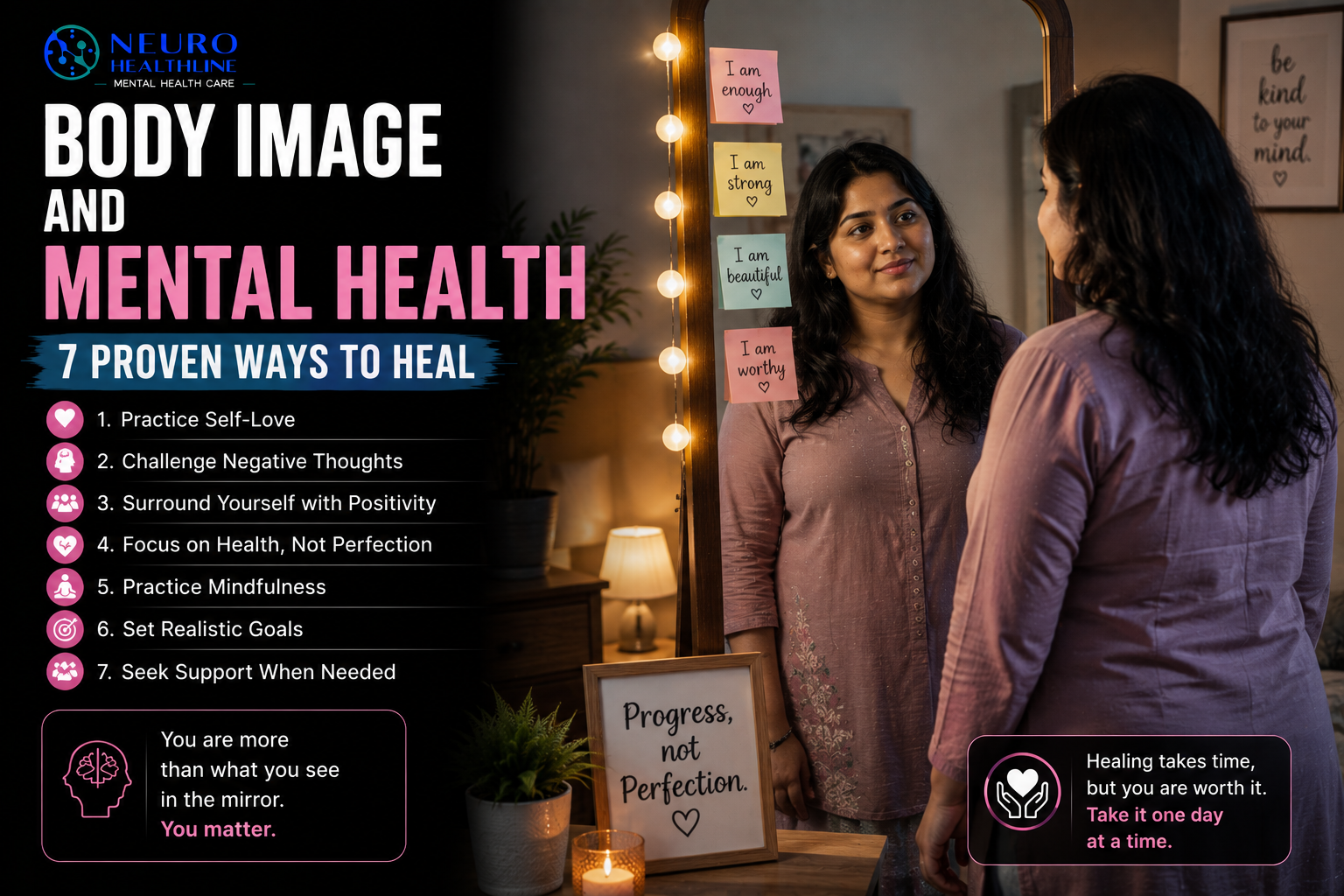
Open Instagram for ten minutes. Count how many images you see of bodies — filtered, curated, posed, and algorithmically selected for maximum engagement. Then ask yourself honestly: how many of those images make you feel genuinely good about your own body? For the vast majority of people who are honest with themselves, the answer is very few, or none at all. Body image and mental health are now so deeply intertwined — particularly for teenagers, young women, and an increasingly significant proportion of young men — that the clinical consequences of the relationship are impossible to overstate. Negative body image is not a superficial vanity concern. It is a significant and often severe mental health challenge that drives anxiety, depression, disordered eating, social withdrawal, self-harm, and a pervasive reduction in quality of life that touches every aspect of how a person moves through the world. At NeuroHealthline, body image and mental health challenges are approached with the clinical depth, neuroscientific rigour, and genuine compassion that this profoundly important but often trivialised area of mental health genuinely deserves.
What Is Body Image and Why Does It Matter So Much?
Body image is not simply how your body looks — it is how you experience your body from the inside. It encompasses your perceptions of your physical appearance, your feelings about those perceptions, your thoughts and beliefs about what your body means about your worth as a person, and your behaviours in response to all of the above. Body image and mental health are connected not through vanity but through the profound and pervasive way that how we feel about our bodies shapes our relationship with ourselves — our confidence, our willingness to take up space, our capacity for intimacy, and our sense of fundamental worthiness as a human being.
Positive body image is not about loving every aspect of your appearance — it is about having a functional, relatively neutral relationship with your physical self that does not occupy a disproportionate amount of cognitive and emotional real estate or significantly impair your capacity to engage fully with your life. Negative body image, by contrast, is characterised by persistent preoccupation with perceived physical flaws, chronic dissatisfaction with appearance, frequent comparison of your body to others’, avoidance of situations in which your body feels exposed or evaluated, and a deeply held belief that your physical appearance is a primary determinant of your value as a person. Understanding this distinction is the foundation for understanding why body image and mental health are so inseparably connected — and why improving one consistently produces improvements in the other.
The Social Media Body Image Crisis
The relationship between body image and mental health has been significantly transformed — and significantly worsened — by social media. Instagram, in particular, has created an image consumption environment of unprecedented scale, frequency, and visual standard that the human brain’s social comparison systems were never designed to navigate without developing pathological responses. The images that populate Instagram’s visual landscape are not representative of human physical diversity — they are a highly curated, heavily filtered, often digitally altered selection of images specifically optimised for aesthetic appeal and engagement maximisation.
When the brain processes these images — multiple times per day, across years of habitual social media use — the social comparison process it engages in is the same process it would engage in when evaluating its standing relative to members of its social group in the ancestral environment. But where the ancestral social group contained perhaps 150 individuals of the same species across a natural range of physical variation, Instagram presents thousands of algorithmically selected, digitally perfected images that collectively establish an implicit beauty standard that no naturally occurring human body can consistently meet. The result is a chronic, algorithmically manufactured body dissatisfaction that drives the body image and mental health crisis affecting a generation of young people across India — and which we explored in the context of Instagram addiction and mental health and social media anxiety in teenagers in Kochi.
Research published on NCBI PubMed confirms that social media use — particularly image-based platforms — is significantly and causally associated with body dissatisfaction, disordered eating attitudes, and negative body image across age groups, with the relationship being strongest among adolescent girls but increasingly significant among adolescent boys and young adults of all genders.
How Negative Body Image Affects Mental Health
The mental health consequences of negative body image are wide-ranging and clinically significant. Anxiety is the most immediate consequence — the constant threat-monitoring that negative body image generates, in which the body itself becomes a source of anticipated social danger and evaluation, maintaining a chronic state of social threat activation that is neurologically identical to generalised anxiety. Depression develops as the persistent negative self-evaluation of poor body image progressively erodes self-worth, reduces social engagement, and displaces the genuine self-care and life engagement that sustained mood requires. Disordered eating — ranging from chronic restrictive dieting and food preoccupation to diagnosable eating disorders including anorexia nervosa, bulimia nervosa, and binge eating disorder — emerges as the behavioural response to negative body image that attempts to control or change the body that is the source of distress.
Social withdrawal — avoiding beaches, swimming pools, social gatherings, romantic relationships, or any situation in which the body feels exposed and evaluated — progressively narrows life and increases isolation. And the profound cognitive burden of chronic body preoccupation — the mental energy devoted to monitoring, evaluating, comparing, and managing the body’s appearance — represents a significant and often unrecognised cognitive load that directly impairs concentration, academic and professional performance, and the capacity for genuine presence in relationships and experiences.
Body Image and Mental Health Across Genders
While body image and mental health challenges have historically been most discussed in relation to women and girls, the clinical reality is significantly more gender-inclusive. Young women and girls face the most intense and most pervasive body image pressure — driven by the intersection of social media’s visual comparison culture, the objectification of women’s bodies in mainstream media, and the particularly intense relationship between female social value and physical appearance that cultural norms perpetuate. But young men and boys face an increasingly significant body image and mental health challenge of their own — one driven by the muscular ideals of fitness influencer culture, the body standards of gaming and sports media, and a social environment in which vulnerability about body concerns is significantly more stigmatised for men than for women.
Body image and mental health challenges among young men in Kerala are significantly underreported and undertreated — precisely because the stigma of both body concern and mental health help-seeking is particularly acute for young men in a cultural context that equates masculine strength with emotional stoicism. At NeuroHealthline, body image and mental health treatment is designed for every gender and every presentation — without the implicit feminisation of the concern that prevents so many young men from seeking the help they genuinely need.
7 Proven Ways NeuroHealthline Heals Body Image and Mental Health
1. Comprehensive Mental Health Assessment
Body image and mental health treatment at NeuroHealthline begins with a comprehensive assessment mapping the specific anxiety, depression, perfectionism, and social comparison patterns underlying each individual’s body image challenges — alongside any disordered eating behaviours that have developed as a response. This assessment ensures treatment is precisely targeted rather than applying a generic body image protocol to a presentation that may have distinct clinical features requiring specific intervention.
2. HEG Neurofeedback for Self-Critical Thought Reduction
The relentless self-critical inner dialogue that characterises negative body image — the constant evaluation, comparison, and condemnation of the body’s appearance — is driven by specific overactive neural circuits involving the prefrontal self-referential networks and their interaction with the brain’s social threat-detection systems. HEG neurofeedback directly reduces the overactivation of these circuits, progressively quieting the self-critical voice and creating the neural space in which a more balanced, compassionate relationship with the body becomes neurologically possible.
3. HRV Biofeedback for Body-Based Safety
Many individuals with significant body image and mental health challenges have a fundamentally adversarial relationship with their own body — experiencing it as a source of shame, threat, and social danger rather than a safe home to inhabit. HRV biofeedback therapy — which works directly with the body’s physiological signals to build autonomic regulation — helps rebuild a felt sense of safety within the body itself, creating a physiological foundation for the more compassionate body relationship that psychological recovery requires.
4. Social Media and Body Comparison Restructuring
Given the central role of social media in driving and maintaining body image and mental health challenges, our treatment program specifically addresses social media comparison behaviour — using a structured, gradual approach to reducing the frequency and intensity of appearance-focused social media consumption while building the internal self-worth reference points that make external comparison less neurologically compelling.
5. Anxiety and Depression Treatment
Where body image challenges have progressed to clinical anxiety or depression — as they frequently do — our dedicated anxiety treatment and depression treatment in Kochi programs address these clinical presentations within an integrated framework that recognises the body image roots of the mental health symptoms rather than treating the anxiety or depression in isolation from its cause.
6. Functional Nutrition for Body Image Recovery
Disordered eating patterns that develop in response to negative body image frequently produce nutritional deficiencies that directly impair mood regulation, cognitive function, and the emotional resilience that body image recovery requires. Our functional nutrition assessment identifies and addresses these deficiencies — including omega-3 fatty acids, B vitamins, zinc, magnesium, and iron — providing the nutritional foundation that supports both physical health restoration and the neurochemical recovery that psychological healing depends on.
7. Compassion-Focused Neuropsychotherapy
The core therapeutic work of body image and mental health recovery is the gradual, clinically supported development of a genuinely compassionate relationship with the body — one that acknowledges its functional capacities, accepts its natural variation, and progressively decouples physical appearance from the fundamental sense of human worth and lovability that it has come to determine. Our compassion-focused neuropsychotherapy approach addresses the specific shame, perfectionism, and social comparison patterns maintaining negative body image — within a therapeutic relationship that models the non-judgmental acceptance that body image recovery requires experiencing to genuinely internalise.
Why Choose NeuroHealthline for Body Image and Mental Health Treatment?
NeuroHealthline’s approach to body image and mental health combines the neurological precision of neurofeedback and biofeedback with the psychological depth of compassion-focused neuropsychotherapy and the physiological comprehensiveness of functional nutrition — addressing every dimension of the body image and mental health relationship simultaneously rather than focusing narrowly on cognitive patterns or behavioural symptoms in isolation. Our Gen Z mental health and social media addiction treatment programs address the broader digital context within which body image challenges most commonly develop — recognising that body image and mental health cannot be fully addressed without engaging with the social media environment that is most powerfully driving them. The World Health Organization recognises the significant global burden of body image-related mental health conditions — and NeuroHealthline’s integrated approach is built to meet this burden with the clinical depth it genuinely requires.
FAQ — Body Image and Mental Health
Is negative body image the same as an eating disorder?
No — though they are closely related. Negative body image is a broader psychological experience that can exist independently of diagnosable eating disorders, though it significantly increases the risk of developing them. Not everyone with poor body image has an eating disorder, but most eating disorders involve significant body image disturbance as a core feature.
Can social media cause body image problems
Yes. Research consistently demonstrates a causal relationship between image-based social media use — particularly Instagram — and body dissatisfaction, with the relationship being strongest among adolescent girls but significant across all genders and age groups
Is body image and mental health treatment available for men and boys?
Yes. NeuroHealthline’s body image and mental health programs are available for all genders — with specific attention to the distinct body image pressures and stigma barriers that men and boys face in seeking support for these challenges.
How long does body image and mental health treatment typically take?
Body image challenges reflect deeply embedded self-concept patterns that typically take several months to meaningfully shift. Most clients report noticeable improvements in self-critical thought frequency and social comparison distress within 4 to 8 weeks, with more comprehensive body relationship change consolidating over 4 to 8 months of consistent treatment.
Can body image issues be treated without addressing social media use?
Partially — but incompletely. Social media is currently one of the most powerful drivers of body image distress, and treatment that directly addresses social media comparison behaviour alongside psychological and neurological intervention consistently produces more comprehensive and more durable outcomes than ignoring the digital environment in which body image is primarily being formed and maintained.