


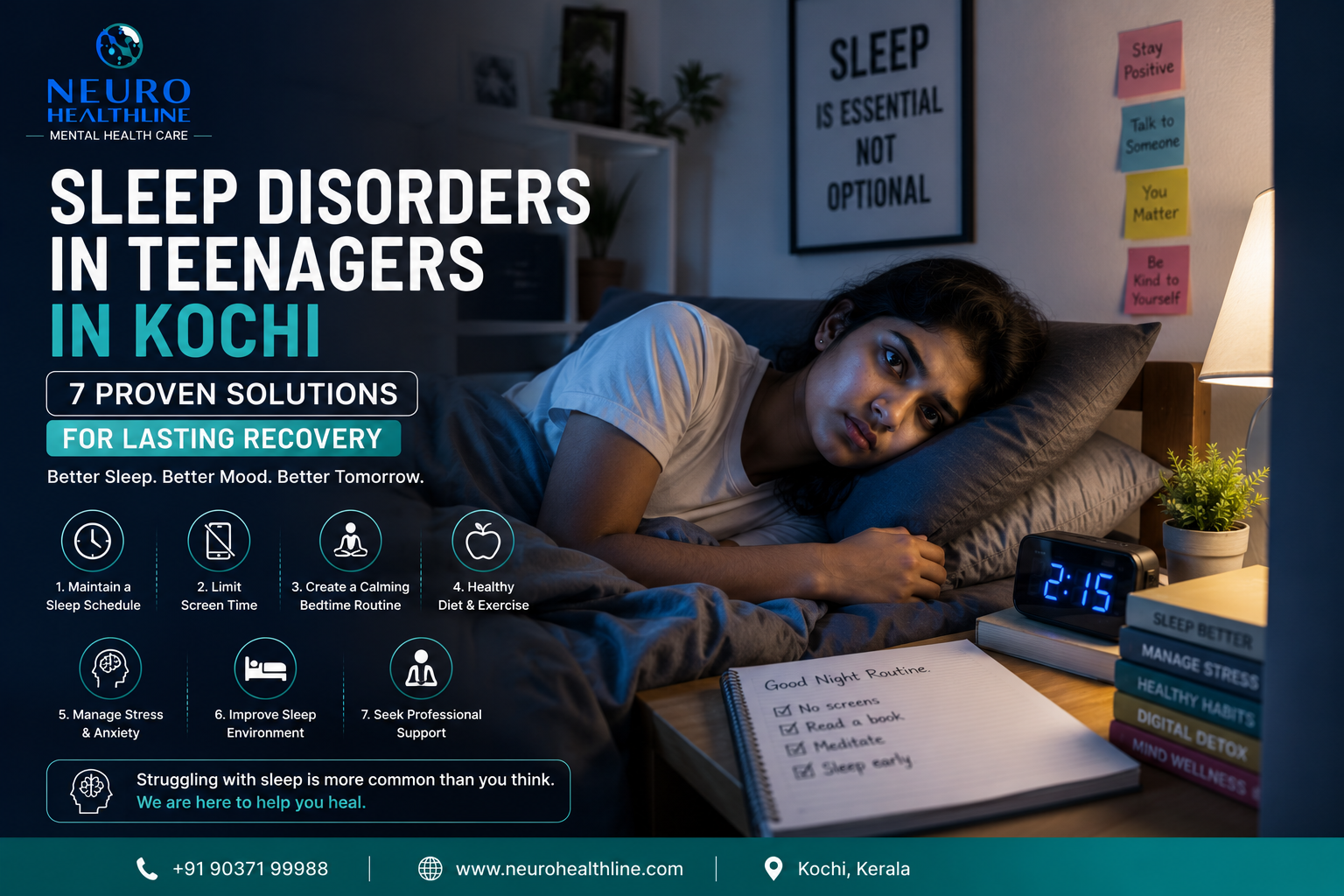
If your teenager in Kochi is consistently staying up until 2 or 3 in the morning, waking unrefreshed regardless of how long they sleep, struggling to get out of bed for school, or complaining of chronic fatigue, brain fog, and low energy throughout the day — you are witnessing one of the most prevalent and most consequential health challenges affecting Kochi’s adolescent population right now. Sleep disorders in teenagers in Kochi have reached levels that can no longer be attributed simply to teenage laziness or poor habits. They reflect a genuine neurological and physiological crisis — one being driven by a convergence of social media-disrupted circadian rhythms, academic pressure-induced anxiety, and the chronic indoor, screen-dominated lifestyle that defines contemporary adolescent life in Kochi. At NeuroHealthline, sleep disorders in teenagers in Kochi are treated with the same clinical rigour and neuroscience-based precision we apply to every condition we treat — because the consequences of untreated adolescent sleep disorders for mental health, academic performance, and long-term brain development are far too serious to address with bedtime rules alone.
Why Sleep Is So Critical for the Teenage Brain
To understand why sleep disorders in teenagers in Kochi are such a serious concern, it helps to understand what the teenage brain is doing during sleep that makes rest so critically important at this developmental stage. Sleep is not passive recovery time — it is one of the most neurologically active periods of the entire day. During deep sleep, the brain consolidates the memories and learning acquired during waking hours, pruning unnecessary neural connections and strengthening those that matter. During REM sleep, the brain processes emotional experiences, regulating the limbic system’s response to the day’s social and emotional demands. During slow-wave sleep, the brain’s glymphatic system — its waste-clearance mechanism — flushes out the metabolic byproducts of neural activity, including the neuroinflammatory molecules that, when accumulated, are strongly associated with depression, anxiety, and cognitive decline.
For a teenager whose brain is undergoing the second most significant period of neural remodelling it will ever experience — the first being early childhood — sleep deprivation is not simply uncomfortable. It actively disrupts the developmental processes that are reshaping the architecture of their adult brain. Sleep disorders in teenagers in Kochi are therefore not a lifestyle inconvenience — they are a genuine developmental emergency that requires targeted clinical attention.
What Is Causing Sleep Disorders in Teenagers in Kochi?
Understanding the specific drivers of sleep disorders in teenagers in Kochi is essential for effective treatment, because different causes require different intervention approaches. The most prevalent causes seen at NeuroHealthline include social media and screen use — the single most significant driver of sleep disorders in teenagers in Kochi today. The blue light emitted by smartphone and laptop screens suppresses melatonin production, delaying sleep onset, while the psychological arousal generated by social media content — the comparison anxiety, the social threat processing, the dopaminergic stimulation of notification checking — keeps the nervous system in a state of activation incompatible with sleep onset long after screens are put away. This is precisely the connection we explored in our blog on social media anxiety in teenagers in Kochi — where the same social media mechanisms that drive anxiety are simultaneously dismantling the sleep architecture that would otherwise buffer that anxiety.
Academic pressure-induced anxiety is the second major driver — the pre-examination racing thoughts, the revision-driven late nights, and the performance anxiety that keeps the nervous system in sympathetic activation during the hours that should be transitioning into parasympathetic sleep preparation. Circadian rhythm phase delay — a genuine neurobiological shift in the timing of the sleep-wake cycle that occurs during puberty, pushing the adolescent’s natural sleep window later — is exacerbated by evening screen use and insufficient morning light exposure, creating a biological clock misalignment that makes early school start times particularly damaging for teenage sleep. And the downstream consequences of anxiety and depression — which, as we explored in our blog on teenage depression treatment in Kochi — create and maintain sleep disorders through a bidirectional relationship in which poor sleep worsens mental health and worsening mental health further disrupts sleep.
The Consequences of Untreated Sleep Disorders in Teenagers in Kochi
The consequences of untreated sleep disorders in teenagers in Kochi extend across every dimension of adolescent functioning. Academically, sleep deprivation directly impairs the memory consolidation, cognitive flexibility, and attentional capacity that effective learning and examination performance require — creating a cruel irony for academically pressured teenagers who sacrifice sleep for revision only to impair the very neural processes that make revision productive. Emotionally, sleep deprivation dramatically reduces the prefrontal cortex’s regulatory capacity over the amygdala’s emotional responses — making sleep-deprived teenagers more emotionally reactive, more irritable, and less capable of the social reasoning and empathy that healthy peer relationships require. Physically, chronic sleep deprivation disrupts growth hormone secretion, immune function, and metabolic regulation — with long-term implications for physical health that extend well beyond the teenage years.
Most significantly, untreated sleep disorders in teenagers in Kochi substantially increase vulnerability to depression and anxiety — creating the developmental trajectory that the broader Gen Z mental health crisis in Kochi is increasingly reflecting in clinical presentations across the city. The relationship between sleep disorders and mental health in teenagers is bidirectional and mutually reinforcing — which is precisely why effective treatment must address both simultaneously rather than treating each in isolation.
7 Proven Solutions for Sleep Disorders in Teenagers in Kochi
1. Comprehensive Sleep and Circadian Assessment
Treatment for sleep disorders in teenagers in Kochi begins with a thorough assessment of each teenager’s specific sleep pattern, circadian rhythm alignment, HRV profile, and contributing psychological factors — mapping the precise combination of neurological, physiological, and behavioural drivers creating their individual sleep disorder presentation.
2. Circadian Rhythm Realignment
For the large proportion of teenagers with sleep disorders in Kochi whose sleep difficulties reflect circadian phase delay, a structured circadian realignment protocol is the essential first intervention — gradually shifting the biological clock through strategic morning light exposure, consistent sleep-wake timing, and evening light reduction protocols designed specifically around the adolescent circadian biology.
3. HRV Biofeedback for Pre-Sleep Nervous System Regulation
HRV biofeedback therapy teaches teenagers the breathing-based nervous system regulation skill most directly applicable to the sleep onset problem — the ability to actively shift the autonomic nervous system from sympathetic activation into the parasympathetic state required for sleep, rather than lying awake with a physiologically activated nervous system waiting passively for sleep to arrive.
4. Cranioelectrical Stimulation (CES)
CES promotes delta and theta brainwave activity — the brain states associated with deep, restorative sleep onset — making it one of the most directly applicable interventions for sleep disorders in teenagers in Kochi. Used as part of a pre-sleep protocol, CES helps teenagers who struggle to quiet an overactive mind at bedtime transition more efficiently into restful sleep states.
5. HEG Neurofeedback for Anxiety-Driven Sleep Disruption
For teenagers whose sleep disorders in Kochi are primarily driven by anxiety — the racing thoughts, performance worry, and social media-triggered rumination that prevent sleep onset — HEG neurofeedback directly addresses the underlying neural overactivation, reducing the anxiety that is keeping the brain alert when it should be winding down.
6. Light Therapy and Photobiomodulation
Strategic morning light therapy using clinically calibrated HappyLight sessions is one of the most powerful tools for resetting circadian clock timing in teenagers with phase-delayed sleep disorders in Kochi — providing the strong morning light signal that outdoor morning exposure previously delivered naturally but that contemporary indoor, screen-dominated adolescent lifestyles no longer provide.
7. Digital Behaviour Restructuring for Sleep
Given the central role of social media and screen use in driving sleep disorders in teenagers in Kochi, our treatment program includes practical, sustainable digital behaviour restructuring specifically focused on the evening hours — not blanket screen bans but strategic, evidence-based restructuring of device use patterns that significantly reduces the neurological and circadian impact of screens on sleep without requiring the complete social media withdrawal that most teenagers in Kochi would find neither acceptable nor beneficial.
Why Choose NeuroHealthline for Sleep Disorders in Teenagers in Kochi?
NeuroHealthline’s approach to sleep disorders in teenagers in Kochi integrates circadian science, neurofeedback, biofeedback, and digital behaviour restructuring within a single, developmentally sensitive program — addressing the multiple overlapping drivers of adolescent sleep disorders simultaneously rather than offering generic sleep hygiene advice that fails to engage with the neurological and physiological complexity of the problem. Our stigma-free, evidence-based approach is designed to be genuinely engaging for Gen Z teenagers who respond to data, science, and practical tools rather than rules and restrictions.
According to NCBI PubMed, adolescent sleep deprivation is one of the most significant and most modifiable risk factors for poor mental and physical health outcomes in young people — with targeted intervention producing measurable improvements in mental health, academic performance, and physical wellbeing simultaneously. Our broader sleep labs in Kochi program provides comprehensive sleep assessment and treatment for adults, while this specific program addresses the unique drivers and developmental context of sleep disorders in Kochi’s teenage population. The World Health Organization recognises adolescent sleep deprivation as a significant global health concern requiring targeted, evidence-based intervention — the standard our program upholds
Frequently Asked Questions About Sleep Disorders in Teenagers in Kochi
How much sleep do teenagers in Kochi actually need?
The American Academy of Sleep Medicine recommends 8 to 10 hours of sleep per night for teenagers aged 13 to 18. Most teenagers with sleep disorders in Kochi are consistently getting significantly less than this, with serious consequences for brain development, mental health, and academic performance.
Is it normal for teenagers in Kochi to be night owls?
There is a genuine biological basis for teenagers’ tendency toward later sleep timing — puberty produces a real shift in circadian clock timing. However, when this natural shift is amplified by social media use and insufficient morning light, it becomes a clinical sleep disorder in teenagers in Kochi that warrants targeted treatment rather than simple accommodation.
Can sleep disorders in teenagers in Kochi cause depression?
Yes. Sleep deprivation is one of the most significant risk factors for teenage depression — impairing the emotional processing, neurogenesis, and glymphatic clearance that protect mental health. Treating sleep disorders and depression simultaneously, as our program does, consistently produces better outcomes than addressing either in isolation.
Should I let my teenager sleep in on weekends to catch up on sleep?
While understandable, weekend sleep extension — commonly called social jetlag — further disrupts the circadian clock alignment that is already compromised in teenagers with sleep disorders in Kochi, typically worsening the Monday morning sleep difficulty rather than resolving the underlying problem.
How long does treatment for sleep disorders in teenagers in Kochi take to show results?
Most teenagers undergoing treatment at NeuroHealthline report measurable improvements in sleep onset, sleep quality, and daytime energy within 3 to 6 weeks, with more comprehensive circadian realignment and sleep architecture restoration typically consolidating over 2 to 4 months.