


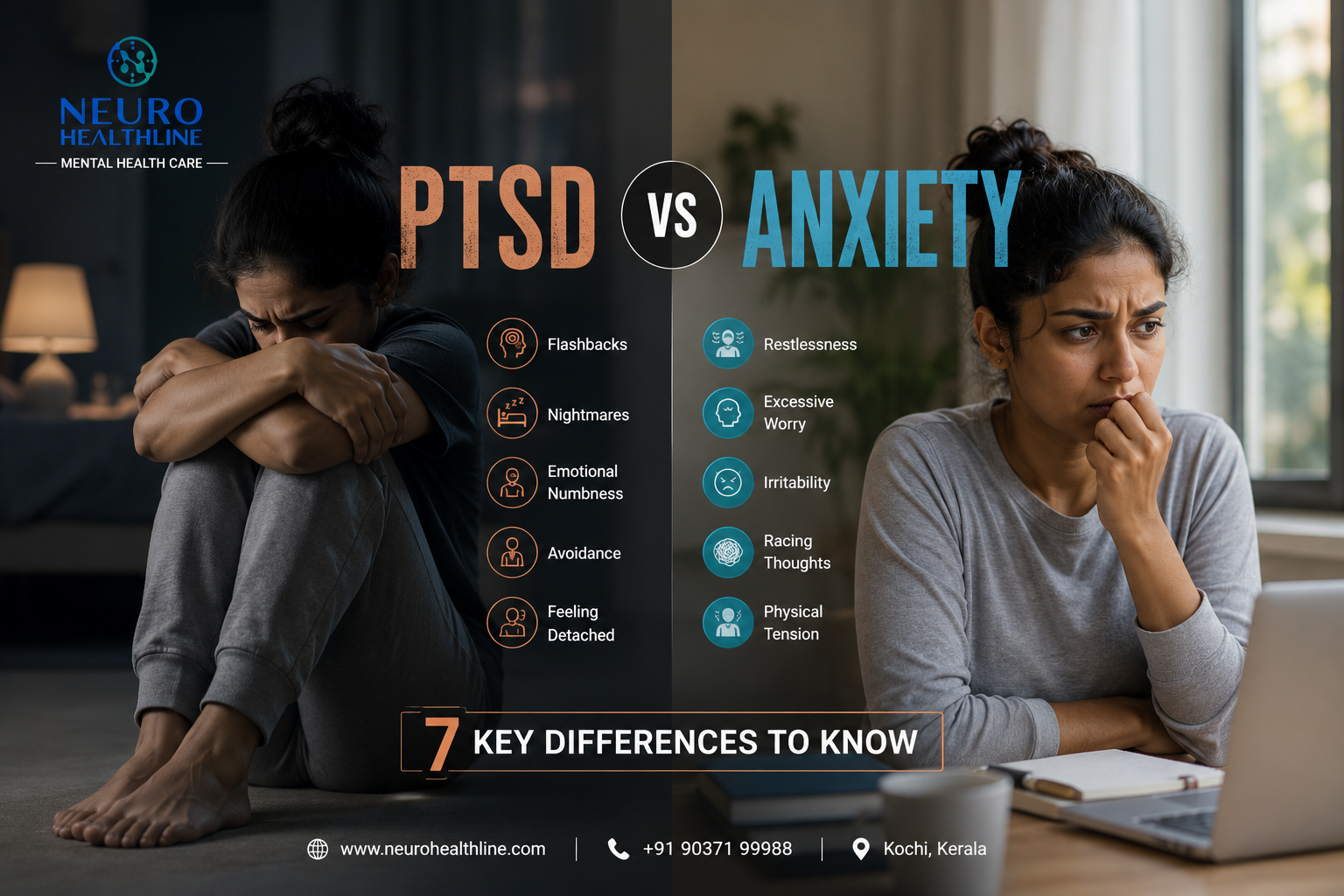
One of the most common questions asked by people seeking mental health support in Kochi is whether what they are experiencing is PTSD or anxiety. This confusion is completely understandable — PTSD and anxiety share a significant number of overlapping symptoms, including persistent worry, sleep disturbance, irritability, and difficulty concentrating, which can make it genuinely difficult to distinguish one from the other without a proper clinical assessment. Understanding PTSD vs anxiety in Kochi is important not simply as an academic exercise but because the distinction directly shapes which treatment approach will be most effective. At NeuroHealthline, our clinical assessments are specifically designed to map the precise neurological and physiological patterns underlying a person’s presentation — removing the guesswork from the PTSD vs anxiety in Kochi question and ensuring every treatment program is built around an accurate understanding of what is actually driving your symptoms.
What Is Anxiety? A Clinical Overview
Anxiety is a broad category of conditions characterised by persistent, excessive worry, apprehension, or fear that is disproportionate to the actual level of threat present in a person’s circumstances. In generalised anxiety disorder — the most common anxiety presentation — worry tends to be diffuse and wide-ranging, attaching itself to multiple areas of life simultaneously rather than being anchored to a specific past event or trigger. Anxiety also manifests in more focused forms, such as social anxiety, health anxiety, or performance anxiety, but in all cases the defining characteristic is a forward-looking orientation — worry about what might happen — rather than a backward-looking one rooted in what has already happened. When examining PTSD vs anxiety in Kochi, this temporal orientation is one of the most clinically significant distinguishing features.
At a neurological level, anxiety involves dysregulation of the brain’s threat-detection and worry-generation systems — including the amygdala, the anterior cingulate cortex, and the prefrontal cortex — but typically without the specific neural signature of trauma memory encoding that characterises PTSD.
What Is PTSD? How It Differs at Its Core
PTSD develops specifically following exposure to a traumatic event or period of sustained trauma, and its symptoms are fundamentally anchored to that specific experience. While anxiety tends to be forward-looking and diffuse, PTSD is backward-looking and specific — organised around the nervous system’s failure to fully process and integrate a traumatic experience. When examining PTSD vs anxiety in Kochi, understanding this core distinction helps clarify why the two conditions, despite their symptomatic overlap, require meaningfully different treatment approaches.
PTSD involves four distinct symptom clusters that together distinguish it from anxiety: intrusion symptoms such as flashbacks and intrusive memories; avoidance of trauma-related triggers; negative alterations in mood and cognition connected to the traumatic experience; and hyperarousal symptoms including hypervigilance and exaggerated startle response. While some of these — particularly hyperarousal — closely resemble anxiety symptoms, their specific connection to a traumatic experience and their characteristic pattern as a whole differentiates them clearly from generalised anxiety.
7 Key Differences When Examining PTSD vs Anxiety in Kochi
1. Origin and Trigger
The most fundamental difference in PTSD vs anxiety in Kochi is origin. PTSD is always preceded by a specific traumatic event or period — it does not develop in the absence of trauma. Anxiety can develop without any identifiable traumatic experience, arising from genetic predisposition, chronic stress, or physiological factors including nutritional deficiencies and autonomic nervous system dysregulation.
2. Intrusive Memories and Flashbacks
Intrusive re-experiencing of the traumatic event — through vivid flashbacks, intrusive memories, or distressing dreams that feel like a reliving of the experience — is a hallmark of PTSD with no true equivalent in generalised anxiety. In anxiety, worry about future scenarios predominates rather than involuntary re-experiencing of past events. This distinction is one of the clearest markers when assessing PTSD vs anxiety in Kochi.
3. Avoidance Behaviour
Both PTSD and anxiety can involve avoidance, but the nature of what is avoided differs significantly. In PTSD, avoidance is specifically organised around trauma reminders — places, people, sensations, or conversations that evoke the traumatic experience. In anxiety, avoidance tends to be organised around feared future outcomes rather than past traumatic triggers.
4. Hypervigilance vs General Worry
While both conditions can involve a heightened state of alertness, the quality differs. In PTSD, hypervigilance reflects a nervous system calibrated by trauma to continuously scan for specific threats associated with past danger. In anxiety, the dominant experience is typically cognitive worry — repetitive, forward-looking thoughts about potential negative outcomes rather than a physiological state of threat readiness.
5. Emotional Numbing and Disconnection
Emotional numbing, detachment from others, loss of interest in previously enjoyed activities, and a restricted range of positive emotion are characteristic PTSD symptoms that are less prominently associated with generalised anxiety. Many people with PTSD describe feeling cut off from their own emotions or from the people around them — an experience that differs from the heightened emotional reactivity more commonly associated with anxiety.
6. Self-Concept and Worldview Changes
PTSD frequently involves significant negative shifts in how a person sees themselves and the world — persistent beliefs such as “I am permanently damaged,” “nowhere is safe,” or “I cannot trust anyone” — directly connected to the traumatic experience. While anxiety can involve negative thinking patterns, the specific self and world distortions seen in PTSD are typically more profound and more directly traceable to the trauma itself.
7. Treatment Response
PTSD vs anxiety in Kochi also differs meaningfully in treatment response. While both conditions respond to nervous system regulation approaches such as HRV biofeedback therapy and neurofeedback therapy, PTSD treatment additionally requires specific trauma processing components — including sensory-enhanced psychotherapy and trauma-informed neuropsychotherapy — that are not typically necessary for anxiety treatment alone. This is why accurate differentiation between PTSD vs anxiety in Kochi is clinically essential before a treatment program is designed.
Why Accurate Differentiation Between PTSD vs Anxiety in Kochi Matters
Treating PTSD as if it were generalised anxiety — for example, using anxiety management techniques alone without addressing the underlying trauma — can provide partial relief but rarely produces lasting resolution. Conversely, applying trauma-specific processing approaches to someone experiencing generalised anxiety without a trauma history can be unnecessary and potentially unhelpful. Getting the PTSD vs anxiety in Kochi distinction right from the beginning is therefore not a bureaucratic clinical formality — it is the foundational decision that determines whether your treatment program will be genuinely targeted or merely symptomatic in its approach.
At NeuroHealthline, we use QEEG brain mapping, HRV profiling, and a detailed clinical assessment to accurately map your specific presentation — giving us the data we need to determine the PTSD vs anxiety in Kochi picture for your individual case before any treatment begins. This precision is what allows us to build programs that produce meaningful, lasting outcomes rather than temporary symptom relief. Our full PTSD treatment in Kochi and anxiety treatment in Kochi programs are both built on this foundation of accurate, data-driven assessment.
When PTSD and Anxiety Co-Occur
It is also important to acknowledge that PTSD vs anxiety in Kochi is not always a clean either-or distinction — many individuals present with both conditions simultaneously. Trauma exposure is itself one of the most powerful risk factors for developing subsequent anxiety disorders, meaning that a significant proportion of people with PTSD also meet criteria for one or more anxiety conditions alongside their trauma symptoms. In these cases, NeuroHealthline’s treatment programs are designed to address both presentations within an integrated, whole-system approach, ensuring that neither condition is treated in isolation while the other continues to maintain the nervous system in a state of chronic dysregulation.
According to NCBI PubMed, comorbid anxiety and PTSD is associated with greater symptom severity and poorer outcomes when treated with single-condition protocols — supporting the importance of integrated assessment and treatment. The World Health Organization similarly recognises the frequent co-occurrence of PTSD with other mental health conditions, emphasising the need for comprehensive clinical assessment before treatment planning.
Frequently Asked Questions About PTSD vs Anxiety in Kochi
Can I have both PTSD and anxiety at the same time in Kochi?
Yes. PTSD and anxiety frequently co-occur, particularly because trauma exposure is itself a significant risk factor for developing subsequent anxiety disorders. NeuroHealthline’s assessment maps both conditions and designs an integrated treatment program addressing both simultaneously.
How do I know if my hypervigilance is PTSD or anxiety?
While hypervigilance appears in both conditions, in PTSD it is specifically calibrated around trauma-related threats and is typically accompanied by intrusive memories and avoidance behaviours. A clinical assessment including QEEG brain mapping and HRV profiling at NeuroHealthline in Kochi will provide a clear picture of which condition is driving your specific presentation.
Does NeuroHealthline in Kochi treat both PTSD and anxiety?
Yes. NeuroHealthline offers dedicated programs for both PTSD treatment in Kochi and anxiety treatment in Kochi, with integrated programs available for those presenting with both conditions simultaneously.
Is the treatment for PTSD vs anxiety in Kochi very different?
There is meaningful overlap — particularly in the use of HRV biofeedback and neurofeedback for nervous system regulation — but PTSD treatment additionally requires trauma-specific processing components not typically necessary for anxiety treatment alone. This is why accurate differentiation through clinical assessment is essential before beginning treatment.
How quickly can NeuroHealthline determine whether I have PTSD or anxiety?
Our initial clinical assessment session, which includes HRV profiling, a detailed symptom history, and QEEG brain mapping, provides sufficient data for our clinical team to determine the most accurate picture of your presentation and design an appropriate treatment program from your very first visit.