


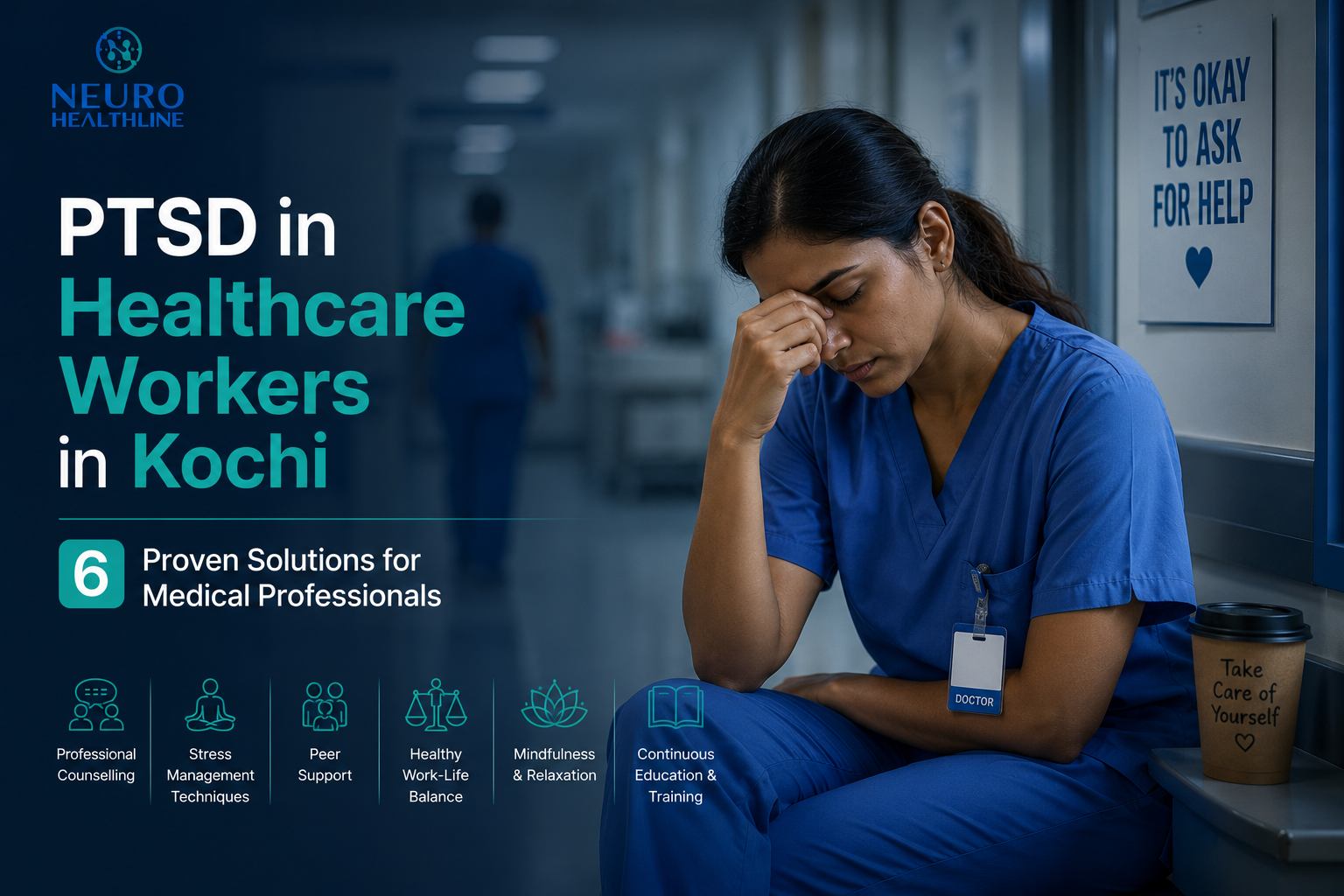
Kochi is home to some of Kerala’s largest and most demanding healthcare institutions — from major teaching hospitals and multispecialty centres to emergency care facilities and community clinics. The professionals who work within these environments — doctors, nurses, paramedics, surgical teams, intensive care staff, and emergency responders — carry an invisible burden that rarely gets acknowledged. PTSD in healthcare workers in Kochi is far more prevalent than most people realise, and yet it remains significantly underdiagnosed and undertreated, partly because the very culture of healthcare discourages professionals from acknowledging their own psychological distress. At NeuroHealthline, we recognise the unique nature of occupational trauma in medical settings and offer a clinically advanced, stigma-free approach to PTSD in healthcare workers in Kochi that respects the demands and identity of medical professionals while delivering genuine, lasting recovery.
Why Healthcare Workers in Kochi Are Particularly Vulnerable to PTSD
Healthcare workers face a distinctive combination of traumatic stressors that few other professions encounter with comparable frequency or intensity. In Kochi’s busy hospitals and emergency departments, medical professionals regularly witness patient suffering, death, and medical emergencies — often under conditions of extreme time pressure, insufficient resources, and the expectation of maintaining complete professional composure throughout. PTSD in healthcare workers in Kochi develops not only from dramatic single incidents such as mass casualty events or traumatic patient deaths, but also from the accumulative weight of repeated, smaller exposures to suffering and loss over months and years of clinical practice.
This cumulative or secondary traumatic stress — sometimes called compassion fatigue when it specifically involves absorbing patients’ emotional pain — can gradually erode a healthcare professional’s psychological resilience without any single identifiable triggering event. The result is a presentation of PTSD in healthcare workers in Kochi that often looks different from textbook PTSD, making it harder to recognise and easier to dismiss as simply “part of the job.”
Beyond direct patient care, healthcare workers in Kochi also navigate significant systemic stressors — long shifts, staffing shortages, administrative pressure, and the moral distress of making difficult clinical decisions under constraint. Each of these factors compounds the neurological and physiological burden carried by medical professionals, increasing their vulnerability to PTSD in healthcare workers in Kochi significantly.
How PTSD in Healthcare Workers in Kochi Presents Differently
Because medical culture in Kochi — as in most of India — emphasises stoicism, professionalism, and prioritising patient welfare above personal wellbeing, PTSD in healthcare workers in Kochi frequently manifests in ways that are easy to rationalise or overlook. Common presentations include emotional detachment from patients as a self-protective strategy, a gradual erosion of empathy and compassion that distresses the professional themselves, increasing cynicism about the healthcare system or the value of one’s work, intrusive memories of specific patient cases or outcomes that surface unexpectedly, persistent guilt over clinical decisions or patient deaths, heightened anxiety before shifts or in clinical environments, difficulty “switching off” mentally after leaving the hospital, and physical symptoms including chronic fatigue, tension headaches, and disrupted sleep.
Many healthcare professionals seeking treatment for PTSD in healthcare workers in Kochi initially present with burnout, generalised anxiety, or depression — and while these often co-exist, the underlying driver is frequently unrecognised and unprocessed occupational trauma.
6 Proven Solutions for PTSD in Healthcare Workers in Kochi
1. Occupational Trauma Assessment
Treatment for PTSD in healthcare workers in Kochi begins with a thorough assessment that specifically maps occupational trauma exposure, cumulative stress load, and the physiological signatures of trauma in the nervous system — including QEEG brain mapping and HRV profiling. This ensures treatment is designed around the specific nature of healthcare-related trauma rather than applying generic PTSD protocols.
2. Sensory-Enhanced Psychotherapy
Our sensory-enhanced psychotherapy approach is particularly well-suited for PTSD in healthcare workers in Kochi because it allows the nervous system to regulate and decompress without requiring detailed verbal recounting of traumatic clinical experiences — which many medical professionals find retraumatising. Vibroacoustic therapy, zero gravity therapy, and aromatherapy create genuine physiological calm that hard-working medical professionals rarely experience.
3. HRV Biofeedback for Clinical Resilience
HRV biofeedback therapy trains the autonomic nervous system to recover more efficiently from the acute stress spikes that define a healthcare worker’s shift — making it both a treatment for existing PTSD in healthcare workers in Kochi and a practical resilience-building tool for ongoing clinical demands.
4. HEG Neurofeedback for Emotional Regulation
PTSD in healthcare workers in Kochi often involves significant impairment in emotional regulation capacity — the ability to remain compassionately present with patients while managing one’s own internal distress. HEG neurofeedback directly trains prefrontal cortex regulation, helping rebuild this critical clinical and personal capacity.
5. Trauma-Informed Neuropsychotherapy
Our neuropsychotherapy component for PTSD in healthcare workers in Kochi is specifically adapted for medical professionals, acknowledging the particular moral, ethical, and emotional dimensions of healthcare-related trauma — including issues of clinical responsibility, systemic constraints, and the complex relationship between professional identity and personal suffering.
6. Burnout and Compassion Fatigue Recovery
Given the frequent co-occurrence of PTSD and burnout in medical professionals, PTSD in healthcare workers in Kochi at NeuroHealthline incorporates functional nutrition assessment, circadian realignment, and nervous system restoration protocols — addressing the physiological depletion that typically accompanies long-term occupational trauma in healthcare settings.
Breaking the Stigma Around PTSD in Healthcare Workers in Kochi
One of the most significant barriers to treatment for PTSD in healthcare workers in Kochi is the deeply ingrained professional culture that equates seeking help with weakness or incompetence. Medical professionals are trained to be the helpers, not the ones who need help — and this identity can make acknowledging PTSD feel threatening to one’s sense of professional competence and worth. At NeuroHealthline, our approach to PTSD in healthcare workers in Kochi is deliberately stigma-free and label-free, framing treatment not as an admission of weakness but as a precisely targeted, science-based intervention to restore a highly skilled professional’s capacity to continue performing at their best. Seeking treatment for PTSD in healthcare workers in Kochi is not a career risk — it is a professional investment in sustainable, long-term clinical performance.
Why Choose NeuroHealthline for PTSD in Healthcare Workers in Kochi?
According to NCBI PubMed, healthcare workers are among the highest-risk occupational groups for PTSD and secondary traumatic stress globally, with rates significantly elevated among intensive care, emergency medicine, and oncology professionals. The World Health Organization recognises occupational trauma as a significant driver of PTSD presentations worldwide, particularly among frontline healthcare professionals. NeuroHealthline’s approach to PTSD in healthcare workers in Kochi is built on this evidence, delivering a non-pharmacological, neuroscience-based program that addresses the specific nature of healthcare occupational trauma while respecting the unique pressures and identity of medical professionals.
For healthcare workers dealing with broader burnout and exhaustion alongside PTSD, our trauma recovery without medication program and burnout treatment in Kochi programs address these overlapping dimensions comprehensively