


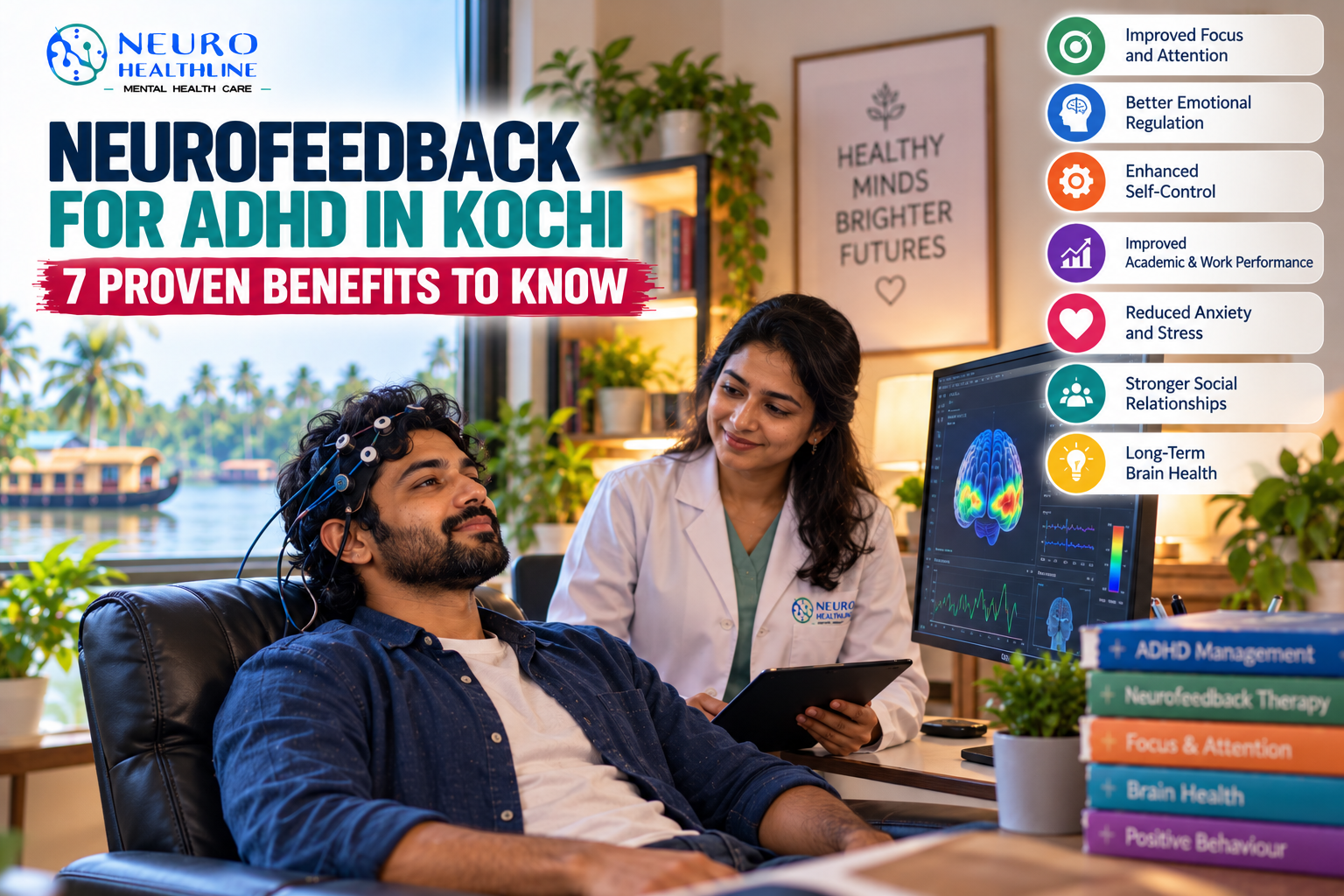
For families and individuals in Kochi seeking an effective, evidence-based, medication-free approach to ADHD — whether for a child who cannot sustain attention in school, a teenager whose academic potential is being blocked by executive function difficulties, or an adult who has finally recognised that decades of struggling to focus, organise, and follow through reflect a neurological condition rather than a character failing — neurofeedback for ADHD in Kochi at NeuroHealthline represents the most clinically advanced and most comprehensively supported non-pharmacological option available in Kerala today.
Neurofeedback for ADHD has one of the strongest evidence bases of any non-pharmacological intervention in the entire field of ADHD treatment — with multiple peer-reviewed meta-analyses confirming its efficacy for improving attention regulation, impulse control, and executive function through direct neurological retraining rather than chemical symptom management. At NeuroHealthline in Kochi, this evidence base is delivered through a QEEG-guided, individually personalised neurofeedback program that targets each client’s specific brainwave patterns — making every session precisely relevant to that individual’s neurological profile rather than applying a generic protocol to all ADHD presentations.
What Makes Neurofeedback for ADHD in Kochi Clinically Distinct
Neurofeedback for ADHD in Kochi at NeuroHealthline differs from generic ADHD support in one fundamental way: it addresses the neurological condition directly rather than managing its symptoms. ADHD is characterised by specific, measurable brainwave dysregulation — typically elevated theta wave activity (associated with daydreaming and inattention) and reduced beta wave activity (associated with alert, focused engagement) in the frontal regions of the brain. These patterns are directly visible in a QEEG brain map — and neurofeedback for ADHD in Kochi is specifically designed to correct them.
During neurofeedback sessions, sensors on the scalp provide real-time feedback about the client’s brainwave patterns. When the brain produces the target brainwave activity associated with focused, regulated attention, it receives a positive feedback signal. Over repeated sessions, the brain learns to produce and sustain these patterns more reliably — not because it has been told to, but because neuroplastic reinforcement has strengthened the neural circuits that generate them. This is neurofeedback for ADHD in Kochi as genuine brain training — not symptom suppression. Research published on NCBI PubMed confirms that neurofeedback for ADHD produces lasting improvements in attention and executive function that persist after treatment completion — an outcome that medication alone consistently fails to deliver.
7 Proven Benefits of Neurofeedback for ADHD in Kochi
1. Improved Sustained Attention
The most directly targeted and most consistently demonstrated benefit of neurofeedback for ADHD in Kochi is measurable improvement in sustained attention — the capacity to maintain focus on a task for the duration required to complete it effectively. Parents of children undergoing neurofeedback for ADHD in Kochi regularly report improvements in school performance, homework completion, and classroom engagement within 10 to 20 sessions.
2. Reduced Impulsivity
Neurofeedback for ADHD in Kochi directly strengthens the prefrontal inhibitory control circuits that modulate impulsive responses — producing measurable reductions in impulsive behaviour, improved capacity to pause before responding, and better decision-making quality that parents, teachers, and the clients themselves recognise across both academic and social contexts.
3. Enhanced Working Memory
Working memory — the capacity to hold and manipulate information in real time — is one of the executive functions most consistently impaired in ADHD and most directly improved through neurofeedback for ADHD in Kochi. Improved working memory produces downstream benefits across academic performance, professional effectiveness, and daily life organisation that clients describe as among the most practically significant outcomes of their program.
4. Improved Emotional Regulation
The emotional dysregulation that ADHD produces — the rapid, intense emotional responses to frustration and perceived failure that so significantly affect relationships and professional functioning — is directly addressed through the prefrontal strengthening that neurofeedback for ADHD in Kochi delivers. Clients consistently report improved emotional composure, reduced reactivity to minor triggers, and better capacity to manage interpersonal situations that previously generated disproportionate emotional responses.
5. Better Sleep Quality
The sleep difficulties that are extremely prevalent in ADHD — difficulty settling at night, resistance to sleep onset, and poor sleep quality — are significantly improved through neurofeedback for ADHD in Kochi, as the regulatory brainwave training that neurofeedback delivers also improves the brain’s capacity to transition efficiently into the slower-wave states required for restorative sleep.
6. Lasting Results Without Medication
One of the most clinically significant benefits of neurofeedback for ADHD in Kochi is the durability of its outcomes — with research demonstrating that the neurological changes produced persist after the program is complete, without requiring continued intervention to maintain. This durability distinguishes neurofeedback from stimulant medication — which requires continued use to maintain its effects and produces no lasting neurological change.
7. Measurable, Data-Driven Progress
Neurofeedback for ADHD in Kochi at NeuroHealthline provides objective, quantifiable evidence of neurological change through periodic QEEG assessments throughout the program — allowing both the clinical team and the client to track real, measurable improvement in brain function rather than relying solely on subjective report. This data-driven accountability resonates particularly strongly with the scientifically minded adults and parents in Kochi’s professional population who seek evidence of clinical progress.
Who Is Neurofeedback for ADHD in Kochi Best Suited For?
Neurofeedback for ADHD in Kochi is suitable for children, teenagers, and adults across all ADHD presentations — combined, predominantly inattentive, and predominantly hyperactive-impulsive. It is particularly well-suited for individuals and families seeking a medication-free approach; those who have tried medication but experienced inadequate results or unacceptable side effects; children and teenagers whose parents prefer a neurological training approach to pharmaceutical management during developmentally critical years; adults who have recently received a first-time ADHD diagnosis and are exploring treatment options; and individuals in high-performance professional contexts — including Kochi’s IT and healthcare sectors — for whom the cognitive side effects of stimulant medication create professional concerns.
Our dedicated ADHD treatment in Kochi and ADHD in adults Kerala programs provide the comprehensive clinical framework within which neurofeedback for ADHD in Kochi is delivered — combining QEEG-guided neurofeedback with HRV biofeedback therapy, functional nutrition, and neuropsychotherapy for a whole-system approach to ADHD treatment.
What to Expect From Your Neurofeedback for ADHD Program in Kochi
Every neurofeedback for ADHD in Kochi program at NeuroHealthline follows a structured, evidence-based sequence. It begins with a comprehensive QEEG brain mapping assessment that identifies the specific brainwave patterns characterising your or your child’s ADHD — creating the individual neurological profile that guides every subsequent training session. From this baseline, a personalised neurofeedback protocol is designed — targeting the specific frequency imbalances most relevant to the presenting ADHD pattern.
Sessions are typically 30 to 45 minutes, conducted two to three times per week for an initial program of 20 to 40 sessions depending on ADHD severity and individual response rate. Each session involves comfortable sensor placement on the scalp and a simple engagement task — watching a screen or listening to audio — while the neurofeedback system monitors brainwave activity and provides real-time feedback. The experience is non-invasive, painless, and requires no special preparation. Many clients and parents report noticing initial changes in attention and behaviour within 10 to 15 sessions, with more comprehensive and lasting neurological change consolidating across a full program. The World Health Organization recognises neurodevelopmental conditions including ADHD as global health priorities requiring evidence-based treatment — the standard neurofeedback for ADHD in Kochi at NeuroHealthline is built to meet.
FAQ — Neurofeedback for ADHD in Kochi
How many sessions of neurofeedback for ADHD in Kochi will my child need?
Most programs consist of 20 to 40 sessions, conducted 2 to 3 times per week, over 10 to 20 weeks. The exact number depends on ADHD severity, individual neurological profile, and treatment response — determined through periodic QEEG reassessment during the program.
Can neurofeedback for ADHD in Kochi be used alongside existing medication?
Yes. Neurofeedback for ADHD can be integrated alongside current medication management, and many clients find that consistent neurofeedback training allows their prescribing physician to review and reduce medication dosage over time. Any medication changes should always involve the prescribing doctor.
Is neurofeedback for ADHD in Kochi safe for children?
Yes — neurofeedback is completely non-invasive, involves no electrical stimulation, and carries no known adverse effects. It is among the safest clinical interventions available for ADHD in children and teenagers, and is recommended by leading international neurodevelopmental organisations as a first-line non-pharmacological treatment.
Will results from neurofeedback for ADHD last after the program ends?
Yes. Unlike medication — which requires continued use to maintain symptom management — neurofeedback produces neuroplastic changes in brainwave patterns that are self-sustaining after the program is complete. Long-term follow-up studies consistently show maintained improvements in attention and executive function 12 to 24 months post-treatment.
How does NeuroHealthline’s neurofeedback for ADHD in Kochi differ from other providers?
NeuroHealthline uses QEEG-guided neurofeedback — meaning every training protocol is individually designed from each client’s specific brain map, rather than applying a generic ADHD protocol across all clients. This precision significantly improves both the speed and the durability of training outcomes.