


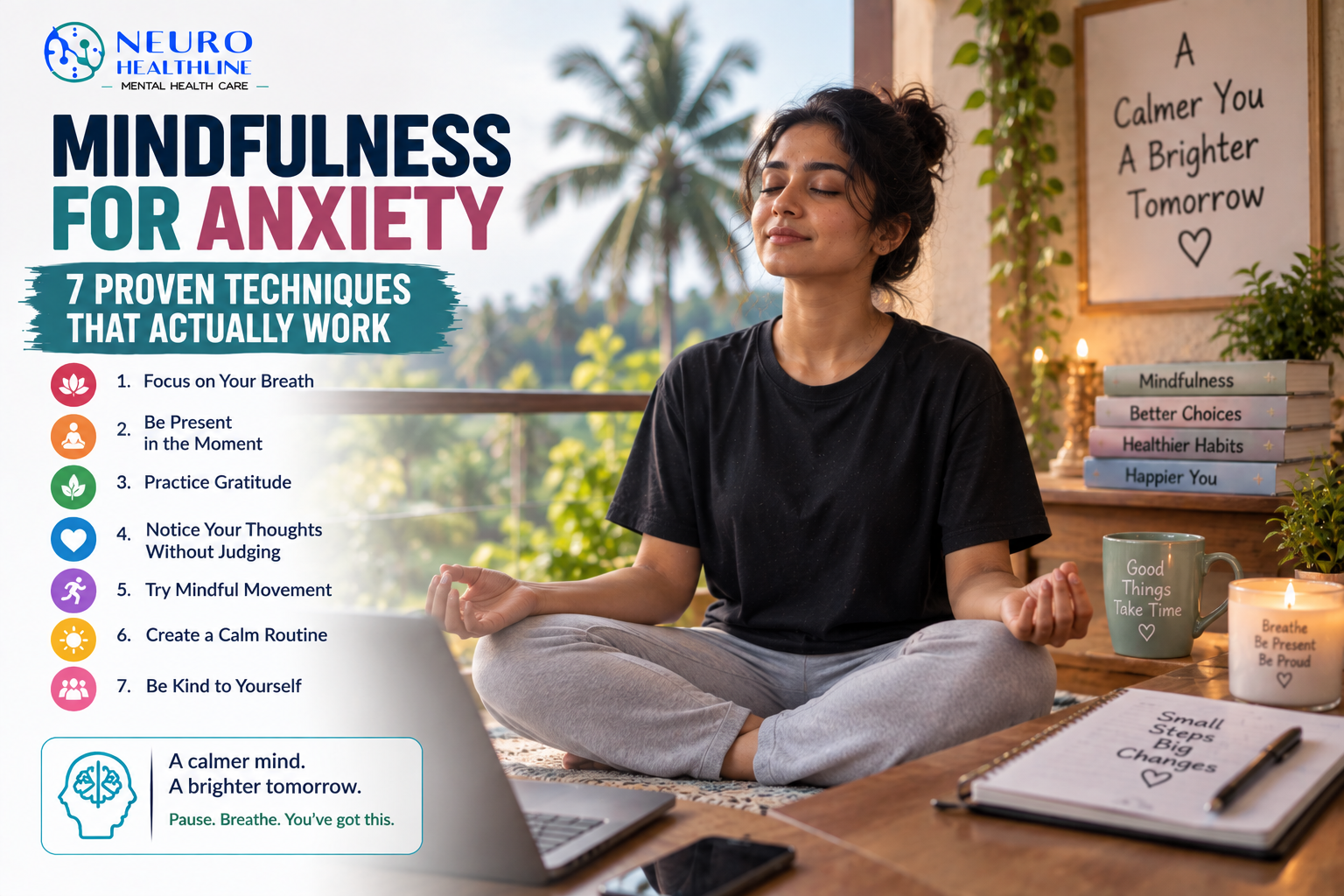
Mindfulness has gone from a fringe contemplative practice to a mainstream mental health recommendation in the space of a decade — recommended by therapists, endorsed by corporate wellness programs, packaged in apps, prescribed by general practitioners, and discussed in virtually every mental health conversation happening today. And yet, for many people who have tried it, the honest answer to “does mindfulness help with anxiety?” is: “sometimes, sort of, but not in the way I hoped, and I am not sure I am doing it right.” This ambivalence is not a personal failure. It reflects the gap between mindfulness as it is typically encountered — as an app-delivered breathing exercise or a ten-minute morning meditation — and mindfulness as a genuinely neurologically grounded practice that, when applied correctly and consistently, produces measurable changes in the specific brain circuits that generate anxiety.
At NeuroHealthline, mindfulness for anxiety is understood not as a spiritual practice or a relaxation technique but as a neurologically active intervention that, when delivered within an appropriate clinical framework, directly modifies the amygdala-prefrontal connectivity patterns that drive anxiety disorders. Understanding the neuroscience of mindfulness for anxiety — why it works, which techniques are most evidence-supported, and how to integrate it within a comprehensive anxiety treatment approach — is the foundation for using it effectively rather than frustratingly.
The Neuroscience of Mindfulness for Anxiety — Why It Actually Works
The clinical effectiveness of mindfulness for anxiety is not simply a matter of relaxation. When mindfulness is practised consistently and correctly, it produces measurable structural and functional changes in the brain — changes that directly address the neural mechanisms generating anxiety. Research published on NCBI PubMed has documented that sustained mindfulness practice produces increased grey matter density in the prefrontal cortex and hippocampus, reduced grey matter density in the amygdala — reflecting reduced threat-detection reactivity — and strengthened connectivity between the prefrontal cortex and amygdala, improving the prefrontal cortex’s regulatory control over the amygdala’s anxiety-generating responses.
These structural changes reflect genuine, lasting neurological remodelling rather than temporary states of relaxation. Mindfulness for anxiety works not because it relaxes the anxious person in the moment — though it often does — but because consistent practice progressively remodels the neural architecture that generates anxiety in the first place. This is why mindfulness for anxiety needs to be understood as a neurological training practice rather than a relaxation tool — one that requires consistency, correct technique, and appropriate clinical context to produce its most significant effects.
Why Mindfulness Alone Is Often Insufficient for Clinical Anxiety
Before presenting the seven proven techniques, it is important to be clinically honest about one crucial limitation of mindfulness for anxiety: for clinical anxiety disorders — anxiety that significantly impairs daily functioning, involves panic attacks, or has become entrenched in the nervous system over years — mindfulness alone is typically insufficient as a standalone treatment. The neurological remodelling that mindfulness produces, while genuine, occurs gradually over months of consistent practice — and the degree of amygdala hyperreactivity present in clinical anxiety may require more targeted neurological intervention than mindfulness alone can adequately address.
This is precisely why NeuroHealthline integrates mindfulness for anxiety within a comprehensive clinical framework that also includes HEG neurofeedback to directly accelerate the prefrontal-amygdala regulatory strengthening that mindfulness approaches more gradually; HRV biofeedback therapy to address the autonomic nervous system dimension of anxiety that mindfulness modulates less directly; and clinical neuropsychotherapy to address the cognitive and attachment patterns maintaining anxiety. Our anxiety treatment in Kochi program integrates all of these approaches — with mindfulness as a powerful component rather than a sole treatment. For those whose anxiety has progressed to specific clinical presentations, our generalised anxiety disorder treatment, social anxiety treatment, and panic attack treatment in Kochi programs provide the clinical depth that mindfulness alone cannot deliver.
7 Proven Mindfulness Techniques for Anxiety That Actually Work
1. Breath-Focused Attention — The Foundation
The most fundamental and most evidence-supported mindfulness for anxiety practice is breath-focused attention — the deliberate, non-judgmental direction and redirection of attention to the physical sensations of breathing. This practice works neurologically by activating the prefrontal cortex’s attentional control systems, reducing the amygdala’s ruminative threat-processing through attentional redirection, and activating the parasympathetic nervous system through the respiratory rate modulation that slower, more deliberate breathing produces. The key to effectiveness is the quality of attentional redirection rather than the absence of distraction — noticing when attention has been captured by anxious thought and gently returning it to the breath, repeatedly, trains the prefrontal cortex’s attention regulation in exactly the same way that physical exercise trains a muscle.
2. Body Scan Meditation for Somatic Anxiety
Body scan meditation — the systematic, non-judgmental direction of attention through different body regions, observing physical sensations without attempting to change them — is particularly effective for the somatic dimension of anxiety, addressing the relationship between physical symptoms of anxiety and the catastrophic misinterpretation that amplifies them. By practicing observing physical sensations without immediately triggering threat responses, the body scan progressively desensitises the interoceptive system to the bodily signals that anxiety has been treating as threatening — directly addressing the somatic anxiety cycle.
3. Observing Thoughts Without Fusion
One of the most neurologically significant mindfulness for anxiety practices is the deliberate cultivation of a non-fused relationship with anxious thoughts — observing them as mental events rather than facts, creating the cognitive distance between the thought and the thinker that allows prefrontal evaluation rather than amygdala-driven fusion. The technique of labelling thoughts — noting “I am having the thought that…” rather than directly engaging with the thought’s content — activates the prefrontal cortex’s metacognitive systems and reduces the amygdala’s direct response to thought content.
4. STOP Practice for Acute Anxiety
The STOP practice — Stop, Take a breath, Observe, Proceed — is one of the most practically applicable mindfulness for anxiety techniques for managing acute anxiety episodes in real-world situations. This four-step micro-practice interrupts the automatic escalation of acute anxiety by inserting a deliberate moment of prefrontal engagement between the anxiety trigger and the anxiety response — creating the neurological space that allows response choice rather than automatic reaction.
5. Compassionate Self-Observation for Self-Critical Anxiety
For the large proportion of anxiety presentations that involve significant self-criticism — the harsh self-evaluation that characterises perfectionism, social anxiety, and health anxiety — mindfulness for anxiety specifically incorporating self-compassion practices produces superior outcomes to attention-focused practices alone. Meeting anxious self-criticism with the same warmth and understanding one would offer a distressed friend activates the brain’s caregiving systems, reducing the stress response that self-criticism generates and progressively building a more compassionate internal relationship that reduces the shame-driven anxiety that self-criticism maintains.
6. Mindful Physical Movement for Body-Based Anxiety
For individuals whose anxiety is strongly somatically held — whose anxiety manifests most prominently in physical tension, chronic muscular holding, and physiological hyperarousal — mindfulness for anxiety through mindful movement practices including yoga, tai chi, and mindful walking produces superior outcomes to seated meditation practices alone. These practices combine the attentional training of mindfulness with the direct physiological benefits of movement — addressing both the neural and the somatic dimensions of anxiety simultaneously.
7. Consistent Practice Over Intensity
Perhaps the most practically important evidence-based insight about mindfulness for anxiety is that consistency of practice matters significantly more than intensity. Research demonstrates that ten to twenty minutes of daily mindfulness practice produces substantially more neurological benefit than occasional longer sessions — because the neurological remodelling that mindfulness produces is a function of regular repetition rather than acute dose. Building a sustainable, consistent daily practice — even when imperfect, even when distraction is frequent, even when the benefits are not immediately perceptible — is the single most important determinant of whether mindfulness for anxiety will produce genuine neurological change.
Mindfulness for Anxiety in Kerala’s Cultural Context
Mindfulness for anxiety carries a particular cultural resonance and a particular cultural complexity in the Kerala context. The roots of mindfulness practice in Buddhist and Vedic traditions mean that many people in Kerala have some cultural familiarity with meditation and contemplative practice — which can facilitate engagement with mindfulness-based anxiety intervention. At the same time, the cultural separation between traditional spiritual practice and contemporary clinical mindfulness can create confusion about whether mindfulness for anxiety is a spiritual practice, a medical intervention, or something else entirely.
At NeuroHealthline, we present mindfulness for anxiety as what the neuroscience confirms it to be — a neurological training practice with measurable brain-based effects, whose origins in contemplative tradition do not limit or contradict its clinical applicability. Whether practised within a devotional spiritual framework or as a purely secular neurological training discipline, the brain-based mechanisms that make mindfulness for anxiety effective operate identically. The World Health Organization recognises mindfulness-based interventions as evidence-based components of comprehensive mental health care — the clinical standard that NeuroHealthline’s integration of mindfulness within its anxiety treatment programs is built to uphold.
FAQ — Mindfulness for Anxiety
How long does it take for mindfulness to reduce anxiety?
Research suggests that consistent daily mindfulness practice produces measurable reductions in self-reported anxiety within 8 weeks — with the structural brain changes associated with anxiety reduction consolidating over 3 to 6 months of sustained practice. Early benefits, including reduced acute anxiety episodes and improved emotional regulation, often appear sooner.
Is mindfulness for anxiety suitable for all types of anxiety disorders?
Mindfulness has evidence for all major anxiety presentations — including generalised anxiety, social anxiety, panic disorder, and health anxiety. For clinical anxiety disorders, mindfulness is most effective as a component of comprehensive treatment rather than a standalone intervention.
Can mindfulness for anxiety replace medication?
For some individuals with mild to moderate anxiety, mindfulness-based interventions have produced outcomes comparable to medication in research studies. For clinical anxiety disorders, mindfulness is most effective integrated within comprehensive neuroscience-based treatment rather than as a medication replacement — which should always be discussed with a prescribing physician.
Why does mindfulness sometimes seem to increase anxiety initially?
Some individuals experience increased awareness of anxious thoughts and bodily sensations when they first begin mindfulness practice — a normal consequence of turning attention toward internal experience that was previously being avoided or suppressed. This initial intensification typically resolves with continued practice as the capacity to observe without fusion develops.
How is mindfulness at NeuroHealthline different from mindfulness apps?
NeuroHealthline integrates mindfulness for anxiety within a comprehensive clinical framework that also includes neurofeedback, biofeedback, and neuropsychotherapy — addressing the neurological mechanisms generating anxiety at multiple levels simultaneously rather than relying on mindfulness as a standalone self-help tool.