


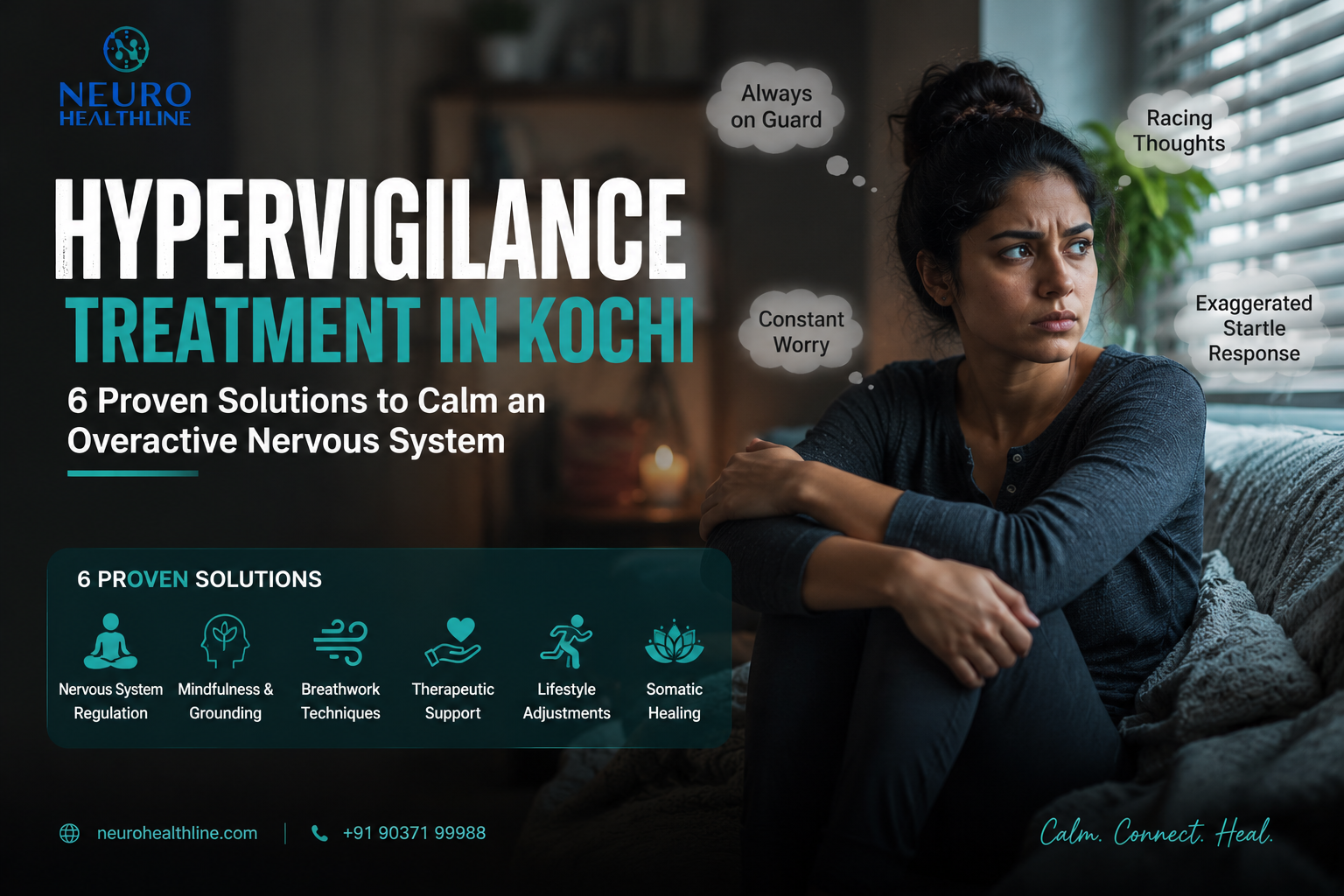
If you find yourself constantly scanning your environment for threats, startling easily at unexpected sounds, struggling to sit with your back to a door, or simply never feeling fully relaxed even in situations others describe as calm and safe — you may be experiencing hypervigilance. Hypervigilance treatment in Kochi is one of the most sought-after interventions at NeuroHealthline, because this symptom profoundly affects quality of life, relationships, sleep, and professional performance, yet is frequently misunderstood or dismissed as simply being “overly anxious” or “too sensitive.” Hypervigilance is not a personality trait or a character flaw — it is a measurable neurological state in which the brain’s threat-detection system has become chronically overactivated, often as a result of past trauma, prolonged stress, or sustained exposure to unpredictable environments. Understanding this distinction is the first step toward effective hypervigilance treatment in Kochi.
What Is Hypervigilance? Understanding the Neuroscience
Hypervigilance is a state of heightened sensory sensitivity and threat awareness that develops when the amygdala — the brain’s primary threat-detection centre — becomes chronically overactivated. In a healthy nervous system, the amygdala activates in response to genuine danger and then deactivates once the threat has passed, allowing the prefrontal cortex to reassert rational, calm assessment of the environment. In hypervigilance, this deactivation fails to occur reliably, leaving the nervous system in a persistent state of alert that treats neutral or safe stimuli as potentially threatening.
This neurological pattern is commonly associated with PTSD, complex trauma, and prolonged stress, but can also develop in individuals who grew up in unpredictable or unsafe environments — where vigilance was genuinely adaptive and necessary for safety. The problem is that once established, this pattern persists even after the original threat environment is long gone. This is precisely why hypervigilance treatment in Kochi must directly address the brain and nervous system — because willpower and positive thinking alone cannot retrain an amygdala that has been calibrated toward chronic threat detection.
Research published on NCBI PubMed confirms that hypervigilance reflects measurable dysregulation in amygdala-prefrontal connectivity, supporting the need for neurologically targeted treatment rather than purely behavioural approaches.
Signs That You May Need Hypervigilance Treatment in Kochi
Many people living with hypervigilance have normalised their experience to such a degree that they don’t recognise it as a treatable condition. Common signs that indicate a need for hypervigilance treatment in Kochi include a persistent inability to fully relax, even in objectively safe environments; constantly scanning rooms for exits, threats, or potential dangers; an exaggerated startle response to sudden noises, movements, or unexpected touches; difficulty concentrating because attention is perpetually diverted to monitoring the environment; sleeping lightly and waking easily, with the body remaining partially alert even during rest; physical tension held chronically in the shoulders, jaw, or abdomen; difficulty trusting others or feeling safe in close relationships; and a pervasive sense that something bad is about to happen, even without a specific identifiable threat.
If several of these resonate, hypervigilance treatment in Kochi can help identify the neurological and physiological drivers of your specific presentation and address them directly.
How Hypervigilance Affects Daily Life in Kochi
For professionals working in Kochi’s demanding corporate, healthcare, and academic environments, hypervigilance creates a particularly significant burden. The constant background processing required to monitor for threats depletes cognitive resources that would otherwise be available for focus, creativity, and decision-making — contributing to mental fatigue, reduced performance, and difficulty sustaining attention across a working day. Social functioning is also significantly affected, as hypervigilance can make crowded public spaces, noisy environments, and large gatherings feel genuinely overwhelming rather than simply uncomfortable. Relationships suffer when a partner or family member cannot understand why someone experiencing hypervigilance consistently seems on edge, reactive, or unable to simply relax and enjoy calm moments together. Sleep is chronically disrupted because the nervous system struggles to fully deactivate at night. Over time, the cumulative physiological cost of sustained hypervigilance — elevated cortisol, disrupted sleep, chronic muscular tension, and impaired digestion — takes a significant toll on overall health. Effective hypervigilance treatment in Kochi addresses all of these dimensions simultaneously rather than treating each consequence in isolation.
6 Proven Solutions in Our Hypervigilance Treatment in Kochi Program
1. QEEG Brain Mapping and HRV Assessment
Hypervigilance treatment in Kochi begins with a comprehensive assessment of nervous system functioning, including QEEG brain mapping to identify the specific overactive neural patterns driving your hypervigilance, and HRV profiling to measure autonomic nervous system dysregulation. This data ensures every subsequent intervention is precisely targeted rather than generic.
2. HRV Biofeedback
HRV biofeedback therapy is one of the most powerful tools in hypervigilance treatment in Kochi, directly training the autonomic nervous system to shift out of chronic sympathetic dominance and into genuine parasympathetic regulation. Over repeated sessions, this builds a measurable, lasting improvement in the nervous system’s capacity to deactivate the threat response when no genuine danger is present.
3. HEG Neurofeedback
By strengthening prefrontal cortex activation and its regulatory influence over the amygdala, HEG neurofeedback is a cornerstone of hypervigilance treatment in Kochi. As prefrontal regulation improves, the amygdala’s threshold for triggering the threat response rises — meaning the same neutral stimuli that previously triggered alarm begin to be processed as genuinely safe.
4. Sensory-Enhanced Psychotherapy
Our sensory-enhanced psychotherapy approach — combining vibroacoustic therapy, zero gravity therapy, and aromatherapy with therapeutic dialogue — creates a physiological experience of deep safety that directly counteracts the chronic threat state underlying hypervigilance. Many clients undergoing hypervigilance treatment in Kochi describe their first vibroacoustic therapy session as the first time they have felt genuinely calm in years.
5. Vibroacoustic Therapy for Somatic Release
Hypervigilance stores significant tension in the body — in the jaw, shoulders, diaphragm, and abdomen. Vibroacoustic therapy delivers low-frequency sound vibrations that physically release this held tension, supporting the nervous system’s transition out of a persistent state of physical preparedness for threat. This somatic component of hypervigilance treatment in Kochi is often what produces the most immediate and tangible relief for clients.
6. Trauma-Informed Neuropsychotherapy
Because hypervigilance most commonly develops in response to past trauma or prolonged exposure to unsafe environments, hypervigilance treatment in Kochi includes trauma-informed neuropsychotherapy to address the underlying experiences and beliefs that keep the nervous system calibrated toward threat detection. This therapeutic component works alongside physiological regulation to produce genuine, whole-system change rather than surface-level symptom management.
Why Hypervigilance Treatment in Kochi Requires a Nervous System Approach
One of the most common mistakes people make when attempting to address hypervigilance is trying to think their way out of it. Cognitive strategies — reminding yourself that you are safe, that the environment is not threatening, that there is no real danger — have limited effectiveness against hypervigilance because the problem is not primarily cognitive. The amygdala operates largely below conscious awareness, generating threat responses faster than the prefrontal cortex can evaluate and override them. This is why hypervigilance treatment in Kochi at NeuroHealthline prioritises direct nervous system interventions — because changing the physiological state changes the experience far more effectively than reasoning alone. Once the nervous system learns through direct experience that it is safe to deactivate the threat response, cognitive and behavioural changes follow naturally as a consequence, rather than being effortfully applied against the grain of a still-hyperactivated nervous system.
Why Choose NeuroHealthline for Hypervigilance Treatment in Kochi?
NeuroHealthline’s hypervigilance treatment in Kochi brings together the most clinically validated nervous system regulation tools available — QEEG-guided neurofeedback, HRV biofeedback, vibroacoustic therapy, and trauma-informed neuropsychotherapy — in a stigma-free, label-free environment that respects your experience without pathologising it. Our partnership with MediTECH, Germany ensures our neurofeedback and biofeedback technologies meet rigorous international clinical standards. The World Health Organization recognises hypervigilance as a core symptom of PTSD requiring appropriately targeted, multimodal treatment — precisely the standard our hypervigilance treatment in Kochi program upholds.
For those whose hypervigilance is part of a broader PTSD presentation, our comprehensive PTSD treatment in Kochi program addresses hypervigilance within the full context of trauma recovery. For those dealing with childhood-rooted hypervigilance patterns, our childhood trauma treatment program provides a developmentally informed approach to the same underlying nervous system dysregulation.
Frequently Asked Questions About Hypervigilance Treatment in Kochi
How long does hypervigilance treatment in Kochi typically take to show results?
Many clients undergoing hypervigilance treatment in Kochi report a noticeable reduction in their baseline state of alertness within the first 6 to 10 sessions of HRV biofeedback and neurofeedback, with more substantial and lasting nervous system changes typically consolidating over a full program of 3 to 6 months.
Can hypervigilance treatment in Kochi help if I have never experienced an obvious traumatic event?
Yes. While hypervigilance is commonly associated with identifiable trauma, it can also develop through prolonged exposure to unpredictable or unsafe environments, chronic stress, or difficult childhood circumstances that may not feel dramatic but nonetheless shaped the nervous system’s baseline calibration toward threat detection.
Is hypervigilance treatment in Kochi suitable for children and teenagers?
Yes. Hypervigilance treatment in Kochi can be adapted for younger clients, particularly adolescents whose hypervigilance is affecting academic performance, social functioning, or sleep.
Can I continue working while undergoing hypervigilance treatment in Kochi?
Yes. Sessions are scheduled flexibly to accommodate working professionals, and many clients find that even early improvements in nervous system regulation produce noticeable benefits in workplace focus and stress tolerance.
Is medication necessary for hypervigilance treatment in Kochi?
No. Our hypervigilance treatment in Kochi relies entirely on non-pharmacological nervous system regulation approaches — neurofeedback, biofeedback, vibroacoustic therapy, and neuropsychotherapy — producing lasting change without pharmaceutical dependency.