


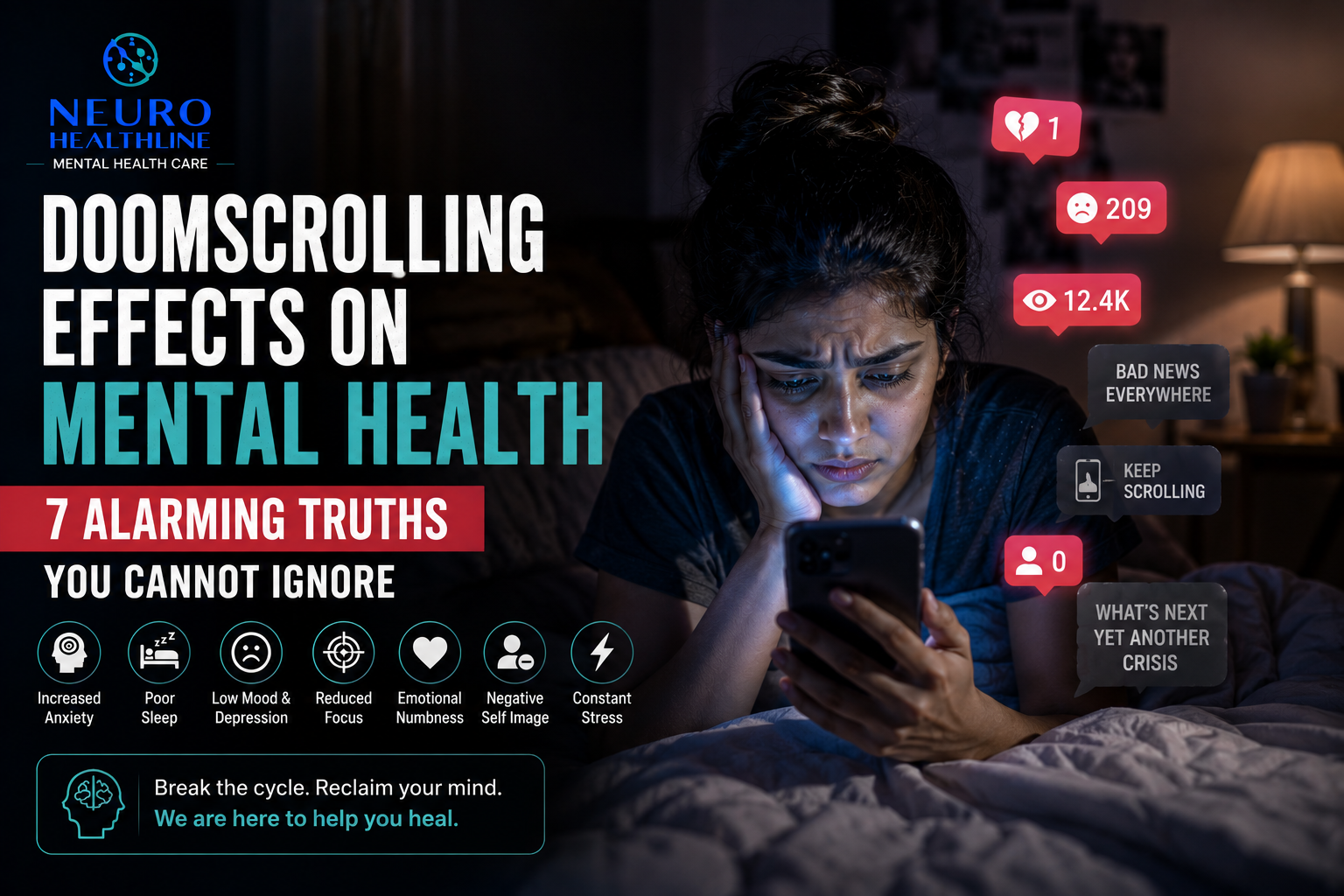
It is 11:30 at night. You have work tomorrow. You told yourself you would be asleep an hour ago. But here you are — phone in hand, scrolling through an endless feed of bad news, alarming headlines, social conflict, and catastrophic predictions about the future — feeling progressively worse with every swipe but somehow completely unable to stop. This is doomscrolling. And if it sounds familiar, you are not alone — and you are not weak. Doomscrolling effects on mental health are now one of the most urgent and most searched topics in digital wellbeing globally, as millions of people across the world are beginning to recognise that their compulsive consumption of negative online content is not simply a bad habit — it is measurably damaging their brain, their nervous system, their sleep, and their psychological wellbeing in ways that are only now being fully understood by neuroscience. At NeuroHealthline, we are seeing the doomscrolling effects on mental health reflected directly in the anxiety, depression, sleep disorders, and emotional dysregulation presentations of a growing number of clients across Kerala — and the clinical picture is deeply concerning.
What Exactly Is Doomscrolling?
Doomscrolling refers to the compulsive consumption of large quantities of negative, distressing, or alarming online content — typically through social media feeds, news apps, or video platforms — despite the awareness that doing so is making you feel worse. The term emerged prominently during the COVID-19 pandemic, when the combination of genuine existential threat, 24-hour news cycles, and prolonged smartphone dependency created the perfect conditions for compulsive negative content consumption to become a defining feature of daily life for hundreds of millions of people globally.
What distinguishes doomscrolling from ordinary news consumption is its compulsive, escalating character. The doomscroller is not simply staying informed — they are caught in a neurological loop in which anxiety drives content consumption in search of certainty or control, negative content activates the threat-detection system further, heightened threat activation drives further compulsive searching for information, and the cycle continues indefinitely — producing progressive emotional deterioration with no satisfying endpoint. Understanding this neurological loop is the foundation for understanding doomscrolling effects on mental health — because it reveals why the behaviour persists despite its clearly negative emotional consequences, and why willpower and self-discipline alone are consistently insufficient to break it.
The Neuroscience Behind Why We Doomscroll
The doomscrolling effects on mental health cannot be understood without first understanding why the human brain is so drawn to negative information in the first place. Negativity bias — the brain’s tendency to weight negative information more heavily than positive information of equivalent magnitude — is one of the most fundamental features of human cognition, deeply rooted in our evolutionary history as a species for whom attending to potential threats was literally a matter of survival. The brain that was alert to danger survived; the brain that was easily satisfied with positive information did not.
In the ancestral environment that shaped this bias, negative information was relatively rare and locally specific — a predator’s tracks, a rival tribe’s warning sign. In the contemporary digital environment, negative information is unlimited in quantity, globally sourced, algorithmically curated for maximum engagement, and available twenty-four hours a day on a device that most people sleep beside. The result is a negativity-biased brain in an environment of unlimited negative content supply — producing the doomscrolling effects on mental health that we are now seeing at population scale. According to NCBI PubMed, compulsive negative news consumption is significantly associated with increased anxiety, depression, and somatic stress symptoms — with the relationship being dose-dependent and bidirectional, meaning higher doomscrolling worsens mental health and poorer mental health drives more doomscrolling.
7 Alarming Doomscrolling Effects on Mental Health
1. Doomscrolling Chronically Activates the Threat Response
Every alarming headline, disturbing image, or catastrophic prediction that doomscrolling delivers activates the amygdala’s threat-detection response — releasing cortisol and adrenaline, increasing heart rate, and shifting the nervous system into sympathetic arousal. A single threat activation is manageable. Hours of continuous threat activation through doomscrolling produces the same physiological state as sustained chronic stress — maintaining cortisol levels that progressively damage the hippocampus, impair prefrontal regulatory function, and entrench the hypervigilant nervous system state that anxiety disorders are built upon. Doomscrolling effects on mental health at this level are not metaphorical — they are measurable neurological consequences of sustained amygdala activation.
2. Doomscrolling Destroys Sleep Architecture
The doomscrolling effects on mental health include a particularly damaging pathway through sleep. Late-night doomscrolling simultaneously suppresses melatonin through screen light exposure and generates intense psychological arousal through threat-activating content — making sleep onset physiologically impossible while the behaviour continues, and producing a cognitively hyperactivated state that persists well after the phone is put down. The resulting sleep disruption directly impairs emotional regulation, memory consolidation, immune function, and the cortisol rhythm that the HPA axis requires for next-day stress resilience — creating a progressive physiological deterioration that accumulates across weeks and months of nightly doomscrolling.
3. Doomscrolling Amplifies Anxiety Disorders
For individuals already experiencing anxiety, the doomscrolling effects on mental health are particularly severe. Doomscrolling feeds directly into the cognitive patterns that maintain anxiety disorders — providing an inexhaustible supply of threat-confirming information that validates catastrophic thinking, preventing the cognitive rest that anxiety recovery requires, and maintaining the hyperaroused nervous system state in which anxiety thrives. Many clients seeking anxiety treatment in Kochi at NeuroHealthline are, on clinical assessment, maintaining and amplifying their anxiety through doomscrolling patterns they have not yet identified as clinically relevant.
4. Doomscrolling Produces Learned Helplessness
One of the most psychologically damaging doomscrolling effects on mental health is the progressive development of learned helplessness — the cognitive state in which repeated exposure to uncontrollable negative events leads the brain to conclude that effort and action are futile. The global and systemic nature of the problems most prominently featured in doomscrolling content — climate change, political conflict, economic instability, public health crises — combined with the genuine individual powerlessness to affect them, creates precisely the conditions that produce learned helplessness at scale. The resulting apathy, loss of motivation, and nihilistic hopelessness are clinical features of depression — and doomscrolling is manufacturing them deliberately and at population scale.
5. Doomscrolling Impairs Attention and Cognitive Performance
The habitual high-speed consumption of short-form negative content that characterises doomscrolling progressively fragments the attentional system — reducing the capacity for the sustained, deep focus that effective work, study, creative engagement, and meaningful conversation all require. Doomscrolling effects on mental health include a measurable deterioration in attention span, working memory capacity, and the cognitive flexibility required for complex problem-solving — consequences that directly impair professional performance, academic achievement, and the quality of engagement with the real-world relationships and activities that sustain mental health.
6. Doomscrolling Produces Emotional Numbing and Compassion Fatigue
Paradoxically, sustained exposure to large volumes of distressing content through doomscrolling progressively reduces rather than increases emotional sensitivity to genuine suffering. The doomscrolling effects on mental health include a well-documented compassion fatigue response — in which the emotional system’s protective mechanisms progressively blunt the capacity for genuine empathy, moral engagement, and meaningful emotional response to real-world events and the people in one’s immediate life. The result is a psychological state that feels simultaneously overwhelmed by global suffering and paradoxically detached from genuine human connection.
7. Doomscrolling Creates a Distorted Reality
The algorithmically curated content environment of doomscrolling creates a systematically distorted picture of reality — one in which the most extreme, most alarming, and most emotionally activating content is consistently overrepresented relative to its actual prevalence in the world. Sustained exposure to this distorted reality progressively recalibrates the brain’s assessment of base rates — how dangerous the world actually is, how likely negative events are, how trustworthy other people are — in ways that directly drive anxiety, paranoia, and social withdrawal. This is one of the most insidious doomscrolling effects on mental health because it operates below conscious awareness, reshaping the brain’s model of reality without the individual recognising that the distortion is happening.
Who Is Most Vulnerable to Doomscrolling Effects on Mental Health?
While doomscrolling effects on mental health affect people across all age groups, certain populations carry heightened vulnerability. Teenagers and Gen Z — for whom smartphone use is ubiquitous, social media consumption is the primary mode of information access, and the negativity bias of the developing adolescent brain is particularly acute — are experiencing doomscrolling effects on mental health at a scale and intensity that represents a genuine public health emergency. The connection to broader Gen Z mental health challenges is direct and significant — doomscrolling is one of the primary mechanisms through which the Gen Z mental health crisis is being maintained and amplified.
Highly conscientious individuals — those with a strong sense of responsibility for global events and a tendency toward information-seeking as a coping strategy for anxiety — are particularly vulnerable to the doomscrolling loop, as their conscientious motivations make it genuinely difficult to disengage from distressing content without feeling irresponsible or uninformed. And individuals already experiencing anxiety and depression are caught in the most damaging iteration of the doomscrolling cycle — using negative content consumption as a misguided attempt to achieve a sense of understanding or control over a threatening world, while the content itself continuously worsens the anxiety and depression driving the behaviour.
Breaking the Doomscrolling Cycle — What Actually Works
Breaking the doomscrolling cycle requires more than screen time limits and willpower — it requires directly addressing the neurological and psychological mechanisms maintaining the behaviour. At NeuroHealthline, our approach to doomscrolling effects on mental health addresses three dimensions simultaneously. First, the nervous system dysregulation — using HRV biofeedback therapy to build genuine autonomic resilience that reduces the anxiety and boredom states that most powerfully trigger doomscrolling. Second, the reward circuit dysregulation — using neurofeedback to retrain the dopaminergic patterns that maintain compulsive content consumption. Third, the cognitive and identity dimensions — using neuropsychotherapy to address the catastrophising, helplessness, and information-seeking anxiety patterns that keep individuals returning to negative content despite its clear psychological cost.
Our social media addiction treatment program addresses doomscrolling as a specific behavioural pattern within the broader social media addiction spectrum — recognising that for many individuals, doomscrolling is the primary mechanism through which Instagram addiction and mental health consequences are being maintained. The World Health Organization recognises problematic digital technology use as a significant and growing global mental health concern — and the evidence linking doomscrolling effects on mental health to clinical anxiety, depression, and sleep disorders is among the strongest and most rapidly accumulating in the field.
Frequently Asked Questions About Doomscrolling Effects on Mental Health
Is doomscrolling the same as staying informed about current events?
No. Healthy news consumption is purposeful, time-limited, and source-selective. Doomscrolling is compulsive, open-ended, algorithmically driven, and characterised by a progressive deterioration in mood that the individual feels unable to stop despite recognising. The key distinction is control — healthy information consumption can be voluntarily stopped; doomscrolling cannot.
Can doomscrolling cause clinical anxiety or depression?
Yes. Sustained doomscrolling produces the same chronic HPA axis activation, negativity bias amplification, and sleep disruption that clinical anxiety and depression involve — both triggering these conditions in previously well individuals and significantly worsening them in those already experiencing mental health difficulties.
Why does doomscrolling feel impossible to stop even when it makes you feel terrible?
Because doomscrolling activates the same variable reward mechanism that makes gambling compulsive — combined with the negativity bias and information-seeking drive that make the brain genuinely reluctant to disengage from potential threat information. This is a neurological phenomenon, not a willpower failure.
How much doomscrolling is too much?
Any doomscrolling that consistently leaves you feeling more anxious, more hopeless, or more emotionally depleted than before you started — and that you find genuinely difficult to stop voluntarily — warrants clinical attention to the doomscrolling effects on mental health it is producing.
What is the most effective treatment for doomscrolling effects on mental health?
The most effective treatment addresses the neurological and psychological drivers simultaneously — using biofeedback and neurofeedback to build genuine nervous system resilience, neuropsychotherapy to address the anxiety and helplessness patterns maintaining the behaviour, and digital behaviour restructuring to reestablish voluntary control over online content consumption.