


Kerala’s men are dying in silence. The state’s male suicide rate is among the highest in India — a statistic that sits in stark, devastating contrast to Kerala’s reputation as India’s most literate, most socially progressive state. The explanation for this paradox is not complicated. Depression in men Kerala is extraordinarily prevalent — driven by the specific combination of financial pressure, occupational stress, Gulf migration-related family separation, alcohol dependency as self-medication, and a cultural masculinity framework that equates emotional expression with weakness and help-seeking with inadequacy. And it goes unrecognised, unacknowledged, and untreated at extraordinary scale — because depression in men Kerala does not look the way depression is supposed to look.
It does not look like sadness and tearfulness. It looks like irritability and anger. It does not look like social withdrawal. It looks like spending every evening watching television rather than engaging with the family. It does not look like loss of hope. It looks like increased alcohol use, increased risk-taking, increased hostility to any suggestion that something might be wrong. Understanding depression in men Kerala requires understanding how completely the masculine cultural framework shapes and conceals its presentation — and how desperately both the men experiencing it and the families watching helplessly need a clinical framework that can see through the concealment to the condition beneath.
Why Depression in Men Kerala Presents So Differently
The clinical presentation of depression in men Kerala is shaped by the interaction between the neurological features of depression and the specific masculine socialisation that determines how those features can be expressed in the Kerala cultural context. Men in Kerala — as across India — are socialised from early childhood to suppress emotional vulnerability, to project strength and competence regardless of internal state, to manage distress through action or avoidance rather than expression, and to interpret any acknowledgment of psychological struggle as a fundamental threat to their masculine identity and social standing.
The result is a population of depressed men whose depression has been forced, through years of cultural conditioning, into the few emotional and behavioural channels that masculine socialisation allows. Anger — the one difficult emotion that cultural masculinity frameworks permit and even valorise in men — becomes the primary expression of the sadness, fear, and hopelessness that depression generates. Increased alcohol use provides the emotional numbing that cultural frameworks prevent men from seeking through direct emotional processing. Withdrawal into passive screen consumption — television, social media — provides a form of disconnection from the emotional state that neither expression nor acknowledgment is available to relieve. And the physical symptoms of depression — chronic fatigue, pain, digestive disturbance, sleep disruption — are presented to general practitioners as physical complaints rather than the affective disorder underlying them.
Research published on NCBI PubMed confirms that men with depression are significantly more likely than women to present through externalising symptoms — irritability, substance use, risk-taking — and significantly less likely to present through the internalising symptoms — sadness, tearfulness, expressed hopelessness — that form the basis of standard clinical depression criteria. This diagnostic mismatch is one of the most important drivers of the underdiagnosis of depression in men Kerala and globally.
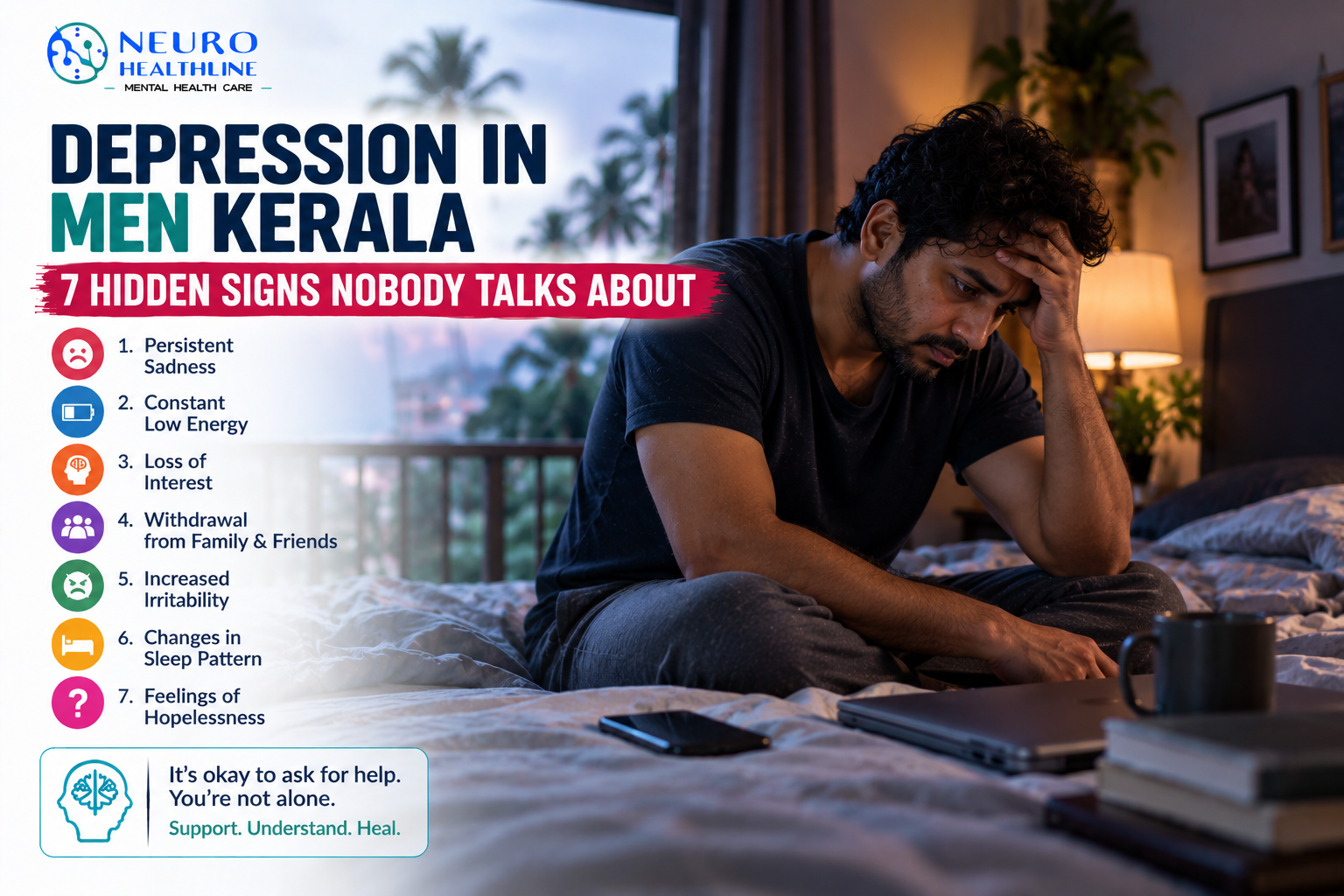
7 Hidden Signs of Depression in Men Kerala
1. Escalating Irritability and Unexplained Anger
The most important hidden sign of depression in men Kerala is persistent, escalating irritability — a short fuse that was not previously characteristic, anger disproportionate to its triggers, and a generalised hostility toward the people closest to the man experiencing it. Partners and family members frequently describe this change as the man becoming “difficult,” “negative,” or “impossible to live with” — without connecting it to depression, because depression is not supposed to look like anger. It is, for many depressed men in Kerala, exactly what it looks like.
2. Increased Alcohol Use
The relationship between depression in men Kerala and alcohol use is bidirectional and clinically critical — depression drives alcohol use as self-medication, and alcohol use worsens depression through its neurobiological and social consequences. The Kerala man whose drinking has escalated — spending more evenings drinking, requiring more alcohol to achieve the same relief, becoming more withdrawn and more difficult when drinking — is frequently a man whose depression is being managed, inadequately and progressively destructively, through the one culturally available coping mechanism that does not require acknowledgment of emotional distress.
3. Withdrawal Into Passive Disengagement
Depression in men Kerala frequently presents as a progressive withdrawal from active life engagement into passive disconnection — spending evenings in front of the television or phone rather than engaging with family, losing interest in hobbies and social activities that previously brought genuine pleasure, becoming increasingly unavailable as a presence in the family even while physically at home. This withdrawal is often interpreted as tiredness, disinterest, or character change — rarely as the anhedonia and disconnection that are core depression symptoms.
4. Physical Complaints Without Clear Medical Cause
Men are significantly more likely than women to present their depression through physical symptoms — chronic fatigue that no amount of sleep resolves, persistent headaches, back pain, digestive disturbance, and a general physical heaviness that general practitioners investigate medically without finding organic explanation. Depression in men Kerala is one of the most common unrecognised causes of repeated medical consultations for physical symptoms that remain unexplained despite investigation.
5. Risk-Taking and Recklessness
Some depressed men in Kerala express their internal state through escalating risk-taking — reckless driving, financial impulsivity, engagement with dangerous behaviours — reflecting a combination of the emotional numbing that depression produces and the unconscious communication that more direct emotional expression is unavailable to make. This externalising pattern of depression in men Kerala is among the most dangerous and most diagnostically overlooked presentations.
6. Withdrawal from Family Responsibility
Depression in men Kerala frequently produces a progressive withdrawal from active family engagement — failing to participate in decisions, disengaging from parenting involvement, becoming emotionally unavailable to partners in ways that produce significant relationship deterioration. This withdrawal is often experienced by partners as deliberate rejection or character failure rather than recognised as the motivational and relational impairment that depression in men produces.
7. Expressions of Hopelessness Disguised as Cynicism
Many depressed men in Kerala express their hopelessness about the future through generalised cynicism — about the economy, about social conditions, about the value of effort — rather than through direct personal expressions of hopelessness that would require vulnerable emotional disclosure. Persistent, escalating negativity and cynicism that are qualitatively different from the man’s previous outlook represent one of the most important and most overlooked cognitive symptoms of depression in men Kerala.
The Kerala Male Suicide Crisis — Why Depression in Men Kerala Cannot Wait
Kerala’s male suicide rate is not a statistical abstraction — it represents thousands of families permanently altered by a loss that, in the majority of cases, was preceded by depression in men Kerala that went unrecognised, unacknowledged, or untreated because help-seeking felt impossible within the cultural framework the man inhabited. The relationship between depression in men Kerala and suicide risk is direct, well-established, and profoundly urgent — untreated depression is the single most significant risk factor for suicide, and the cultural barriers to treatment for depression in men Kerala are the most significant structural drivers of the treatment gap that makes this risk so frequently fatal.
Every family member, partner, friend, or colleague who recognises the hidden signs of depression in men Kerala and creates a space for conversation — without judgment, without the expectation of emotional articulation that masculine socialisation has made impossible, without minimisation of what the man is experiencing — is performing a potentially life-saving act of clinical importance. Our depression treatment in Kochi program is specifically adapted for male presentations — framing treatment in the neuroscience-based, performance-oriented language that resonates with men for whom the conventional mental health framework feels threatening. The World Health Organization identifies male depression as a significant global health emergency — and NeuroHealthline’s clinical response to depression in men Kerala is built on the urgent recognition that current approaches are not reaching the men who most need them.
FAQ — Depression in Men Kerala
How do I approach a man in my family who I think has depression in Kerala?
Focus on behaviour rather than feelings — “I’ve noticed you seem exhausted lately” rather than “are you depressed?” Frame help-seeking as practical problem-solving rather than emotional vulnerability — “let’s get your energy checked” rather than “you need to talk to someone.” And consistently, patiently make it clear that your concern is for his functioning and wellbeing, without pressure or judgment.
Is depression in men Kerala connected to Kerala’s high alcohol use rates?
Significantly. Kerala’s high per-capita alcohol consumption rate is substantially driven by the self-medication of unacknowledged depression in men — creating a bidirectional relationship in which depression drives alcohol use and alcohol use worsens depression, often over many years before either is clinically recognised.
Will treatment for depression in men Kerala require talking about feelings?
Not in the conventional sense. NeuroHealthline’s approach uses neurofeedback, biofeedback, functional nutrition, and sleep restoration to directly address the neurological and physiological dimensions of depression — producing improvement in energy, motivation, sleep, and mood that does not require extensive verbal emotional processing to initiate.
How common is depression in men Kerala?
Significantly underreported but clinically common. Kerala’s male suicide rate — which depression drives — is among India’s highest, suggesting a prevalence of untreated depression in men Kerala that substantially exceeds what mental health service utilisation rates reflect.
Can depression in men Kerala be treated without the man acknowledging he is depressed?
Yes — particularly using NeuroHealthline’s neuroscience framing. Many male clients engage successfully with treatment framed around “brain performance,” “energy restoration,” or “stress management” — entering treatment for the presenting complaint and experiencing depression recovery as the clinical outcome.