


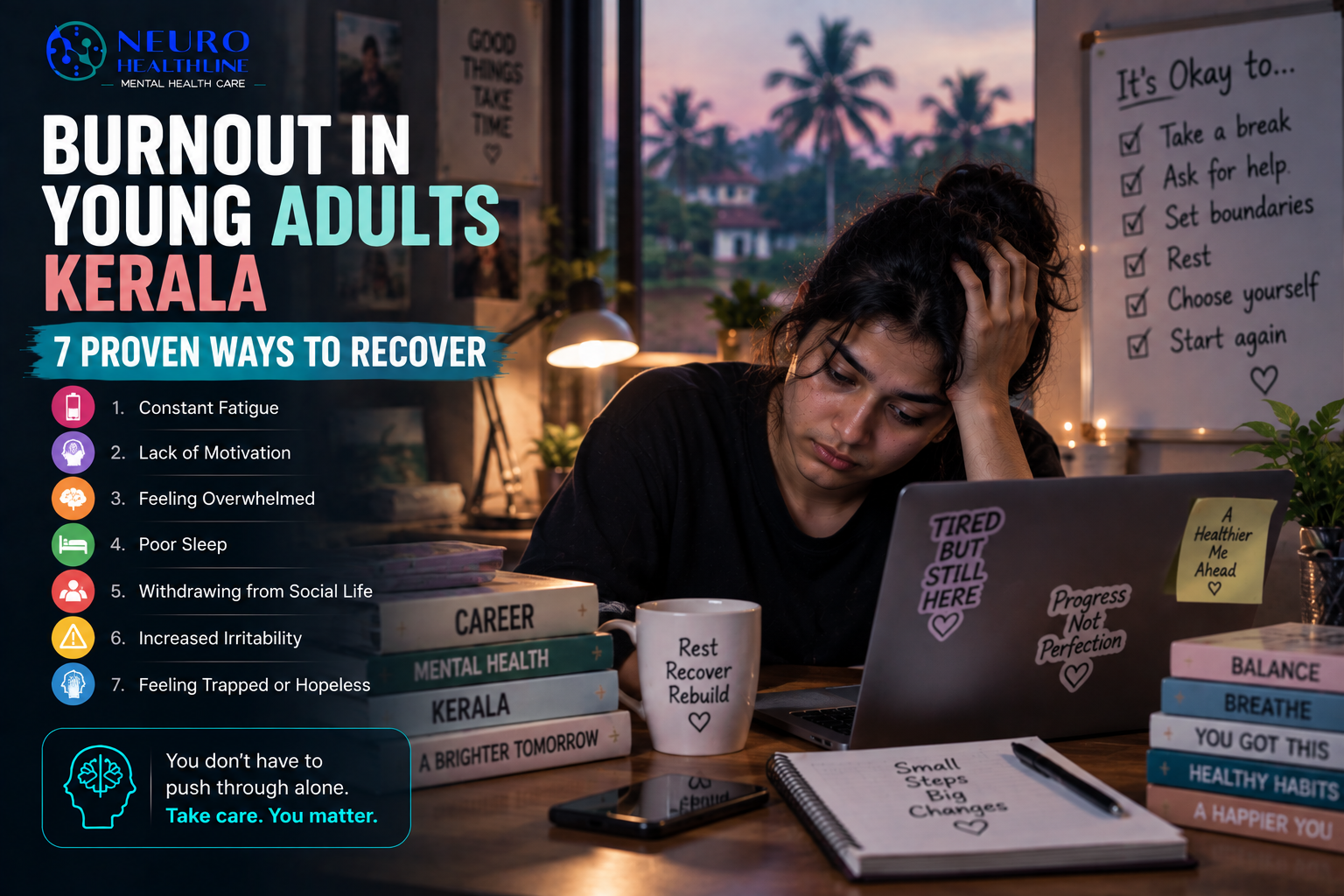
There is a particular type of exhaustion that is spreading through Kerala’s young professional population — one that sleep does not fix, that holidays do not resolve, and that cannot be attributed to any single identifiable cause. It is the exhaustion of a generation that entered adulthood carrying extraordinary expectations — shaped by Kerala’s high-achievement educational culture, by families who sacrificed significantly for their education, and by a social media landscape populated by peers who appear to be thriving effortlessly — only to discover that the professional and personal life they worked toward feels significantly less fulfilling, significantly more exhausting, and significantly more uncertain than anyone told them it would be. Burnout in young adults Kerala is not simply working too hard. It is the physiological and psychological consequence of sustained high demand without adequate recovery, meaningful connection, or a sufficiently nourishing sense of purpose — and it is affecting Kerala’s young professional population at levels that demand genuine clinical and cultural attention.
Why Burnout in Young Adults Kerala Is Different From Older Generations’ Burnout
Burnout in young adults Kerala has a distinctive character that reflects the specific circumstances of this generation’s entry into adult life — and understanding these distinctive features is essential for effective treatment. Previous generations typically experienced burnout after decades of sustained professional commitment — a gradual erosion of reserves accumulated over years of productive engagement. Burnout in young adults Kerala is occurring far earlier in the professional lifespan — often within the first three to five years of a career — reflecting a generation that entered professional life already significantly depleted by years of intensive academic preparation, social comparison anxiety, and the neurological costs of growing up in the social media era.
The particular psychological signature of burnout in young adults Kerala also reflects the collision between the high expectations that Kerala’s educational culture generates and the reality of early career professional life. The medical student who spent seven years preparing for a career of meaningful patient care discovers that hospital working conditions leave little space for the care they envisioned. The IT professional whose engineering degree was meant to open a world of creative problem-solving discovers that most of their working hours are consumed by repetitive, poorly defined tasks in an environment of chronic deadline pressure. The civil service aspirant who devoted their twenties to examination preparation discovers, having succeeded, that the bureaucratic reality of public service bears little resemblance to the meaningful contribution they had imagined. This gap between expectation and reality — combined with the social comparison pressure of seeing peers who appear to have found the purpose and success that feels elusive — is one of the most specific and most clinically significant drivers of burnout in young adults Kerala.
The Neuroscience of Burnout in Young Adults
Burnout in young adults Kerala is not simply a state of tiredness or stress — it is a measurable neurological and physiological condition involving specific dysregulation of the HPA axis, dopaminergic reward system, and prefrontal cortex that must be understood clinically to be effectively treated. Sustained high demand without adequate recovery progressively depletes the cortisol regulatory capacity of the HPA axis — producing the characteristic pattern of adrenal fatigue in which the morning cortisol awakening response becomes blunted, leaving the young professional unable to generate the physiological activation that professional engagement requires, despite the paradox of feeling simultaneously exhausted and unable to genuinely rest.
The dopaminergic depletion that burnout produces is perhaps the most practically significant neurological feature of burnout in young adults Kerala — reflecting the progressive exhaustion of the motivational system that, at its peak, drove the academic and early career achievement that preceded the burnout. The young adult who once found their work genuinely engaging, who was driven by curiosity and ambition, who could access enthusiasm and creativity on demand — discovers, in burnout, that these motivational states have become neurologically inaccessible. This is not laziness. It is the measurable consequence of a reward system that has been operating beyond its sustainable capacity for too long without adequate recovery. According to NCBI PubMed, burnout is associated with measurable alterations in dopaminergic function, cortisol reactivity, and prefrontal cortex activation — neurological changes that directly impair professional performance, emotional regulation, and the capacity for the meaningful engagement that recovery from burnout ultimately requires.
Signs That Burnout in Young Adults Kerala Requires Clinical Attention
Burnout in young adults Kerala becomes a clinical priority when it progresses beyond temporary exhaustion to produce symptoms that significantly impair functioning across multiple life domains. Clinical indicators that warrant professional support include persistent exhaustion that does not improve with rest, weekends, or annual leave — the defining physiological signature of burnout’s HPA axis depletion; progressive cynicism and emotional detachment from work, relationships, and activities that previously brought genuine engagement; significant cognitive impairment — difficulty concentrating, reduced creative capacity, and impaired decision-making — that affects professional performance beyond what tiredness alone explains; physical health deterioration including frequent illness, digestive disturbances, hormonal irregularities, and skin conditions — reflecting the systemic inflammatory and immune consequences of sustained burnout; and the progressive loss of a sense of personal meaning and direction that, in its most severe expression, produces the existential emptiness that distinguishes clinical burnout from ordinary professional dissatisfaction.
Our dedicated burnout treatment in Kochi program addresses these clinical features comprehensively — while this blog specifically addresses the distinctive context and presentations of burnout in young adults Kerala as a regional and generational phenomenon.
7 Proven Solutions for Burnout in Young Adults Kerala
1. Comprehensive Burnout and Neurological Assessment
Treatment for burnout in young adults Kerala begins with a thorough clinical assessment mapping both the physiological markers of burnout — cortisol rhythm, HRV baseline, QEEG brain mapping — and the psychological and contextual factors characterising each young adult’s specific burnout presentation. This integrated assessment provides the clinical foundation for genuinely targeted recovery rather than generic wellness advice.
2. HPA Axis and Cortisol Restoration
The adrenal fatigue pattern — blunted morning cortisol, insufficient stress response capacity, profound fatigue — that characterises advanced burnout in young adults Kerala requires targeted HPA axis restoration through adaptogenic nutritional support, strategic rest protocols, and progressive reduction of the adrenal demand burden that is preventing recovery.
3. HRV Biofeedback for Nervous System Recovery
HRV biofeedback therapy directly retrains the autonomic nervous system to recover the genuine parasympathetic regulatory capacity that burnout progressively depletes — rebuilding the physiological foundation for rest, recovery, and the genuine energy restoration that burnout in young adults Kerala has made neurologically impossible to access through conventional means.
4. HEG Neurofeedback for Motivational Recovery
The dopaminergic depletion and prefrontal hypoactivation of burnout produce the motivational collapse that is among its most distressing and most practically disabling features. HEG neurofeedback directly restores prefrontal cortex activation and dopaminergic regulatory capacity — progressively rebuilding the motivational access and cognitive clarity that burnout has depleted, at the neural level where the depletion has occurred.
5. Sleep and Circadian Restoration
Burnout in young adults Kerala systematically disrupts sleep architecture — producing the non-restorative sleep that prevents the neurological recovery that burnout most urgently requires. Our sleep restoration protocols address the circadian dysregulation, cortisol timing abnormalities, and pre-sleep autonomic activation that prevent genuine recovery sleep — rebuilding the deep sleep architecture that is the most important neurological recovery mechanism available.
6. Functional Nutrition for Burnout Recovery
The nutritional depletion that burnout produces — depleting B vitamins, magnesium, omega-3 fatty acids, vitamin D, and the adaptogenic cofactors of HPA axis function — directly impairs the energy metabolism, neurotransmitter synthesis, and stress response capacity that recovery requires. Our comprehensive functional nutrition assessment identifies and corrects these specific depletions — providing the physiological substrate for the neurological recovery that clinical intervention is simultaneously producing through neurofeedback and biofeedback.
7. Meaning and Purpose Neuropsychotherapy
Burnout in young adults Kerala frequently reflects a crisis of meaning alongside its physiological depletion — a discovery that the goals and values that drove the intense pre-burnout achievement no longer feel compelling, authentic, or sufficient. Our neuropsychotherapy approach to burnout recovery specifically engages with this meaning dimension — helping young adults in Kerala identify, clarify, and begin building toward a genuinely self-authored sense of professional and personal purpose that is both neurologically sustainable and existentially nourishing. This connects directly to the quarter life crisis mental health dimension of burnout that so many young adults in Kerala navigate simultaneously.
A Message to Kerala’s Exhausted Generation
If you are a young adult in Kerala reading this because you recognise yourself in this description — because the exhaustion is real, the cynicism is real, and the sense that something important has been lost is real — there is something important to understand about what is happening to you. Burnout in young adults Kerala is not a sign that you are weak, that you chose the wrong path, or that you are failing at the life you were supposed to build. It is a sign that you have been operating beyond your sustainable capacity in an environment that demanded more than it gave back — and that your brain and body are asking, with increasing urgency, for the recovery that they genuinely need and genuinely deserve.
Our stress treatment in Kochi and depression treatment in Kochi programs address the stress and depression that so commonly co-occur with burnout in young adults Kerala — recognising that comprehensive recovery requires addressing every dimension of the clinical picture simultaneously. The World Health Organization formally recognises burnout as an occupational phenomenon requiring targeted clinical support — the recognition that NeuroHealthline’s burnout recovery programs for young adults in Kerala are built to honour.
FAQ — Burnout in Young Adults Kerala
How do I know if I have burnout or depression?
Burnout and depression frequently co-occur and share significant symptom overlap. The most clinically important distinction is that burnout is specifically rooted in sustained occupational or role-related depletion, while depression involves a broader and more pervasive disruption of mood, cognition, and functioning across all life domains. A comprehensive clinical assessment at NeuroHealthline will accurately map both dimensions and design treatment addressing each appropriately.
Can burnout in young adults Kerala be fully recovered from?
Yes. While recovery from burnout requires time, appropriate clinical support, and genuine lifestyle change, full physiological and psychological recovery is achievable — and for young adults whose nervous systems retain significant neuroplastic capacity, the recovery trajectory can be remarkably complete when addressed with appropriate clinical comprehensiveness.
How long does burnout recovery typically take for young adults in Kerala?
Most young adults report meaningful improvements in energy, motivation, and emotional regulation within 6 to 10 weeks of beginning treatment, with more comprehensive HPA axis restoration and neurological recovery typically consolidating over 4 to 8 months.
Should I take time off work for burnout in young adults Kerala?
The clinical answer depends on severity. For moderate burnout, integrated treatment alongside continued — but restructured — work engagement is often feasible and preferable. For severe burnout with complete motivational collapse and significant physical health consequences, a period of formal leave may be the most clinically appropriate initial intervention.
Is burnout in young adults Kerala the same as the quarter life crisis?
They frequently co-occur and mutually reinforce each other — burnout depletes the physiological capacity for the identity and meaning exploration that quarter life crisis requires, while the unresolved meaning questions of the quarter life crisis maintain the purposeless engagement that drives burnout. Treating both simultaneously is the most effective clinical approach.