


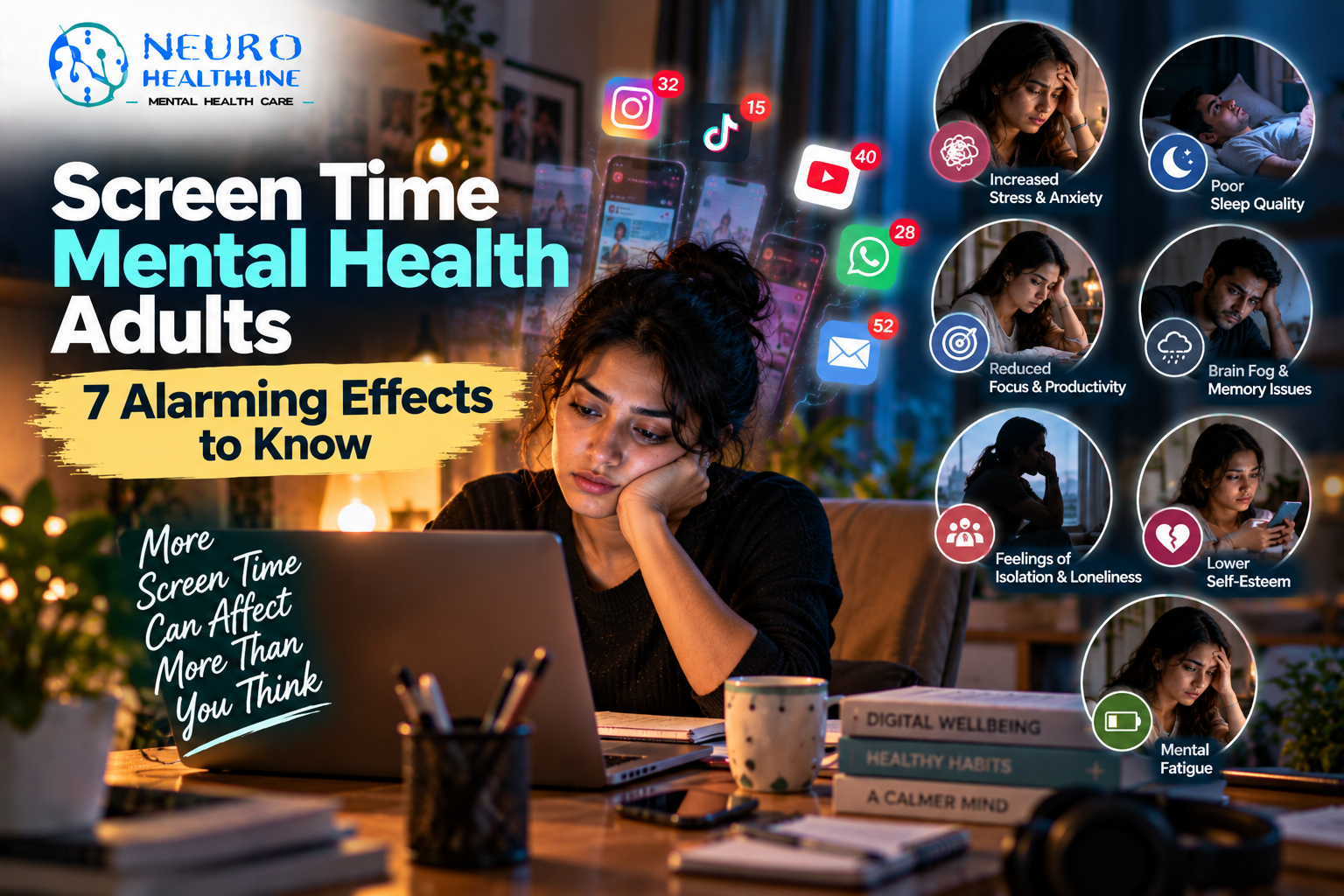
The conversation about screen time and mental health has been almost entirely focused on teenagers — and with good reason. But there is a parallel conversation that is urgently needed, significantly less heard, and equally clinically important: the impact of screen time on the mental health of adults. Screen time mental health adults research is now accumulating rapidly — and what it shows is that while the adult brain is less neurologically vulnerable than the adolescent one, the scale of screen exposure that contemporary adult life involves — averaging 6 to 9 hours of daily screen time across professional, entertainment, and social media categories — is producing measurable mental health consequences at a population scale that dwarfs the teenager problem in absolute numbers if not in neurological intensity.
The average adult professional in Kochi spends 8 hours in front of a work screen, an additional 2 to 3 hours on a smartphone across social media, messaging, and news consumption, and 1 to 2 hours on streaming entertainment — creating a total daily screen exposure that leaves approximately 3 to 4 hours of waking time unmediated by a screen outside of eating and bathing. Screen time mental health adults consequences are not the dramatic presentation of gaming addiction or social media-driven teenage depression — they are quieter, slower, and in many ways more insidious precisely because they accumulate below the threshold of obvious clinical concern until their effects on cognitive function, emotional regulation, sleep, and relationship quality have become significant enough to be impossible to ignore.
What Screen Time Does to the Adult Brain — The Neuroscience
Screen time mental health adults consequences begin at the neurological level — with specific, measurable effects on the adult brain that distinguish healthy technology use from the problematic screen engagement that a majority of Kochi’s working adults are now exhibiting. The attentional fragmentation produced by high-frequency screen switching — the average office worker switches between screen-based tasks or windows every 47 seconds — progressively degrades the sustained attention capacity that deep work, creative thinking, and effective professional decision-making require. The adult brain adapts to the attentional demands placed on it — and a brain habituated to 47-second task switching develops an attentional system that is specifically adapted for rapid switching and progressively less capable of the sustained single-focus engagement that most valuable cognitive work requires.
The dopaminergic consequences of adult screen time are less dramatic but no less clinically significant than those seen in teenage digital addiction. The chronic low-level dopaminergic stimulation of notification checking, social media browsing, and content streaming progressively raises the adult brain’s reward threshold — making the slower, deeper rewards of genuine human connection, creative engagement, and real-world accomplishment feel increasingly inadequate by comparison with screen-delivered stimulation. Screen time mental health adults research published on NCBI PubMed confirms that excessive screen time in adults is significantly associated with increased anxiety, depression, sleep disruption, and reduced life satisfaction — with the relationship being dose-dependent and most significant for passive social media consumption rather than purposeful professional screen use.
7 Alarming Screen Time Mental Health Effects in Adults
1. Chronic Attentional Fragmentation
The most cognitively consequential screen time mental health adults effect is the progressive fragmentation of the sustained attention capacity that the adult brain requires for its most important work. Research consistently shows that the average adult worker cannot sustain uninterrupted focus for more than a few minutes before voluntarily or reflexively turning to a screen — a pattern that, over years of habitual reinforcement, has produced a professional population significantly less capable of the deep, sustained cognitive work that both career excellence and intellectual satisfaction require.
2. Sleep Architecture Destruction
Screen time mental health adults consequences include some of the most clinically significant sleep effects in the entire population — driven by the combination of blue light-mediated melatonin suppression, psychological arousal from evening content consumption, and the habitual late-night screen engagement that has replaced the natural winding-down period that healthy sleep architecture requires. The resulting sleep deprivation produces the cascading mental health, cognitive, hormonal, and immune consequences that we have documented extensively in our content — making evening screen habits one of the most important clinical targets in adult mental health maintenance.
3. Anxiety Amplification Through News and Social Media
The specific screen activities most associated with screen time mental health adults anxiety consequences are news consumption and social media browsing — both of which deliver a continuous stream of threat-relevant, socially activating, and emotionally arousing content that maintains the amygdala’s threat-detection system in chronic low-level activation. The adult professional who begins their morning with news, checks social media between meetings, and ends their evening with more news is subjecting their threat-detection system to approximately 12 to 14 hours of continuous threat-relevant stimulation — a physiological stress load whose anxiety consequences are cumulative, significant, and directly addressable through deliberate screen behaviour modification. The doomscrolling effects on mental health we explored in detail earlier sits at the centre of this anxiety amplification mechanism.
4. Relationship Deterioration Through Phubbing
Screen time mental health adults consequences extend powerfully into relationship quality through the now-ubiquitous phenomenon of phubbing — the presence of screens in social situations that physically co-locates individuals while psychologically separating them. Research consistently shows that the mere presence of a smartphone on a table during conversation reduces reported intimacy, trust, and relationship satisfaction — even when the phone is not being actively used. The cumulative relationship damage of years of dinner-table phone checking, screen-present bedtimes, and media-distracted family interactions represents one of the most significant and most underappreciated screen time mental health adults consequences for long-term relational wellbeing.
5. Cognitive Decline Acceleration
Screen time mental health adults research increasingly documents an association between chronic high screen time and accelerated cognitive ageing — with sedentary, indoor, screen-intensive lifestyles reducing the physical activity, natural light exposure, social interaction, and cognitive variety that protect against cognitive decline. The cognitive decline prevention framework we explored earlier identifies screen-intensive sedentary lifestyle as a significant modifiable risk factor — making adult screen time management a genuine cognitive longevity concern alongside its more immediate mental health consequences.
6. Identity Erosion Through Constant Comparison
Adult social media use — while less neurologically intense than teenage use — produces a persistent social comparison effect that progressively erodes adult self-worth and life satisfaction through the continuous visibility of peers’ achievements, acquisitions, and apparent life quality. Screen time mental health adults consequences in this domain include the specific adult form of social comparison depression — the quiet, accumulating dissatisfaction with one’s own life that develops from years of scrolling past curated evidence that others are succeeding, experiencing, and enjoying more.
7. Boredom Intolerance and Diminished Inner Life
The progressive destruction of boredom tolerance that high adult screen time produces — the inability to sit quietly without reaching for a device — systematically prevents access to the internal states most associated with creativity, self-reflection, genuine relaxation, and the spontaneous generation of meaning that a rich inner life provides. Screen time mental health adults consequences in this domain are among the most existentially significant — producing a generation of adults who are constantly stimulated and consistently unstimulated, chronically entertained and genuinely unfulfilled.
Reclaiming Balance — What Actually Works for Adults
Screen time mental health adults recovery is not about eliminating screens — which is neither realistic nor necessary for professional, social, and creative life. It is about reestablishing the deliberate, purposeful relationship with screen technology that produces genuine productivity and connection rather than the compulsive, dysregulated engagement that produces mental health consequences. The most effective approaches combine neurological treatment — HEG neurofeedback to restore the prefrontal regulatory capacity that chronic screen overstimulation has degraded; HRV biofeedback therapy to rebuild the autonomic regulation that screen-driven anxiety has depleted — with structured digital behaviour redesign, sleep restoration, and neuropsychotherapy addressing the identity, meaning, and emotional regulation needs that excessive screen engagement has been meeting inadequately.
Our phone addiction and mental health and social media addiction treatment programs provide the clinical delivery for adults whose screen time mental health consequences have progressed to clinical-level digital addiction. The World Health Organization recognises problematic technology use as a significant and growing contributor to global mental health burden across all age groups — and NeuroHealthline’s approach to screen time mental health adults consequences is built to address this burden with the clinical precision and evidence-based depth that the adult population deserves.
FAQ — Screen Time Mental Health Adults
How many hours of daily screen time is considered harmful for adult mental health?
Research does not identify a single universal threshold — what matters more than total hours is the type of use, the degree of voluntary control, and the functional consequences. Passive social media and news consumption show the strongest associations with adult mental health consequences at relatively lower daily doses, while purposeful professional screen use shows weaker associations at higher doses.
Is screen time mental health damage in adults reversible?
Yes. The attentional fragmentation, sleep disruption, and anxiety amplification that adult screen time produces are reversible through appropriate clinical intervention and structured behaviour change — with many adults reporting significant improvements in cognitive function, sleep quality, and emotional regulation within weeks of implementing deliberate screen reduction strategies.
Can reducing screen time alone improve adult mental health?
Structured reduction of the most harmful screen activities — particularly passive social media browsing, late-night screen use, and doomscrolling — produces meaningful improvements in anxiety, sleep, and relationship quality for many adults without requiring clinical intervention. For adults whose screen time mental health consequences have progressed to clinical anxiety, depression, or insomnia, professional support produces significantly more comprehensive outcomes.
Is screen time mental health impact worse for people with existing anxiety or depression?
Yes — significantly. Anxiety and depression both increase the neurological sensitivity to the threat-detection activation, social comparison distress, and dopaminergic dysregulation that high screen time produces, creating a mutually amplifying relationship in which existing mental health conditions worsen screen time consequences and high screen time worsens mental health conditions simultaneously.
What is the single most impactful screen behaviour change an adult can make for their mental health?
Eliminating screens — particularly smartphones — from the bedroom and establishing a screen-free period of at least 60 to 90 minutes before sleep consistently produces the most significant and most immediately tangible mental health improvements available from screen behaviour modification alone, through its direct effects on sleep quality, melatonin production, and evening nervous system deactivation.