


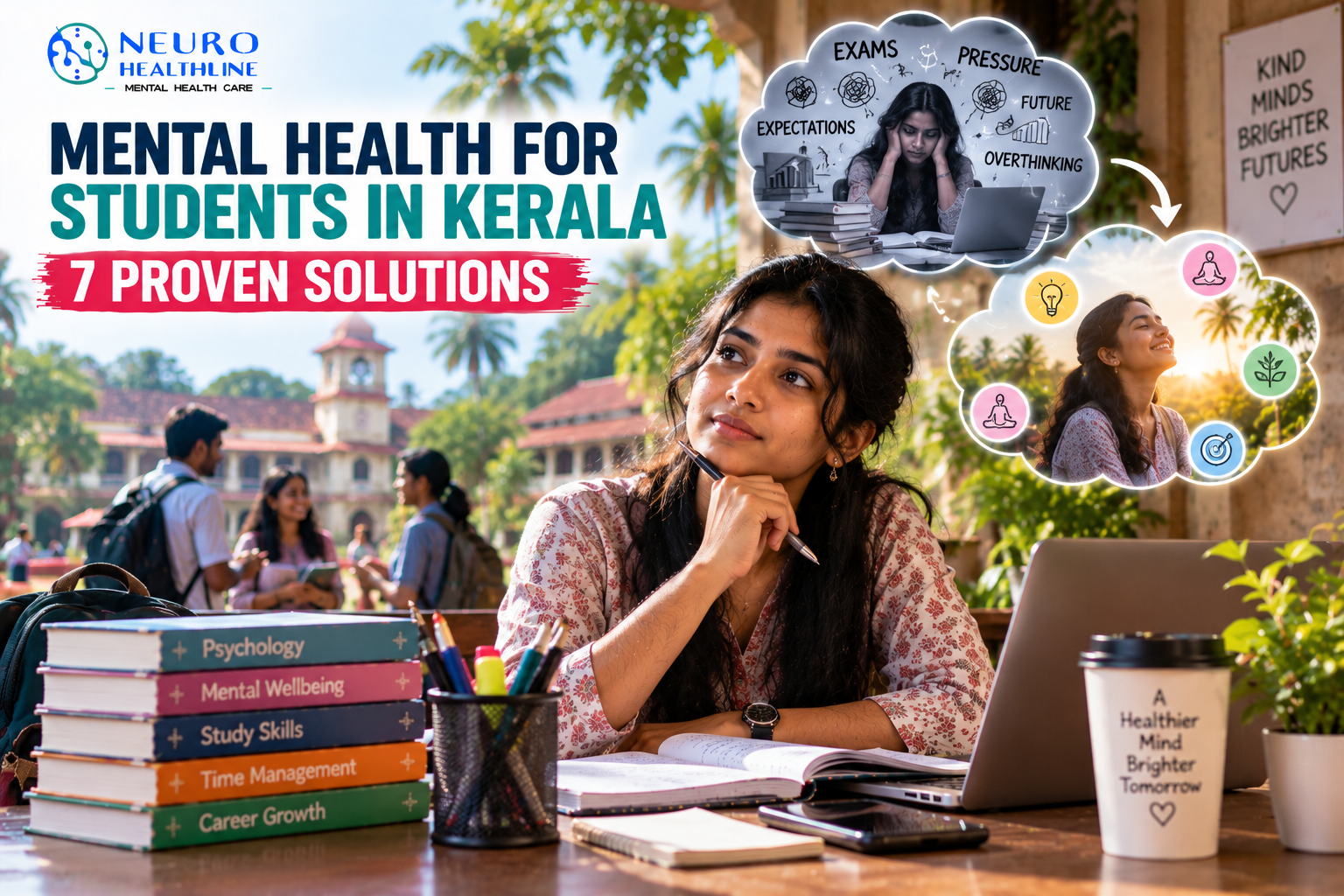
Kerala produces some of India’s highest-achieving students — and some of India’s most psychologically distressed ones. The state’s extraordinary literacy rates, its culturally embedded investment in education, and the genuine career opportunities that academic achievement unlocks have created a student population of remarkable capability and ambition. They have also created a mental health emergency that is playing out in examination halls, family kitchens, and hospital emergency departments across Kerala with a frequency and urgency that the education system, the healthcare system, and most families are still not adequately equipped to address.
Mental health for students in Kerala is not simply about managing exam stress. It is about a comprehensive, systemic challenge in which academic pressure, social media saturation, sleep deprivation, nutritional compromise, family expectation, competitive identity threat, and inadequate access to appropriate support converge on developing nervous systems that were never designed to carry this load — and are increasingly breaking under its weight. At NeuroHealthline, mental health for students in Kerala is one of our most important clinical commitments — because the students struggling today are Kerala’s professionals, parents, and community leaders of tomorrow, and the mental health patterns they develop now will shape the quality of their lives and their contributions for decades.
The Scale of the Mental Health Crisis for Students in Kerala
The data on mental health for students in Kerala is stark and cannot be minimised. Kerala’s student suicide rate is among the highest in India — a devastating reflection of the gap between the psychological demands placed on students and the support available to them. NEET examination pressure has created a generation of medical aspirants navigating years of intensive preparation in which a single examination result determines the accessibility of their professional dream — generating a level of existential stakes attached to a single day of cognitive performance that the adolescent nervous system was never designed to manage.
The post-pandemic academic disruption has compounded pre-existing mental health vulnerabilities for students in Kerala — with two to three years of social isolation, disrupted learning, and cancelled developmental milestones leaving a cohort significantly more anxious, more socially uncertain, and more emotionally underprepared than students who navigated their formative educational years in normal social environments. Social media saturation has added the comparison, validation-seeking, and doomscrolling dimensions we have explored across multiple earlier blogs — all operating simultaneously on student nervous systems already stretched beyond sustainable capacity.
Mental health for students in Kerala is therefore not a niche clinical concern — it is a population-level emergency requiring the same urgency of response that any other public health crisis of equivalent scale and consequence would demand. According to NCBI PubMed, academic pressure and examination stress are among the strongest predictors of anxiety disorder development in adolescents — with the relationship being dose-dependent, bidirectional, and significantly amplified by social media exposure and sleep deprivation.
What Is Harming Mental Health for Students in Kerala Most Significantly?
Understanding which specific factors are most significantly harming mental health for students in Kerala is essential for designing interventions that address root causes rather than symptoms. The most clinically significant drivers, in order of prevalence and impact, are as follows.
Academic pressure and examination culture represent the most pervasive and most structurally embedded threat to mental health for students in Kerala — particularly the competitive entrance examination system that attaches career-defining consequences to single examination outcomes and creates a social environment in which academic performance determines social identity and family reputation simultaneously. Sleep deprivation — driven by academic preparation demands, social media use, anxiety-driven insomnia, and the late-night screen culture that defines contemporary adolescent life — represents the most physiologically damaging threat, removing the neurological recovery that mental health resilience requires.
Social media comparison and digital addiction have created a mental health burden that previous student generations did not carry — adding continuous social comparison, FOMO, body image pressure, and the neurological costs of digital addiction to an already overwhelming academic stress load. Family pressure and expectation — frequently well-intentioned but transmitted through anxiety that students absorb and carry as their own — represents the relational dimension of mental health challenges for students in Kerala that is most difficult to address without family system engagement. And inadequate awareness and access — the persistent stigma around mental health help-seeking, the limited availability of appropriate school-based support, and the financial barriers to private clinical care — mean that most students experiencing significant mental health challenges never receive the support that would make a meaningful difference.
7 Proven Solutions for Mental Health for Students in Kerala
1. QEEG Brain Mapping for Student Mental Health Assessment
Effective support for mental health for students in Kerala begins with objective neurological assessment — using QEEG brain mapping to identify the specific anxiety patterns, attention difficulties, and stress response dysregulation characterising each student’s individual presentation. This neuroscience-based approach resonates with Kerala’s academically oriented student population — providing an evidence-based, non-stigmatising framework for understanding mental health challenges as brain states rather than personal failures.
2. HEG Neurofeedback for Academic Performance and Anxiety
HEG neurofeedback is the single most powerful intervention available for mental health for students in Kerala — simultaneously addressing the anxiety that impairs academic performance and directly strengthening the prefrontal cognitive functions that academic success requires. Students consistently report improvements in both examination performance and anxiety levels following HEG neurofeedback training — an outcome that directly addresses the most urgent practical concerns driving help-seeking in this population.
3. HRV Biofeedback for Examination Regulation
HRV biofeedback therapy teaches Kerala’s students a portable, evidence-based nervous system regulation skill that can be applied directly in examination conditions — preventing the acute amygdala activation that produces mind-blanking and cognitive shutdown, and maintaining the optimal arousal state for peak academic performance. This is one of the most practically valuable contributions to mental health for students in Kerala available — because it is applicable precisely at the moments of highest clinical risk.
4. Sleep Restoration for Brain Performance
Given the central role of sleep deprivation in both the academic performance impairment and the mental health deterioration driving Kerala’s student crisis, sleep restoration is a non-negotiable component of comprehensive support for mental health for students in Kerala. Our sleep optimisation protocols address the circadian disruption, pre-sleep anxiety, and screen-driven sleep architecture damage that systematically undermine the memory consolidation and emotional regulation that academic and psychological functioning both depend on.
5. Functional Nutrition for Student Brain Health
The nutritional profile of Kerala’s student population — characterised by the dietary irregularity, high glycaemic index snacking, and specific micronutrient deficiencies of time-pressured academic preparation — directly impairs both cognitive performance and mental health resilience. Our functional nutrition support for mental health for students in Kerala targets omega-3 fatty acids for cognitive function and anxiety regulation, magnesium for nervous system stability and sleep quality, B vitamins for energy metabolism and neurotransmitter synthesis, and iron for the cognitive energy that anaemia-related depletion so commonly diminishes in Kerala’s student population.
6. School and Family System Engagement
Mental health for students in Kerala cannot be adequately addressed through student-only clinical intervention — because the most significant drivers of student mental health challenges are located in the academic system, the family expectation environment, and the peer social dynamics that clinical intervention alone cannot change. NeuroHealthline’s approach includes psychoeducation for parents and educators — helping families understand the neurological reality of academic stress and the counterproductive consequences of anxiety-driven performance pressure, and developing communication patterns that support rather than amplify the student’s mental health challenges.
7. Identity Development Beyond Academic Achievement
The most important long-term clinical intervention for mental health for students in Kerala is the development of a stable, internally anchored sense of identity and self-worth that is not contingent on examination outcomes. Many of the most severe mental health presentations in Kerala’s student population reflect not simply anxiety about examinations but an existential crisis in which the student’s entire sense of personal value has been staked on an academic outcome — making any outcome less than perfect feel genuinely catastrophic. Our neuropsychotherapy work with students develops the psychological resilience of a self that can survive and grow through failure as well as success — the foundation of the lifelong mental health that academic achievement alone cannot provide. Our anxiety in students in Kochi and exam stress in students Kerala programs provide the specific clinical delivery through which this broader mental health for students in Kerala framework is implemented.
A Direct Message to Kerala’s Students
If you are a student in Kerala reading this: what you are carrying right now is genuinely heavy. The pressure is real. The stakes feel enormous. And the expectation that you should simply handle it, keep performing, and never show the cost — that expectation is wrong. Your mental health is not a distraction from your academic goals. It is the neurological foundation that makes achieving them possible. And reaching out for support is not a sign that you cannot manage — it is the most intelligent decision a high-achieving mind can make when it recognises that it is operating under conditions it was not designed to navigate alone.
Our teen depression treatment in Kochi and Gen Z mental health programs stand alongside this blog as the clinical delivery mechanisms for the most urgent presentations of mental health challenges among Kerala’s students. The World Health Organization identifies adolescent mental health as a global health priority — and NeuroHealthline’s commitment to mental health for students in Kerala is our direct, practical response to that priority in the community we serve.
FAQ — Mental Health for Students in Kerala
How do I know when my child’s academic stress has become a mental health problem?
When stress persists beyond examination periods, significantly impairs sleep, social functioning, or appetite, produces expressions of hopelessness or worthlessness, or generates physical symptoms without medical explanation for more than two weeks — these are indicators that academic stress has progressed to a clinical mental health presentation requiring professional assessment.
Can neurofeedback improve both anxiety and academic performance simultaneously?
Yes. HEG neurofeedback strengthens prefrontal regulatory capacity that simultaneously reduces anxiety intensity and improves the working memory, attention stability, and cognitive flexibility that academic performance most critically depends on — making it uniquely well-suited to the dual challenge of mental health for students in Kerala.
Is mental health support for students in Kerala available during active academic terms?
Yes. NeuroHealthline’s programs are specifically designed to integrate into active academic schedules — with sessions timed and structured to support rather than compete with academic preparation, and producing improvements in cognitive performance and sleep quality that make the remaining study time more productive.
Should parents disclose to schools that their child is receiving mental health support?
This is a personal decision that depends on the specific school environment and the nature of the support required. NeuroHealthline maintains complete clinical confidentiality, and disclosure to schools is entirely the family’s choice — with guidance provided on managing school accommodation requests where academic modifications would benefit the student’s recovery.
What is the most important single thing a family can do for a student’s mental health in Kerala?
Separate the student’s worth as a person from their academic performance — consistently, explicitly, and genuinely. The most powerful protective factor against mental health deterioration in Kerala’s students is the experience of being unconditionally valued regardless of examination outcomes — an experience that costs nothing to provide and is worth more than any clinical intervention.