


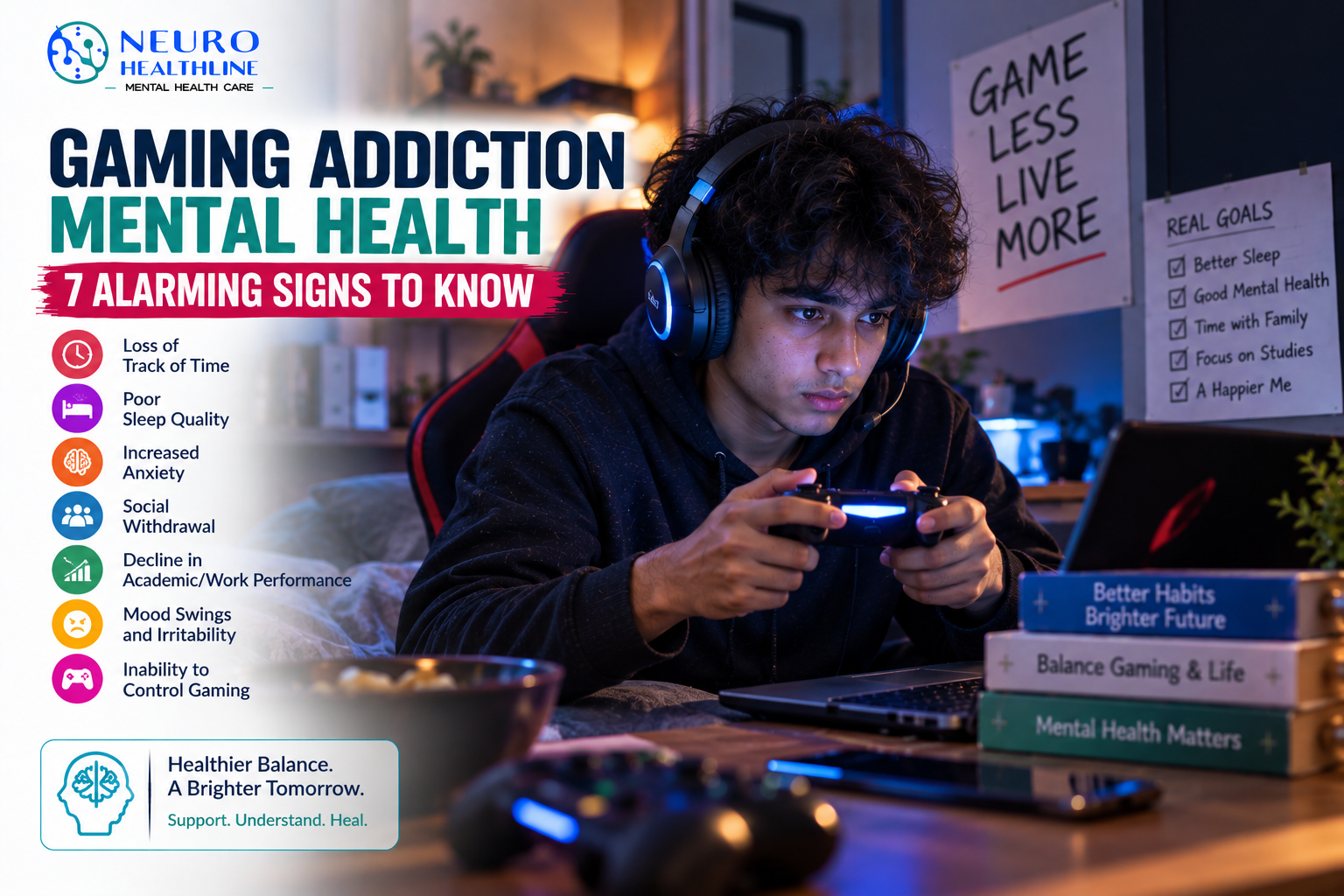
It begins innocently enough — a teenager discovers online gaming, finds a social world where they are competent and respected, and begins spending increasing amounts of time in a digital environment that rewards skill, delivers instant feedback, and provides the belonging that the pressures of Kerala’s competitive academic culture have made real-world social life feel inadequate to deliver. Within months, the same teenager is gaming until 3 AM, missing school, refusing meals, becoming physically aggressive when asked to stop, and showing signs of depression, anxiety, and cognitive decline that parents struggle to connect to a screen because gaming has always seemed like just a hobby. Gaming addiction mental health consequences are among the most severe and most rapidly progressing of all digital addiction presentations — and in Kerala, where the combination of high smartphone penetration, academic pressure, and inadequate awareness of gaming disorder creates uniquely fertile conditions for its development, they are becoming one of the most urgent clinical priorities in adolescent mental health.
The World Health Organisation formally recognised Gaming Disorder as a clinical condition in the International Classification of Diseases in 2018 — a landmark decision that positioned gaming addiction mental health consequences within the same clinical framework as other recognised behavioural addictions and removed any remaining doubt that what affected families had been observing was a genuine neurological condition rather than a parenting problem.
Why Gaming Is Neurologically Different From Other Screen Activities
Understanding gaming addiction mental health consequences requires understanding what makes gaming neurologically distinct from other screen-based activities — including social media, streaming, and general internet use. Gaming is uniquely addictive for several interconnected reasons that together create a neurological engagement environment of unprecedented power.
Games are specifically engineered around variable reward schedules — the same mechanism that makes gambling compulsive — delivering rewards that are unpredictable in timing and magnitude in ways that maximise dopaminergic anticipation and minimise the satiation response that predictable rewards would produce. Unlike passive content consumption — watching videos, scrolling feeds — gaming requires active engagement that creates a flow state: a condition of complete attentional absorption characterised by intrinsic reward, loss of self-consciousness, and distorted time perception that is neurologically compelling and physically difficult to exit voluntarily.
The social dimension of online multiplayer gaming adds a powerful additional layer — creating genuine social belonging, team-based identity, and the experience of competence and status that the gaming world delivers with a reliability and immediacy that real-world social environments frequently fail to match for teenagers navigating academic pressure and social uncertainty. Gaming addiction mental health consequences are therefore rooted in genuine social and psychological needs being met — inadequately but compellingly — by a digital environment specifically engineered to maximise time-in-game at any cost to the player’s wellbeing. According to NCBI PubMed, gaming disorder is associated with measurable dopamine system dysregulation, prefrontal regulatory deficit, and autonomic nervous system imbalance consistent with other recognised behavioural addictions — confirming the neurological basis of gaming addiction mental health consequences.
7 Alarming Signs of Gaming Addiction Mental Health Consequences
1. Complete Loss of Time Awareness During Gaming
The most universally reported early sign of gaming addiction mental health development is the progressive loss of accurate time perception during gaming sessions — teenagers who intend to play for one hour and discover four hours have passed with no subjective awareness of the interval. This time distortion reflects the deep attentional capture of flow states combined with the progressive impairment of the prefrontal cortex’s time-monitoring function under chronic gaming engagement.
2. Violent or Explosive Responses to Interruption
One of the most clinically alarming gaming addiction mental health signs — and the one most commonly prompting parents across Kerala to seek help — is the extreme emotional and behavioural response to gaming interruption. Rage episodes, physical aggression, property destruction, and sustained hostility following interruptions reflect genuine withdrawal-like dysregulation of the dopaminergic and emotional regulation systems — not deliberate behavioural choice or normal teenage moodiness.
3. Sleep Destruction and Inverted Schedules
Gaming addiction mental health consequences consistently include severe sleep disruption — with the combination of gaming’s intrinsic resistance to natural stopping points and its frequent nocturnal social dimension producing progressively inverted sleep-wake cycles. Teenagers with gaming addiction in Kerala are routinely gaming through the night and sleeping through the school day — a circadian inversion whose consequences for academic performance, mental health, and physical development are among the most serious of all gaming addiction presentations. The connection to our analysis of sleep disorders in teenagers in Kochi is direct and clinically significant.
4. Academic Collapse
The cognitive consequences of gaming addiction — attentional fragmentation, working memory impairment, chronic sleep deprivation, and the motivational inaccessibility of academic work relative to gaming’s stimulation level — produce academic performance collapse that is often dramatic and rapid. Students who were previously capable and engaged become completely unable to sustain academic engagement — not because intelligence has diminished but because the attentional and motivational systems that academic engagement requires have been recalibrated toward a stimulation level that schoolwork cannot approach.
5. Social Withdrawal from the Physical World
Gaming addiction mental health consequences include a progressive withdrawal from face-to-face social engagement as the online gaming social world becomes increasingly primary and the real-world social environment feels increasingly understimulating and socially threatening by comparison. The teenager with gaming addiction becomes increasingly invested in online relationships and gaming community belonging while becoming progressively disengaged from family, school friendships, and the real-world social activities that healthy adolescent development requires.
6. Physical Health Deterioration
Gaming addiction mental health consequences extend into significant physical health deterioration — through chronic sleep deprivation, sedentary behaviour, nutritional compromise driven by meal-skipping during gaming sessions, chronic postural strain, and the progressive physical deconditioning that gaming addiction’s displacement of physical activity produces. The physical health consequences — combined with the neurological and psychological ones — make gaming addiction mental health impact genuinely whole-system in its scope.
7. Depression and Anxiety Outside Gaming
Perhaps the most clinically significant gaming addiction mental health consequence is the progressive development of depression and anxiety in the spaces outside gaming — as the dopamine system’s recalibration toward gaming-level stimulation makes ordinary life feel genuinely grey, purposeless, and anxiety-provoking by comparison. The teenager who appears animated and engaged only during gaming and progressively flat, irritable, or withdrawn at all other times is demonstrating the most advanced and most urgent expression of gaming addiction mental health consequences.
Gaming Addiction in Kerala’s Teenage Boys — A Specific Clinical Picture
Gaming addiction mental health presentations in Kerala carry specific contextual features that distinguish this population from generic gaming addiction presentations. Kerala’s intensely competitive academic environment creates the conditions in which gaming functions as a particularly powerful escape — offering the competence, status, and immediate reward that the academic environment consistently withholds from the significant proportion of students who are not among its highest performers. The academic shame and identity threat of perceived educational failure drives retreat into gaming environments where a different, more immediately accessible form of competence and respect is available — making gaming addiction mental health in Kerala frequently a self-medication response to academic anxiety and low academic self-worth.
The social dimension of gaming addiction in Kerala’s teenage male population also reflects the specific cultural constraints on male emotional expression and vulnerability that we explored in our discussion of mental health stigma in India — where online gaming communities may provide one of the few socially acceptable spaces for emotional engagement, genuine peer belonging, and identity expression outside the constraints of performance-focused real-world social environments.
How NeuroHealthline Addresses Gaming Addiction Mental Health
NeuroHealthline’s approach to gaming addiction mental health addresses the neurological, psychological, and social dimensions simultaneously — recognising that effective recovery requires more than device restriction and parental enforcement. HEG neurofeedback directly retrains the prefrontal regulatory capacity and dopamine system normalisation that gaming addiction has progressively depleted — building genuine voluntary control over gaming urges rather than relying on effortful suppression. HRV biofeedback therapy rebuilds the autonomic nervous system regulation that reduces the anxiety and dysphoria outside gaming most powerfully driving return to games. Sleep restoration addresses the circadian damage that gaming addiction has produced. Functional nutrition corrects the dopamine precursor and B vitamin deficiencies that gaming addiction’s dietary disruption creates. And our neuropsychotherapy approach specifically addresses the academic shame, social needs, and identity dimensions that gaming was meeting — helping teenagers build the real-world competence, belonging, and meaning that make gaming’s digital substitutes progressively less necessary.
Our broader social media addiction treatment and substance abuse in teenagers programs provide additional clinical context for the addiction frameworks within which gaming addiction mental health sits. The World Health Organization formally recognises Gaming Disorder as a clinical condition — the diagnostic foundation on which NeuroHealthline’s gaming addiction mental health treatment is built.
FAQ — Gaming Addiction Mental Health
How many hours of daily gaming indicates addiction?
Hours alone are insufficient — what matters is loss of voluntary control, functional impairment across sleep, academic performance, relationships, and physical health, and withdrawal-like distress when gaming is prevented. A teenager gaming eight hours daily with maintained school performance, social relationships, and sleep is different from one gaming four hours with complete academic collapse.
Is gaming disorder recognised as a real medical condition?
Yes. The World Health Organization formally classified Gaming Disorder in ICD-11 in 2018 — recognising it as a clinical condition characterised by impaired control over gaming, prioritisation of gaming over other activities, and continuation despite negative consequences.
Can gaming addiction mental health consequences be reversed?
Yes. The neurological changes produced by gaming addiction — dopamine system dysregulation, prefrontal underactivation, autonomic nervous system imbalance — are neuroplastic changes rather than permanent structural damage, and are directly reversible through appropriate clinical intervention.
Should I confiscate all devices to treat gaming addiction?
Abrupt device confiscation typically produces acute withdrawal-like distress, increases family conflict, drives underground gaming, and addresses the behaviour without addressing the neurological and psychological drivers maintaining it. A graduated, clinically supported approach produces significantly more durable and less conflictual outcomes.
Is gaming addiction treatment available in Kochi?
Yes. NeuroHealthline’s programs address gaming addiction mental health through neurofeedback, biofeedback, sleep restoration, and neuropsychotherapy — available at our Kochi centre with scheduling adapted for adolescents and their families.