


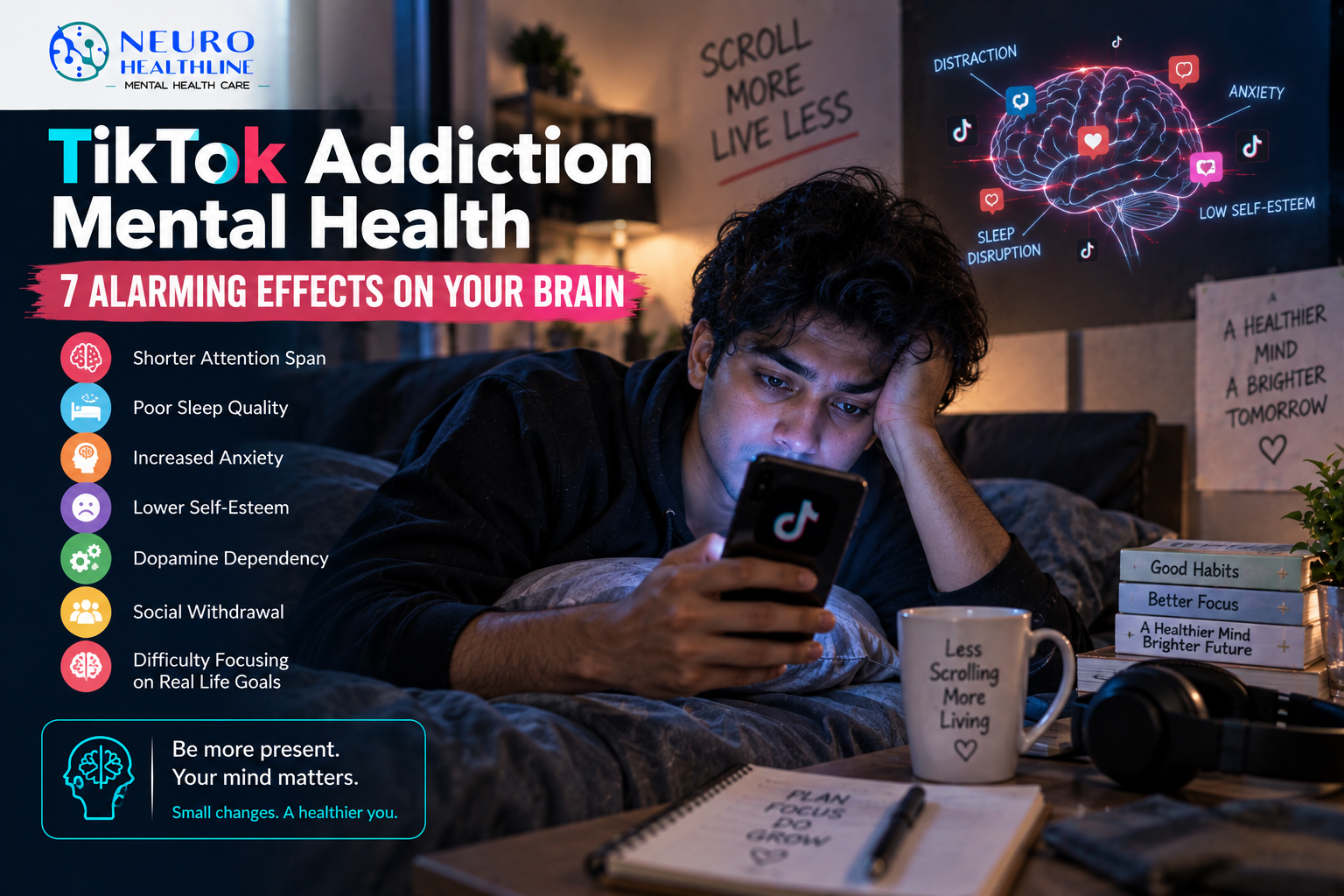
You open TikTok to watch one video. Forty-five minutes later you are still there — having absorbed approximately 270 videos, experienced 270 emotional micro-responses, and registered almost nothing you could describe five minutes after putting the phone down. This is not entertainment. This is what the most sophisticated attention-capture algorithm ever built does to the human brain when given unconstrained access — and TikTok addiction mental health consequences are among the most clinically significant and least understood dimensions of the digital mental health crisis currently unfolding across India and Kerala.
TikTok’s algorithm is fundamentally different from every social media platform that preceded it. Instagram and YouTube require some initial act of search or selection to deliver content — TikTok delivers a precisely personalised, continuously updated stream of content without any search required at all. Within hours of a new user’s first session, TikTok’s recommendation system has built a psychological profile of sufficient accuracy to serve content that reliably produces the maximum possible dopaminergic response in that specific individual — effectively becoming a personalised, infinitely scrollable slot machine that has learned exactly which levers to pull for maximum engagement with your specific brain. TikTok addiction mental health consequences are the predictable outcome of this engineering.
The Neuroscience Behind TikTok Addiction Mental Health Damage
The specific features of TikTok’s content format make it neurologically more damaging than other social media platforms in several distinct ways. The ultra-short video format — typically 15 to 60 seconds — creates a content consumption pattern that delivers reward signals at a frequency that no natural environment has ever produced. The dopaminergic system responds not to the reward itself but to the anticipation of a reward — and TikTok’s format creates a perpetual anticipation cycle in which every video ends with the implicit promise of a potentially better one immediately following. This cycle operates at a frequency that progressively trains the brain to expect, require, and eventually compulsively seek stimulation at a rate that ordinary life cannot provide.
The attentional consequence of TikTok addiction mental health impact is particularly severe. The attentional system adapts to the demands placed on it — and habitual TikTok consumption trains the attentional system for a very specific pattern: rapid engagement, rapid disengagement, rapid reengagement with new stimulation. The sustained, deep, single-focus attention that effective studying, meaningful conversation, creative work, and professional excellence all require is the precise attentional pattern that TikTok consumption progressively degrades. Research published on NCBI PubMed confirms that frequent short-form video consumption is associated with measurable reductions in sustained attention capacity and working memory performance — the specific cognitive functions most critical for academic and professional success.
7 Alarming TikTok Addiction Mental Health Effects on the Brain
1. Dopamine System Dysregulation
TikTok’s ultra-high stimulation frequency produces the same dopamine receptor downregulation seen in other addictions — progressively raising the threshold at which the reward system registers satisfaction. The TikTok-addicted brain progressively loses its capacity to find ordinary life, ordinary conversation, and ordinary experience genuinely rewarding — because the baseline stimulation level to which the dopamine system has adapted far exceeds what real life can consistently deliver. This is one of the most profound and most lasting TikTok addiction mental health consequences — a brain recalibrated toward a stimulation level that only a phone screen can provide.
2. Attention Span Destruction
The association between TikTok addiction mental health impact and dramatically reduced attention span has moved from anecdotal observation to clinically documented reality. The habituation of the attentional system to ultra-short content cycles — engaging and disengaging every 15 to 60 seconds — produces genuine neurological adaptation that reduces the threshold for attentional disengagement when stimulation does not change rapidly enough. Students, professionals, and parents across Kerala are reporting progressively worsening difficulty sustaining attention during tasks that would previously have been unproblematic — and TikTok consumption patterns are a primary clinical suspect.
3. Sleep Architecture Destruction
TikTok addiction mental health consequences include some of the most severe sleep disruption of any digital platform — driven by the platform’s specifically engineered resistance to natural stopping points. YouTube videos end. Instagram posts require active scrolling. TikTok’s infinite, autoplay stream has no natural endpoint — making the transition from watching to stopping entirely dependent on internal regulatory capacity that anxiety, boredom, and dopaminergic engagement have progressively depleted. Late-night TikTok consumption produces both direct melatonin suppression through screen light and the psychological arousal of continuous emotional micro-stimulation — making sleep onset physiologically impossible until the phone is finally put down, often hours after intended bedtime.
4. Anxiety and Emotional Dysregulation
TikTok’s content algorithm preferentially surfaces emotionally activating content — because emotional activation drives engagement and engagement drives platform revenue. The emotional micro-cycling that results — moving rapidly between funny, frightening, sad, outrageous, and heartwarming content within a single session — produces a state of chronic emotional stimulation and dysregulation that the nervous system struggles to process. TikTok addiction mental health consequences include measurable increases in emotional volatility, reduced emotional regulation capacity, and heightened anxiety baseline — all reflecting the toll of sustained high-frequency emotional stimulation on a nervous system that was designed for a much lower emotional stimulation rate.
5. Social Comparison and Self-Worth Erosion
While TikTok’s body and lifestyle comparison dynamics are similar to Instagram’s, its algorithm’s precision and its content volume create a social comparison environment of unprecedented intensity. The TikTok algorithm learns which comparison content produces the most engagement in the specific user — and serves increasingly targeted content that reliably activates the particular social comparison most psychologically activating for that individual. TikTok addiction mental health consequences related to self-worth erosion are particularly acute among teenagers — connecting directly to the body image and mental health and eating disorders and social media dynamics we have explored in depth elsewhere.
6. Misinformation-Driven Health Anxiety
TikTok has become one of the most significant vectors for health misinformation in India — with medical, psychological, and wellness misinformation spreading virally through its algorithm in ways that generate significant TikTok addiction mental health consequences through health anxiety. Self-diagnosis based on TikTok mental health content, adoption of dangerous health practices promoted by wellness influencers, and catastrophisation driven by medically inaccurate content about symptoms and conditions are clinical presentations that mental health professionals across Kerala are increasingly encountering as direct consequences of TikTok health content consumption.
7. The Productivity and Motivation Collapse
The combination of attention fragmentation, dopamine system dysregulation, and sleep deprivation that TikTok addiction mental health consequences produce together create a particularly devastating impact on productivity and motivation. The student or professional who begins their day with TikTok consumption primes their attentional and dopaminergic systems for rapid stimulation cycling — making the sustained, lower-stimulation engagement that effective work requires neurologically uncomfortable and progressively more effortful. TikTok addiction mental health impact on academic and professional performance represents one of the most practically urgent dimensions of the digital mental health crisis — and one that NeuroHealthline’s social media addiction treatment program addresses with the neurological precision this level of digital conditioning requires.
Breaking Free From TikTok Addiction — What Actually Works
Breaking TikTok addiction is significantly more neurologically challenging than breaking other social media habits — precisely because TikTok’s algorithm is specifically engineered to maximise engagement in ways that make voluntary disengagement harder. The same neurological framework that addresses all forms of digital addiction applies to TikTok — HEG neurofeedback to restore the prefrontal regulatory capacity that TikTok has progressively depleted; HRV biofeedback therapy to rebuild genuine nervous system regulation that reduces the anxiety and boredom states most powerfully driving TikTok use; functional nutrition to support dopamine system restoration; sleep restoration to address the circadian damage TikTok’s late-night algorithm creates; and neuropsychotherapy to address the identity, meaning, and emotional regulation needs that TikTok has been meeting inadequately but compellingly.
The broader phone addiction and mental health framework we explored earlier is directly applicable — TikTok addiction is the most acute expression of the broader smartphone addiction pattern, requiring the same neurological and psychological intervention framework at higher clinical intensity. The World Health Organization increasingly recognises problematic short-form video consumption as a significant and rapidly growing public health concern — and NeuroHealthline’s clinical programs are specifically equipped to address it.
FAQ — TikTok Addiction Mental Health
Is TikTok more addictive than other social media platforms?
Yes — by design. TikTok’s algorithm delivers a fully personalised, infinitely scrolling content stream without requiring any search or selection, creating a variable reward environment of unprecedented precision that produces stronger compulsive engagement than any platform requiring active content selection.
Can TikTok addiction cause ADHD-like symptoms?
TikTok addiction produces attentional fragmentation and dopamine system dysregulation that closely mimic ADHD symptomatology — making it important to distinguish pre-existing ADHD from TikTok-induced attentional difficulties when assessing academic or professional performance concerns.
At what point does TikTok use become a clinical addiction?
When it produces loss of voluntary control — spending significantly more time than intended despite repeated genuine intentions to reduce; functional impairment across sleep, relationships, or academic or professional performance; and withdrawal-like distress when access is restricted.
Is TikTok addiction treatable without deleting the app?
Yes. The clinical goal is restoration of voluntary, deliberate, time-limited engagement rather than complete elimination — achieving genuine control over TikTok use rather than avoidance of a platform that has become deeply embedded in social and cultural life.
How does TikTok addiction affect the mental health of teenagers specifically?
More severely than adults — through the adolescent brain’s heightened dopaminergic sensitivity, still-developing prefrontal regulation, and the central role TikTok occupies in the social identity formation and peer belonging that are the primary developmental tasks of the teenage years.