


When Netflix released 13 Reasons Why in 2017 — a show depicting in graphic detail the suicide of a teenage girl — the platform ignored the explicit warnings of mental health professionals and suicide prevention organisations who had reviewed the script and advised against the suicide scene’s depiction. In the months following the show’s release, suicide rates among American teenagers aged 10 to 17 rose by 28.9% compared to the same period in prior years — the largest single-month increase ever recorded in US adolescent suicide data. The research linking the show to this increase, published in the Journal of the American Academy of Child and Adolescent Psychiatry, is among the most disturbing pieces of evidence for the relationship between toxic shows and teenage mental health that exists — and it raises urgent questions for every family in India where OTT platforms have brought this and similar content into the bedrooms and smartphones of teenagers with developing, highly impressionable brains.
The relationship between toxic shows and teenage mental health is not a moral panic — it is a clinical reality with a robust and growing evidence base. And with the explosive growth of OTT platform access across Kerala and India, understanding this relationship is one of the most important things that parents, educators, and mental health professionals can do for the young people in their care.
Why Teenagers Are Particularly Vulnerable to Toxic Show Content
Understanding the relationship between toxic shows and teenage mental health requires understanding the specific neurological vulnerabilities of the adolescent brain that make harmful content disproportionately impactful during this developmental stage. The adolescent brain is characterised by a highly responsive social learning system — one that is specifically calibrated to learn from the social behaviours, emotional experiences, and outcomes of observed others as a developmental mechanism for acquiring the social knowledge required for adult functioning. This same learning system that makes teenage brains so effectively educated by genuine social experience also makes them highly susceptible to the narratives, social models, and emotional scripts presented by dramatic content — particularly when that content is delivered with the production quality, emotional authenticity, and parasocial intimacy that contemporary streaming content achieves.
The phenomenon of social contagion — the epidemiological spread of behaviours including suicide and self-harm through exposure to media depictions — is specifically active during adolescence precisely because the adolescent brain’s social learning systems are at their most sensitive and most responsive to observed social behaviour. This is why toxic shows and teenage mental health is not simply about individual psychological vulnerability — it is about the neuroscience of a developmental stage that is specifically designed to be shaped by narrative and social learning, encountering content that provides the most compelling possible depictions of the most harmful possible behaviours.
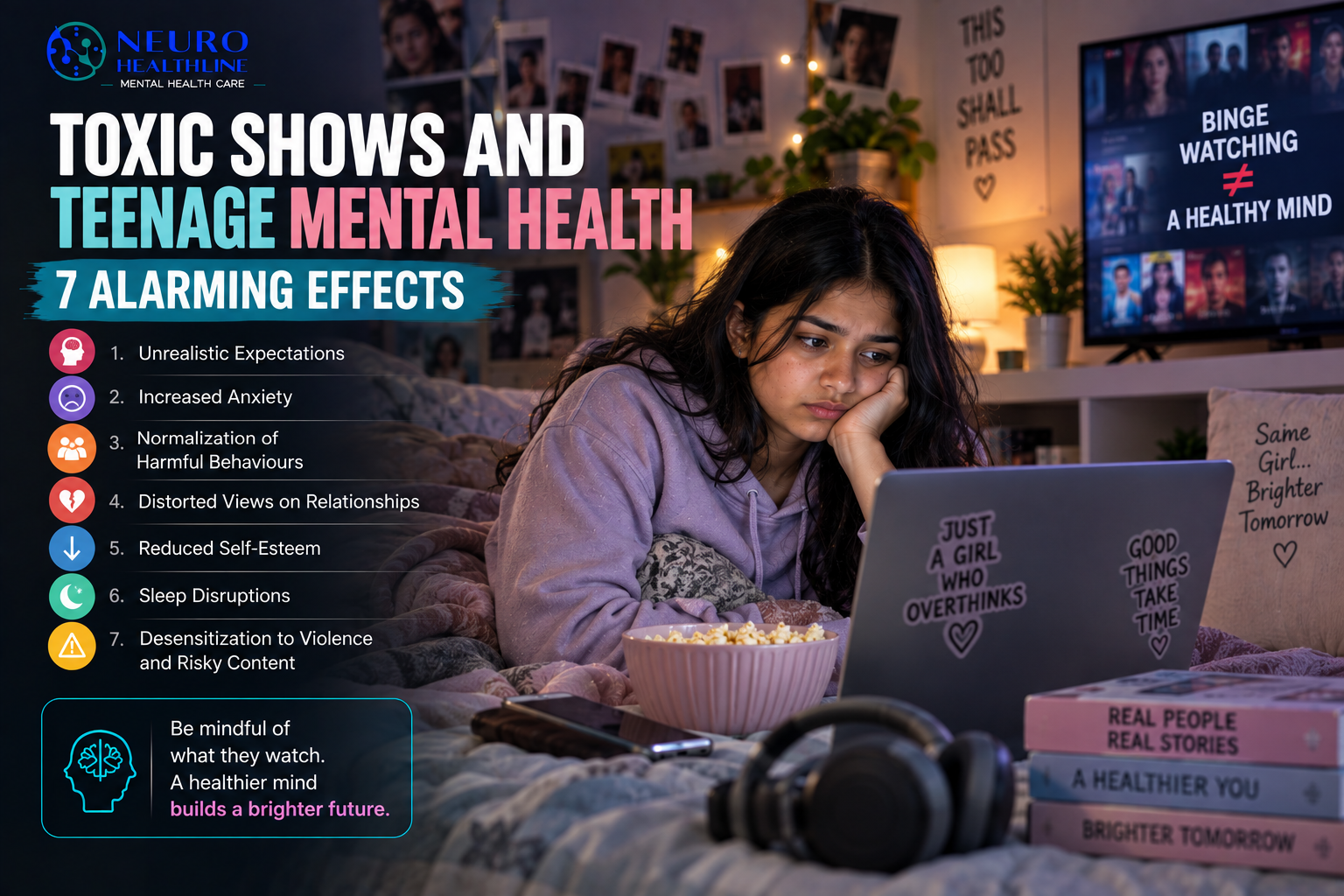
7 Alarming Effects of Toxic Shows on Teenage Mental Health
1. Suicide and Self-Harm Contagion
The most clinically alarming intersection of toxic shows and teenage mental health is the well-established phenomenon of Werther effect — the increase in suicide and self-harm rates following high-profile media depictions of these behaviours. The 13 Reasons Why data cited above represents the most dramatic documented instance, but the underlying mechanism — suicide contagion through media exposure — is one of the most consistently replicated findings in adolescent psychiatric research. According to NCBI PubMed, media depictions of suicide that present the method, that romanticise or aestheticise the act, or that depict it as producing the outcomes the individual sought — attention, revenge, love — are specifically associated with increased suicide rates among the most vulnerable adolescent audiences. The suicide scene in 13 Reasons Why violated every established safe messaging guideline — and streaming platforms continue to produce and distribute content with comparable characteristics.
2. Normalisation of Substance Use and Addiction
A significant proportion of the most viewed OTT content among Indian teenagers normalises, glamourises, or romanticises substance use — presenting drug and alcohol consumption as the natural accompaniment of social sophistication, artistic identity, or emotional intensity. Toxic shows and teenage mental health intersect critically here because the adolescent brain’s reward system is particularly sensitive to social modelling of rewarding behaviours — and content that presents substance use as integral to the attractive, interesting lives of protagonists the teenager has developed parasocial relationships with constitutes precisely the social modelling most likely to reduce the inhibitory thresholds around substance experimentation. The connections to our exploration of drug abuse and mental health are direct — the content environment in which teenagers are making their first decisions about substances is saturated with glamourised representations of use.
3. Glamourisation of Mental Illness as Identity
One of the subtler but clinically significant intersections of toxic shows and teenage mental health is the increasing glamourisation of mental illness as a component of interesting, aesthetically appealing identity — the sad, tragic, emotionally turbulent protagonist whose suffering is presented as the source of their depth, creativity, and desirability. This narrative template — present across Euphoria, Skins, and a significant proportion of indie-aesthetic content popular among Gen Z — risks creating a cultural environment in which mental illness is unconsciously adopted as identity rather than recognised as a clinical condition requiring treatment, potentially deepening actual mental health conditions while delaying the help-seeking that would address them.
4. Hyperviolence and Desensitisation
Toxic shows and teenage mental health intersect through the progressive desensitisation to violence that exposure to graphic content produces in the developing adolescent brain. Shows including Squid Game — the most watched Netflix series in history — present extreme violence with a visual fidelity and emotional investment that creates genuine psychological impact in first-time viewers and progressively less impact with repeated exposure — the desensitisation that signals neurological adaptation to violence as entertainment. Desensitisation to violence is associated with reduced empathy, increased aggression, and a progressive recalibration of the threat threshold that makes real-world violence feel less significant.
5. Toxic Relationship Normalisation
A significant proportion of teen-targeted dramatic content presents relationships characterised by emotional manipulation, controlling behaviour, jealousy-as-love, and toxic dependency as the most romantic and most desirable relationship template — creating relational scripts that teenage viewers, without the experience or prefrontal development to critically evaluate them, may internalise as relationship ideals. Toxic shows and teenage mental health intersect here through the formation of relationship expectations and relationship-behaviour normalisation that directly influences how teenagers interpret, enter, and maintain their first significant relationships.
6. Anxiety and Existential Dread Amplification
Content that presents nihilistic worldviews, existential meaninglessness, climate catastrophe, societal collapse, or the fundamental futility of human endeavour — themes present in significant proportion of the critically acclaimed content most watched by Gen Z — interacts with the quarter life crisis identity uncertainty and Gen Z mental health challenges that are already generating anxiety and hopelessness at clinical levels. Toxic shows and teenage mental health intersect through the amplification of existential anxiety in an audience that is already struggling to construct a coherent, hopeful personal narrative in a genuinely uncertain world.
7. Sleep Disruption Through Binge Watching
The relationship between toxic shows and teenage mental health includes a powerful and often overlooked physiological pathway through sleep disruption. Binge watching — the platform-designed, autoplay-facilitated consumption of multiple episodes in a single session — is associated with severely disrupted sleep architecture, with teenagers routinely sacrificing 2 to 4 hours of sleep per night during active series engagement. The sleep consequences — connecting directly to our analysis of sleep disorders in teenagers in Kochi — include impaired emotional regulation, reduced cognitive performance, increased anxiety and depression vulnerability, and the chronic fatigue that makes every other mental health challenge more difficult to manage.
What Parents Can Do About Toxic Shows and Teenage Mental Health
The most effective parental response to the relationship between toxic shows and teenage mental health is neither blanket content prohibition — which typically drives consumption underground while damaging the trust relationship that genuine influence requires — nor uncritical acceptance of all content as simply entertainment. It is engaged, ongoing, curious conversation about the content teenagers are consuming — what it presents, how it makes them feel, what it normalises, and what it might be teaching them about relationships, mental health, substance use, and what constitutes a meaningful life.
The most important protective factor against the harmful effects of toxic shows and teenage mental health consequences is not content restriction but critical media literacy — the capacity to engage with content as a constructed narrative with specific choices behind it, rather than as a transparent window onto social reality. NeuroHealthline’s neuropsychotherapy approach to teen mental health specifically develops this critical media literacy alongside the nervous system regulation, anxiety treatment, and identity development work that our Gen Z mental health and teen depression treatment programs provide. The World Health Organization identifies media exposure as a significant and modifiable environmental factor in adolescent mental health — and responsible media literacy education is among the most scalable interventions available for population-level adolescent mental health protection.
FAQ — Toxic Shows and Teenage Mental Health
Should parents prevent teenagers from watching all dark or challenging content?
No — exposure to challenging themes in fiction, when processed with critical reflection and emotional support, can build empathy, emotional intelligence, and the capacity to engage with complexity. The concern is specifically content that glorifies harmful behaviours, depicts them irresponsibly, or is consumed without any critical processing framework.
How do I talk to my teenager about toxic show content without seeming controlling?
By approaching the conversation with genuine curiosity rather than judgment — asking what they found compelling, what they felt during and after watching, and what they think the show is saying about mental health, relationships, or substance use — rather than immediately expressing concern or imposing restrictions.
Are all dark and intense shows harmful to teenage mental health?
No. Darkness, moral complexity, and emotional intensity in storytelling are not inherently harmful — they are often the characteristics of the most meaningful and developmentally valuable fiction. The concern is specifically content that presents suicide methods irresponsibly, glamourises self-harm or substance use without consequence, or normalises toxic relational dynamics as romantic.
My teenager seems more anxious and withdrawn after binge watching a particular show. What should I do?
Take it seriously and make space for conversation. Ask about the show and what they are feeling without immediately attributing the mood change to the content — creating a safe environment in which they can share their experience. If withdrawal and anxiety persist beyond a few days, a professional assessment is appropriate.
Can therapy address the mental health effects of harmful media content?
Yes. Neuropsychotherapy specifically addresses the narrative frameworks, relational scripts, and normalised behaviours that harmful content installs — alongside the anxiety, depression, and identity challenges they interact with. Media content is treated as a relevant clinical variable, not a peripheral lifestyle factor.