


In 2021, Frances Haugen — a former Facebook data scientist — leaked internal company research to the United States Congress revealing that Meta’s own researchers had concluded that Instagram made body image issues worse for one in three teenage girls. The company knew. They continued anyway. This single fact encapsulates the most important clinical reality about eating disorders and social media — that the relationship between them is not accidental, not incidental, and not simply the result of vulnerable individuals responding badly to neutral content. It is a measurable, documented, causally established relationship in which platforms engineered for maximum engagement are producing eating disorder pathology in a generation of young people at a scale and speed that clinical services are struggling to keep pace with. Across India — where the combination of social media penetration, appearance-focused influencer culture, and a cultural silence around eating disorders as a legitimate mental health condition has created uniquely fertile conditions for eating disorder development — eating disorders and social media represent one of the most urgent and most underacknowledged mental health challenges of the current decade.
Understanding the Connection Between Eating Disorders and Social Media
The relationship between eating disorders and social media operates through multiple simultaneous psychological and neurological mechanisms — each of which would be concerning in isolation, and which together create a uniquely powerful eating disorder risk environment. Social comparison is the most fundamental mechanism — the brain’s evolved tendency to evaluate its social standing relative to perceived peers is systematically exploited by image-based social media platforms that algorithmically surface the most physically idealised content to the most appearance-sensitive viewers. For a teenager whose body is changing in ways they feel uncertain about, whose sense of social belonging is contingent on peer acceptance, and whose prefrontal regulatory capacity is still developing — being served an algorithmically curated stream of perfectly proportioned, flawlessly filtered bodies multiple hours per day activates a social comparison response that the developing nervous system has no neurological defence against.
Thin inspiration content — colloquially known as thinspiration or thinspo — is among the most clinically concerning intersection of eating disorders and social media. Despite years of platform moderation efforts, content glorifying extreme thinness, restriction, and eating disorder behaviours continues to circulate across Instagram, TikTok, and Pinterest — often coded in ways that evade algorithmic detection while remaining perfectly legible to the eating disorder community for whom it serves as both triggering content and subcultural reinforcement. Research published on NCBI PubMed confirms that even brief exposure to idealised body images on social media produces measurable increases in body dissatisfaction and dietary restraint intentions — with repeated exposure over months and years producing the progressive reinforcement of restrictive eating cognitions that characterise eating disorder development.
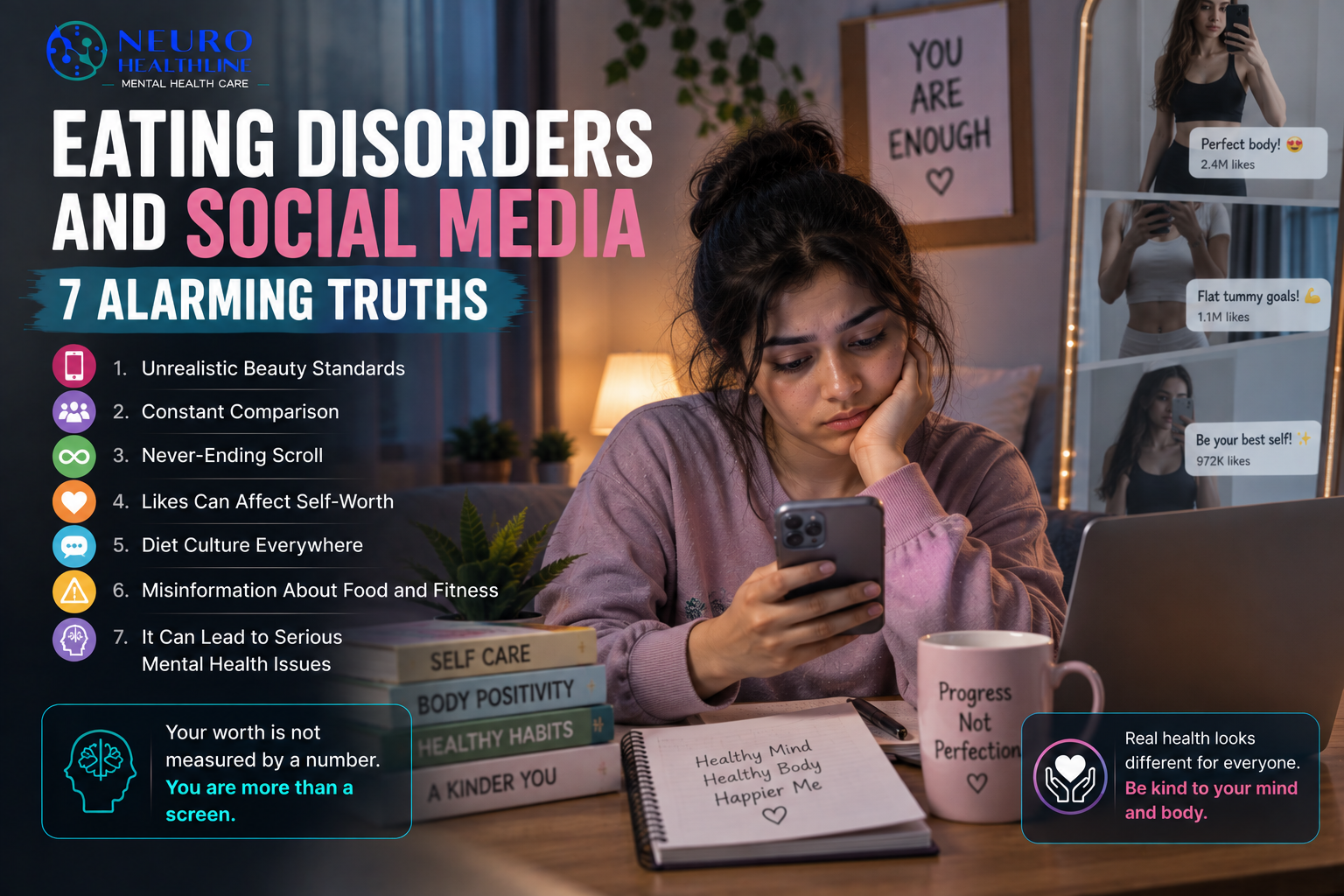
7 Alarming Truths About Eating Disorders and Social Media
1. Instagram’s Own Research Confirmed the Harm — And They Continued Anyway
The most alarming truth about eating disorders and social media is not that social media causes body image problems — it is that at least one major social media company possessed internal research demonstrating that its platform made body image worse for teenage girls and continued operating without meaningful change. The Frances Haugen revelations established beyond reasonable doubt that the eating disorders and social media relationship is not an unintended consequence of a neutral technology — it is a documented harm produced by a platform that prioritised engagement metrics over user safety, specifically in relation to its youngest and most vulnerable users.
2. Fitspiration Is as Dangerous as Thinspiration
One of the most important and least recognised truths about eating disorders and social media is that the fitness and wellness content that presents itself as a healthy alternative to thin ideal content — fitspiration, clean eating, wellness influencers — is associated with equivalent levels of body dissatisfaction and disordered eating behaviour as explicitly pro-thin content. The pursuit of a particular body aesthetic, packaged in the language of health and discipline rather than thinness and beauty, produces the same cognitive and behavioural patterns of appearance preoccupation, dietary restriction, and body dissatisfaction that characterise clinical eating disorders — while clothing them in socially acceptable, even admirable language that makes them more insidious and more difficult for both the individual and those around them to recognise as pathological.
3. Eating Disorders Are the Most Lethal Mental Health Condition
In the context of eating disorders and social media, it is essential to understand that eating disorders are not a phase, a diet gone wrong, or an expression of vanity — they are serious, potentially life-threatening psychiatric conditions with the highest mortality rate of any mental health disorder. Anorexia nervosa specifically carries a mortality rate of approximately 10% — from cardiac complications, electrolyte abnormalities, and suicide — making the eating disorders and social media relationship one of the most literally deadly intersections of technology and mental health that exists.
4. Boys and Young Men Are Increasingly Affected
The cultural narrative around eating disorders and social media positions this as a girls’ issue — and while girls and women are disproportionately affected, the clinical reality is that eating disorders among boys and young men are rising sharply, driven by the muscular ideal that fitness influencer culture promotes as aggressively for male audiences as thin ideal culture does for female ones. Male eating disorder presentations — often oriented around muscle dysmorphia, orthorexia, and compulsive exercise rather than restriction — are significantly underdiagnosed because they do not fit the culturally dominant eating disorder template, and because the stigma of eating disorders is particularly acute for young men in India.
5. Social Media Algorithms Actively Recommend Eating Disorder Content
Multiple investigations have demonstrated that social media algorithms — particularly on TikTok and Instagram — actively recommend increasingly extreme body image and eating disorder-adjacent content to users who engage with initial appearance-focused posts. A teenager who likes one fitness post may find, within a series of algorithmic recommendation steps, that their feed has been progressively populated with increasingly extreme dietary restriction content — not because they sought it out but because engagement maximisation algorithms identified that this content profile drives more viewing time for this user type. The eating disorders and social media relationship is therefore not simply about individual vulnerability to harmful content — it is about algorithms actively navigating users toward more extreme content in pursuit of engagement.
6. Kerala’s Teenagers Are Not Protected by Cultural Norms
There is a tendency to assume that India’s cultural relationship with food — in which eating well and having a healthy body are traditionally valued rather than stigmatised — provides some protection against the eating disorders and social media dynamic that is driving eating disorder rates in Western countries. The clinical evidence does not support this assumption. Across Kerala’s urban adolescent population, eating disorder presentations are rising — driven by the same Instagram influencer exposure, the same fitness culture content, and the same appearance-focused social comparison that is driving eating disorder development in every other country with significant social media penetration. Cultural protective factors do not override algorithmically delivered, neurologically targeted body image content consumed multiple hours daily.
7. Recovery Requires Addressing Social Media Directly
The final and most practically important truth about eating disorders and social media is that recovery from eating disorders that have developed in the context of social media use requires directly addressing social media as part of the treatment — not simply as a lifestyle recommendation but as a clinical intervention. Social media exposure is not a neutral backdrop to eating disorder recovery — it is an active, ongoing source of eating disorder-maintaining content that requires clinical management as deliberately and specifically as any other aspect of the treatment plan. This is precisely the clinical approach that NeuroHealthline’s treatment framework incorporates — recognising that eating disorders and social media cannot be effectively addressed by treating the disorder while leaving the environment generating it unchanged. Our body image and mental health and social media addiction treatment programs address these intersecting dimensions of eating disorder recovery within an integrated clinical framework.
The Neuroscience of Eating Disorders — Why They Are Not a Choice
Understanding eating disorders and social media from a neuroscientific perspective is essential for the compassion and clinical accuracy that effective response requires. Eating disorders are not choices, not diets that went too far, and not expressions of vanity or attention-seeking — they are serious neuropsychiatric conditions involving measurable dysregulation of the reward system, the interoceptive processing network, the serotonin and dopamine systems governing mood and appetite regulation, and the cognitive flexibility systems governing the rigid thinking patterns that maintain eating disorder behaviours.
Social media accelerates eating disorder development by providing the social comparison, visual triggers, and subcultural reinforcement that activate and maintain these neurological patterns in individuals with biological vulnerability — and by creating the social environment in which the most extreme eating disorder behaviours receive the most social engagement. The neurological vulnerability to eating disorders is not created by social media — but social media creates the environmental conditions in which existing vulnerability is most rapidly and most powerfully activated.
At NeuroHealthline, our approach to supporting eating disorder recovery uses HEG neurofeedback to directly address the prefrontal rigidity, reward dysregulation, and self-critical neural overactivation underlying eating disorder cognitions; HRV biofeedback therapy to restore the autonomic nervous system regulation that eating disorder behaviours progressively disrupt; functional nutrition support to address the medical nutritional rehabilitation that eating disorder recovery requires; and compassion-focused neuropsychotherapy to address the body image, self-worth, and perfectionism patterns that maintain eating disorder behaviours — within a clinical framework that directly engages with the social media environment as a core component of comprehensive eating disorder treatment. The World Health Organization recognises eating disorders as serious mental health conditions requiring specialist, evidence-based treatment — the clinical standard our approach is built to uphold.
FAQ — Eating Disorders and Social Media
Can social media directly cause eating disorders?
Social media does not cause eating disorders independently — eating disorders involve biological, psychological, and environmental factors. However, social media is a powerful environmental trigger and amplifier that significantly increases eating disorder development risk in individuals with existing biological vulnerability, and maintains eating disorder behaviours in those already affected.
Which social media platforms are most strongly linked to eating disorders?
Instagram has the strongest evidence base linking it to eating disorder development — primarily through its image-based format and the idealised body content it preferentially promotes. TikTok has emerged as a significant concern through its algorithm’s capacity to progressively recommend extreme dietary content, while Pinterest has faced criticism for hosting pro-eating disorder communities.
How can parents identify if their teenager’s social media use is contributing to disordered eating?
Key indicators include significant changes in eating behaviour following increased social media use; comments about food, weight, and body image that reflect social media influencer language; following large numbers of fitness, diet, or appearance-focused accounts; and evidence of searching for or engaging with restriction, diet, or body transformation content.
Is eating disorder treatment available in Kochi?
NeuroHealthline provides neuroscience-based mental health support for the psychological dimensions of eating disorder recovery — including body image, anxiety, depression, and the social media behaviours maintaining the disorder. Comprehensive eating disorder treatment typically requires a multidisciplinary team including medical, nutritional, and psychological professionals working in coordination.
What is the most important first step if you suspect an eating disorder?
Seek professional assessment immediately — eating disorders are the most lethal mental health condition and early intervention produces dramatically better outcomes than delayed treatment. Approach the conversation with the affected individual with compassion rather than concern about appearance, and focus on wellbeing rather than food or weight.