


Here is a number that should stop you in your tracks: the average Indian smartphone user picks up their phone 150 times per day. That is once every six and a half minutes of waking life — before accounting for the extended sessions of scrolling, watching, messaging, and consuming that happen between those pickups. Phone addiction and mental health are now so deeply intertwined that neuroscientists, psychologists, and public health researchers are describing smartphones as the most consequential behavioural health challenge of the twenty-first century — not because smartphones are inherently harmful, but because the applications built on them have been engineered with extraordinary sophistication to exploit the deepest vulnerabilities of the human brain’s attention, reward, and social systems. If you recognise that your phone use is affecting your sleep, your relationships, your concentration, your anxiety levels, or your capacity to be genuinely present in your own life — and if you have noticed that your attempts to change this have consistently failed despite genuine intention — you are not weak and you are not alone. Phone addiction and mental health consequences are not a personal failure. They are the predictable outcome of a technology environment specifically designed to make voluntary disengagement as neurologically difficult as possible.
What Makes Smartphones So Addictive — The Neuroscience
Understanding phone addiction and mental health begins with understanding why the smartphone is neurologically unlike any technology that has preceded it. The smartphone is not simply a communication device or an entertainment platform — it is a delivery mechanism for an unprecedented concentration of dopaminergic triggers, social reward signals, variable reward schedules, and infinite novelty that activates the brain’s reward circuitry with a frequency, intensity, and unpredictability that no naturally occurring environment has ever produced.
Every notification — a like, a comment, a message, a news alert — delivers a micro-dose of dopaminergic anticipation. Every swipe downward to refresh a feed replicates the variable reward mechanism that makes slot machines compulsive. Every social media post received engages the social reward system — the same neural circuits that, in the ancestral environment, governed belonging, status, and survival. Every alarming headline activates the negativity bias and threat-detection system that compels attention to potential danger. The smartphone delivers all of these simultaneously, continuously, in a package that fits in your pocket and is available every moment of every day.
The result of sustained exposure to this neurological environment is measurable brain change — the same dopamine receptor downregulation, reward circuit dysregulation, and prefrontal underactivation that characterises other recognised addictions. Phone addiction and mental health consequences are not metaphorical — they reflect genuine neurological changes produced by a technology environment that the human brain was not designed to navigate without developing pathological patterns of engagement. Research published on NCBI PubMed confirms that problematic smartphone use is associated with measurable alterations in dopamine signalling, prefrontal regulatory capacity, and autonomic nervous system function — the same neurological signatures observed in substance and behavioural addiction.
The Full Spectrum of Phone Addiction and Mental Health Consequences
Phone addiction and mental health consequences operate across every dimension of psychological and physiological functioning — making their cumulative impact on wellbeing significantly greater than any individual symptom suggests when considered in isolation.
Anxiety is the most immediate and most prevalent mental health consequence of phone addiction. The chronic notification monitoring that smartphone dependency requires — the persistent background awareness of potentially incoming messages, alerts, and social responses — maintains the nervous system in a state of chronic low-level sympathetic activation that is neurologically indistinguishable from anxiety. The social comparison generated by social media apps on the smartphone continuously activates the threat-detection system. The fear of missing out created by the real-time visibility of others’ activities and experiences generates genuine anticipatory anxiety. And the phantom phone vibrations — the experience of feeling the phone vibrate when it has not — that heavy smartphone users commonly report are a clinically recognised symptom of anxiety generated by phone addiction specifically.
Depression develops through multiple simultaneous pathways in the context of phone addiction and mental health deterioration. The progressive displacement of real-world sources of meaning, connection, and accomplishment by the hollow, algorithmically dispensed rewards of phone-based consumption. The social comparison depression generated by the curated highlight reels of others’ lives. The dopamine system downregulation that chronic phone overuse produces — raising the reward threshold to a point where offline activities feel genuinely unrewarding by comparison. And the sleep disruption that phone addiction reliably produces — which is itself one of the most significant risk factors for depression available to modern life.
Attention fragmentation is perhaps the most pervasive and most professionally consequential phone addiction and mental health impact. The habitual high-frequency interruption of attentional flow by phone notifications — research suggests the average attention interruption from a smartphone notification persists for 23 minutes beyond the notification itself — progressively degrades the capacity for the sustained, deep focus that effective work, creative thinking, meaningful learning, and genuine conversation all require. The attentional system that heavy phone users develop is specifically adapted for frequent switching, rapid processing, and brief engagement — precisely the opposite of the sustained, deep attention that professional excellence and academic achievement demand.
Relationship deterioration is a profoundly underestimated phone addiction and mental health consequence. The phenomenon of phubbing — being physically present with another person while psychologically present with your phone — has been consistently demonstrated to reduce relationship satisfaction, increase interpersonal conflict, and produce genuine emotional detachment in partners, family members, and friends who experience it. The phone creates physical presence without psychological presence — the worst of both worlds for the quality of human connection that sustained mental health genuinely requires.
Sleep destruction is the most physiologically consequential phone addiction and mental health impact. Late-night phone use suppresses melatonin through blue light exposure, generates psychological arousal that prevents sleep onset, and fragments sleep architecture through notification interruptions — producing the chronic sleep deprivation whose cascading consequences for mental health, cognitive performance, immune function, and metabolic health are among the most serious and most extensively documented in contemporary medicine. The connection to our analysis of doomscrolling effects on mental health is direct — doomscrolling is primarily a phone behaviour, and its mental health consequences are inseparable from the broader phone addiction picture.
Who Is Most Vulnerable to Phone Addiction and Mental Health Consequences?
While phone addiction and mental health consequences affect people across all age groups and demographics, certain populations carry heightened vulnerability that warrants specific clinical attention. Teenagers and Gen Z — for whom smartphones are the primary medium of social life, information access, and identity formation, and whose prefrontal regulatory capacity is still developing — are experiencing phone addiction and mental health consequences at a scale and intensity that represents one of the most significant public health challenges facing India’s healthcare system today. The connections to our explorations of depression among youngsters, YouTube addiction in teenagers, and Instagram addiction and mental health are direct — phone addiction is the infrastructure through which all of these specific digital addiction patterns operate.
Young professionals in Kochi’s IT, finance, and corporate sectors face a distinctive phone addiction vulnerability — one in which the boundary between professional necessity and addictive overuse has been systematically eliminated by workplace cultures that expect constant connectivity, and in which the same device used for professional communication hosts every addictive application simultaneously. The occupational stress consequences of this pattern are explored in detail in our blog on stress management for IT professionals — where phone addiction is one of the primary mechanisms through which the always-on connectivity culture maintains occupational stress at clinical levels.
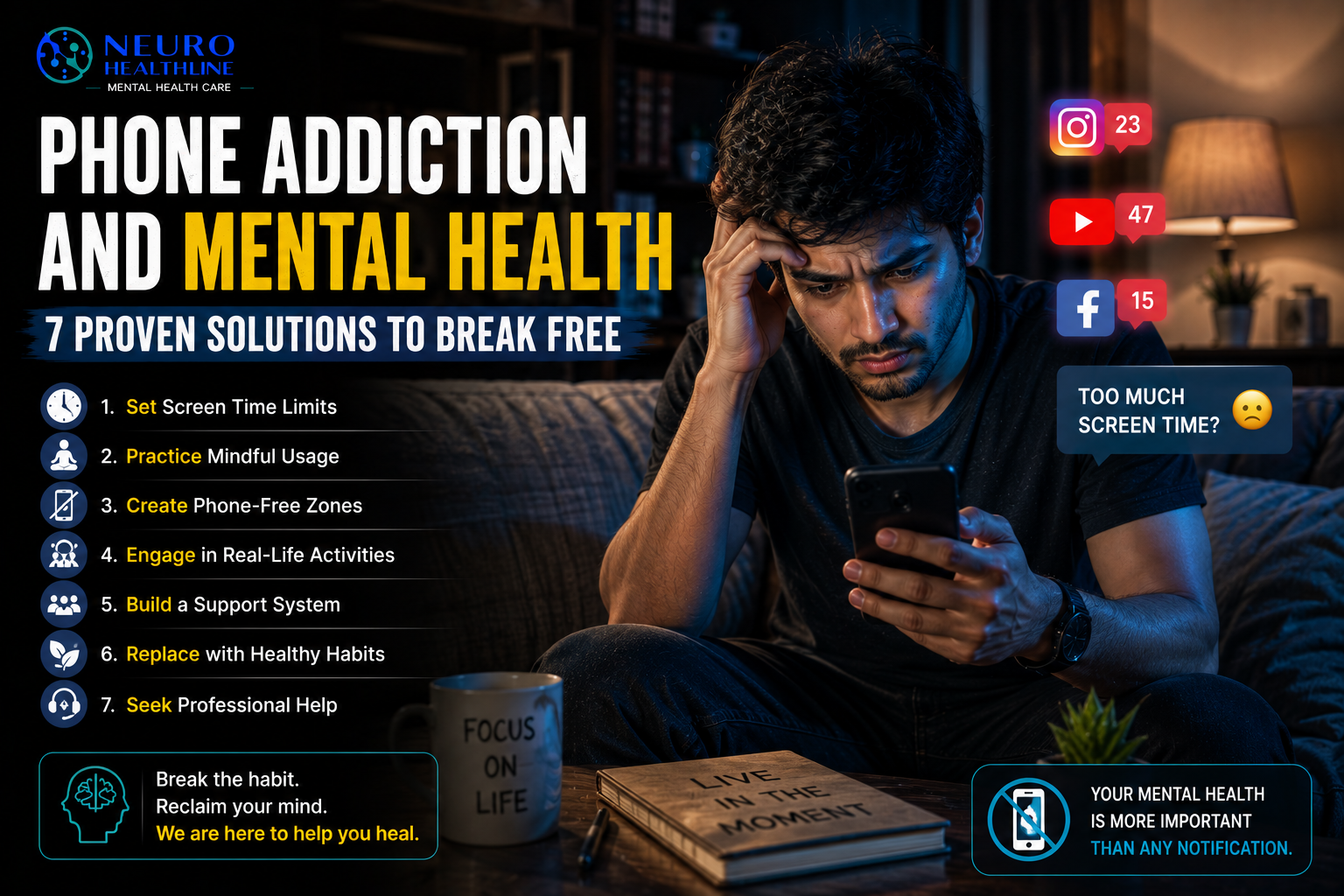
7 Proven Solutions for Phone Addiction and Mental Health Recovery
1. Neurological Assessment of Addiction Severity
Phone addiction and mental health recovery at NeuroHealthline begins with a comprehensive neurological assessment — using QEEG brain mapping to identify the specific reward circuit dysregulation and prefrontal underactivation driving the addiction pattern, and HRV profiling to map the autonomic nervous system dysregulation that phone addiction has produced. This objective neurological data repositions phone addiction from a moral failing to a measurable brain condition — reducing shame and increasing therapeutic engagement significantly.
2. HEG Neurofeedback for Reward Circuit Retraining
HEG neurofeedback is the cornerstone of neurological treatment for phone addiction and mental health recovery — directly strengthening the prefrontal cortex activation and regulatory capacity that phone addiction has progressively depleted. As prefrontal regulation improves, impulse control over phone use increases, the compulsive checking pattern weakens, and the capacity for voluntary disengagement from the phone strengthens — not through effortful suppression but through genuine neurological change in the regulatory systems governing behaviour.
3. HRV Biofeedback for Anxiety and Boredom Regulation
Anxiety and boredom are the two most powerful triggers of compulsive phone use — and HRV biofeedback therapy directly builds the autonomic nervous system resilience that makes these states genuinely manageable without the phone as a coping mechanism. Clients consistently report that as HRV regulation improves, the urgency of the impulse to reach for the phone in moments of discomfort, uncertainty, or boredom progressively diminishes — creating the neurological space in which genuine behavioural change becomes possible.
4. Dopamine System Restoration
Phone addiction produces measurable dopamine receptor downregulation — reducing baseline reward sensitivity and making offline activities feel genuinely less rewarding than they did before phone addiction developed. Phone addiction and mental health recovery at NeuroHealthline includes targeted functional nutrition and lifestyle protocols specifically designed to support dopamine system restoration — rebuilding the capacity for genuine satisfaction from the slower, deeper rewards of real-world activities, relationships, and accomplishment.
5. Sleep Restoration
Given the central role of phone-driven sleep disruption in maintaining and amplifying the mental health consequences of phone addiction, comprehensive sleep restoration is a non-negotiable component of phone addiction and mental health recovery. Our sleep restoration protocols address the specific phone-related sleep disruptors — melatonin suppression, psychological arousal from late-night content consumption, and notification-driven sleep fragmentation — through circadian realignment, pre-sleep HRV biofeedback, and CES-supported sleep architecture restoration.
6. Structured Digital Behaviour Redesign
Effective phone addiction and mental health recovery does not require living without a smartphone — which is neither realistic nor necessary in contemporary professional and social life. It requires a deliberately structured redesign of phone use patterns — moving from reactive, compulsive, notification-driven phone engagement to deliberate, intentional, values-aligned use that serves genuine goals rather than the platform’s engagement metrics. Our digital behaviour redesign approach is practical, gradual, and specifically adapted to each client’s professional and social context — producing sustainable change rather than temporary restriction.
7. Neuropsychotherapy for Identity and Meaning Beyond the Phone
Phone addiction frequently fills a psychological vacuum — providing stimulation, social connection, validation, and identity performance that the offline life does not currently provide in adequate measure. Phone addiction and mental health recovery at NeuroHealthline includes existential neuropsychotherapy that addresses this vacuum directly — helping clients identify, invest in, and build the offline sources of meaning, connection, accomplishment, and identity that make the phone’s hollow substitutes progressively less compelling. This therapeutic dimension of recovery is what distinguishes genuine phone addiction treatment from digital detox programs that address the behaviour without addressing the psychological needs it is meeting.
Breaking Free — What Recovery from Phone Addiction Actually Looks Like
Recovery from phone addiction and mental health consequences is not a dramatic overnight transformation — it is a progressive, neurologically grounded process in which the compulsive urgency of phone use gradually diminishes, the capacity for genuine presence in offline life gradually rebuilds, and the relationship with the smartphone shifts from one of compulsive dependency to one of deliberate, purposeful use. Most clients at NeuroHealthline undergoing phone addiction and mental health treatment report a noticeable reduction in checking compulsivity within the first three to four weeks of neurofeedback and biofeedback training — a subjective sense of increasing space between the impulse to reach for the phone and the act of doing so that represents genuine neurological change rather than effortful suppression. As this space grows, offline experiences progressively recover their capacity to be genuinely rewarding, real-world relationships become more engaging and satisfying, sleep improves with cascading benefits for cognitive performance and emotional regulation, and the overall sense of presence and aliveness in one’s own life — the quality most systematically eroded by phone addiction — gradually returns.
Our comprehensive social media addiction treatment program addresses phone addiction within the full context of digital addiction — recognising that phone addiction rarely exists in isolation but is the primary vehicle through which social media addiction, YouTube addiction, and doomscrolling collectively operate. The World Health Organization recognises problematic smartphone use as one of the most significant and most rapidly growing contributors to global mental health burden — and NeuroHealthline’s phone addiction and mental health recovery program is built to address this burden with the clinical depth and neurological precision it genuinely demands.
Frequently Asked Questions About Phone Addiction and Mental Health
How do I know if I have phone addiction rather than normal heavy smartphone use?
The defining features of phone addiction rather than heavy but healthy smartphone use are loss of voluntary control — being unable to stop or reduce phone use despite genuine intention and repeated attempts; functional impairment — measurable negative impact on sleep, relationships, work performance, or emotional wellbeing attributable to phone use; and withdrawal-like distress — genuine anxiety, irritability, or restlessness when unable to access the phone, rather than simple inconvenience.
Can phone addiction cause permanent brain damage?
The neurological changes associated with phone addiction — dopamine receptor downregulation, reduced prefrontal activation, altered reward sensitivity — are neuroplastic changes rather than structural damage, meaning they are fully reversible with appropriate intervention. The brain’s capacity for neuroplastic recovery is one of the most important clinical realities of phone addiction treatment — and is the neurological foundation on which NeuroHealthline’s neurofeedback-based recovery approach is built.
Is phone addiction worse for teenagers than adults?
Significantly. The adolescent brain’s still-developing prefrontal regulatory capacity and heightened dopaminergic reward sensitivity make it substantially more vulnerable to phone addiction’s neurological impact — both in terms of the speed with which addiction patterns develop and the depth of neurological change they produce during the critical developmental window of adolescence.
Can I recover from phone addiction without professional help?
Mild phone addiction with limited functional impairment may respond to self-directed digital behaviour restructuring — structured screen-free periods, notification management, device-free zones, and intentional offline activity investment. More significant phone addiction and mental health consequences — particularly where anxiety, depression, or sleep disorders have developed — typically require clinical support that directly addresses the neurological dysregulation driving the addiction.
How long does recovery from phone addiction and mental health consequences take?
Most clients undergoing treatment at NeuroHealthline report meaningful reductions in checking compulsivity and associated anxiety within three to six weeks, with more comprehensive neurological recovery and sustainable behavioural change typically consolidating over three to five months of consistent treatment.