


Something is happening to an entire generation. In schools and colleges across India, in family WhatsApp groups and parent-teacher meetings, in the quietly alarmed conversations happening between teachers who are watching their students change and parents who feel their child slipping away — a crisis is unfolding that is finally beginning to receive the serious attention it has always deserved. Depression among youngsters has reached levels that cannot be explained by typical adolescent moodiness, growing pains, or the inevitable challenges of growing up. It is a clinical emergency — one driven by the collision of an unprecedented social media environment, an intensely competitive academic culture, a rapidly changing world that offers fewer clear roadmaps than previous generations navigated, and a collective mental health literacy that has not yet caught up with the scale of what young people are experiencing. At NeuroHealthline, depression among youngsters is one of the presentations we see most urgently and most frequently — and understanding it clearly is the essential first step toward helping the young person in your life who may be silently struggling.
Why Depression Among Youngsters Is Different from Adult Depression
One of the most important clinical realities about depression among youngsters is that it frequently looks nothing like the adult depression that most parents, teachers, and even general practitioners are trained to recognise. This presentation gap is one of the most significant reasons depression among youngsters goes undiagnosed for so long — and why the gap between a young person beginning to experience depression and receiving appropriate help typically spans more than a year in India.
Adult depression is typically characterised by prominent sadness, tearfulness, and social withdrawal that is visible and recognisable to the people around the depressed individual. Depression among youngsters, by contrast, more commonly presents as persistent irritability and anger — making depressed young people appear difficult, defiant, or disrespectful rather than distressed; academic performance decline that teachers and parents interpret as laziness or attitude rather than neurological impairment; physical complaints including chronic headaches, stomach aches, and fatigue that generate medical investigations rather than mental health assessment; and a maintained social media presence that creates a misleading picture of social engagement that masks the internal reality of isolation and despair.
Understanding these age-specific presentations is not simply clinically useful — it is the difference between catching depression among youngsters early, when intervention is most effective and most transformative, or missing it entirely until the consequences have escalated to a point that demands crisis response.
The Perfect Storm — What Is Driving the Rise of Depression Among Youngsters
Depression among youngsters does not develop in a vacuum — it emerges from a specific intersection of biological, psychological, social, and environmental factors that have converged with unprecedented intensity in the lives of today’s young people. Understanding this intersection is essential for anyone seeking to prevent, recognise, or address depression among youngsters effectively.
Social media is the single most discussed driver of the rise in depression among youngsters — and the clinical evidence increasingly supports this concern. The social comparison that platforms like Instagram, YouTube, and Snapchat systematically generate exposes young people to a curated reality in which everyone else appears more attractive, more socially connected, more academically successful, and more generally enviable than they themselves feel — a distorted reality that the brain processes as genuine social inferiority and responds to with the neurological markers of depression. The connection to our explorations of Instagram addiction and mental health and doomscrolling effects on mental health is direct — these digital behaviours are not separate from depression among youngsters but among its most powerful contemporary drivers.
Academic pressure is the second major driver — particularly in Kerala, where the competitive examination culture creates a social environment in which examination results carry enormous implications for family pride, career trajectory, and social standing. For young people navigating this environment with developing nervous systems and incomplete emotional regulation capacity, the sustained pressure of academic competition creates a chronic stress state that directly depletes the neurochemical and physiological resources that protect against depression. Sleep deprivation — driven by late-night social media use, exam anxiety, and the academic demands of a curriculum that leaves insufficient time for genuine rest — removes the most important neurological protection against depression that the developing brain has available to it.
Research published on NCBI PubMed confirms that depression among youngsters is strongly associated with the convergence of social media exposure, academic pressure, sleep disruption, and reduced face-to-face social connection — all of which are acutely present in the lives of young people across India today, and particularly among Kerala’s academically oriented youth population.
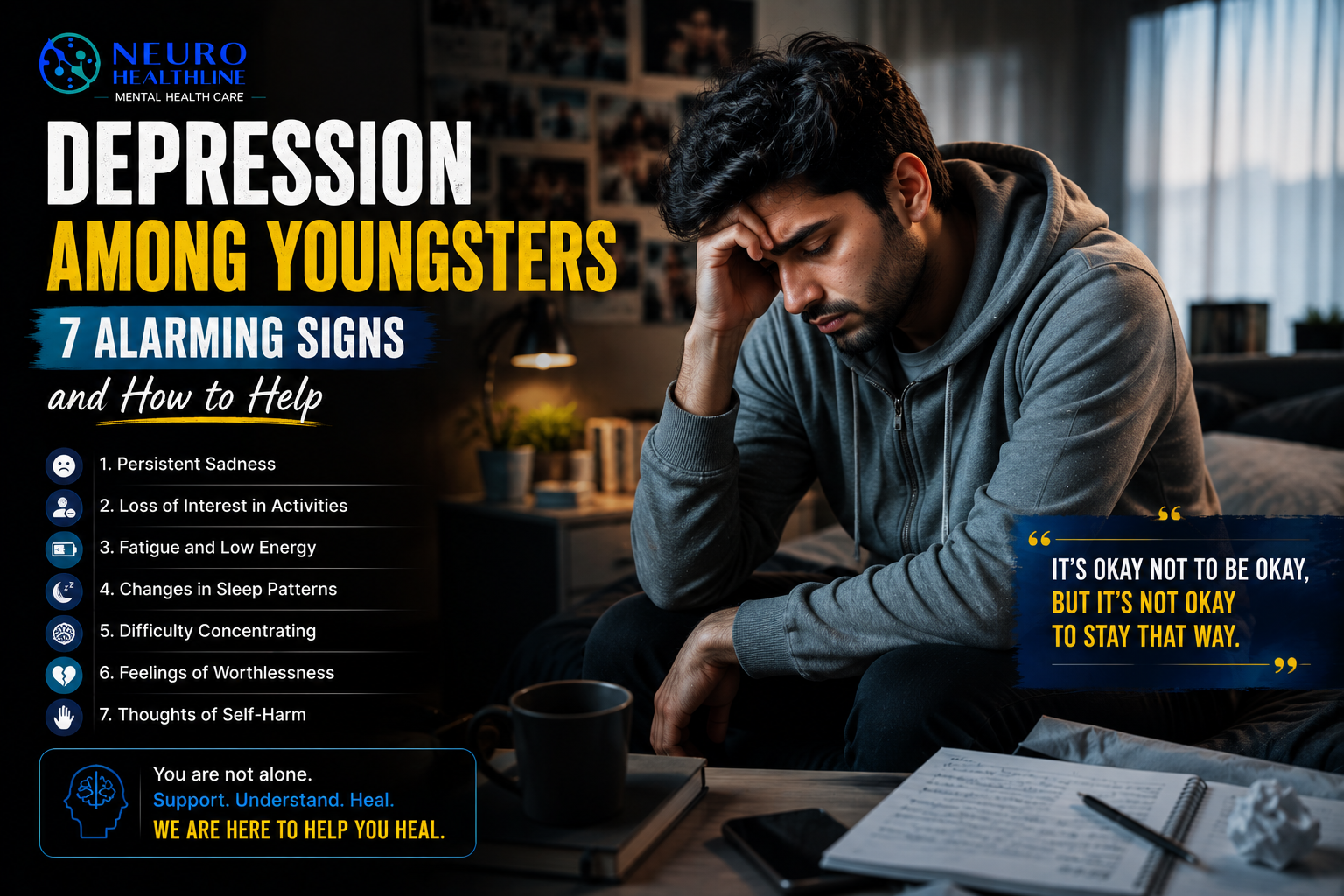
7 Alarming Signs of Depression Among Youngsters
1. Persistent Irritability and Unexplained Anger
Rather than visible sadness, depression among youngsters frequently presents as persistent, disproportionate irritability — snapping at family members, becoming angry over minor frustrations, and displaying an emotional reactivity that feels qualitatively different from typical teenage moodiness. This irritability reflects the neurological impairment of prefrontal regulatory control that depression produces — the brain’s reduced capacity to modulate emotional responses — rather than deliberate behavioural choice.
2. Withdrawal from Previously Loved Activities
When a young person who previously loved football, music, art, or social gatherings progressively stops participating — not because of schedule conflicts but because they simply no longer feel like going — this anhedonia is one of the most clinically significant signs of depression among youngsters. The loss of capacity to experience pleasure from activities that previously brought genuine enjoyment reflects the specific dopaminergic and serotonergic disruption that defines the neurobiology of depression.
3. Declining Academic Performance Without Clear Cause
Depression among youngsters directly impairs the cognitive functions most critical for academic performance — working memory, sustained attention, information processing speed, and executive function. When a previously capable student’s grades begin to fall, concentration becomes difficult, and intellectual engagement progressively reduces without a clear academic explanation, depression is a clinical priority that must be ruled out before attributing the change to effort or attitude.
4. Changes in Sleep Patterns
Either sleeping far more than usual — the hypersomnia that depression frequently produces as the brain attempts to escape a waking state that feels unbearable — or experiencing severe insomnia, with an inability to fall asleep despite exhaustion, are significant signs of depression among youngsters. Sleep changes that are qualitatively different from the teenager’s normal pattern, persistent across more than two weeks, and accompanied by other signs on this list warrant clinical assessment rather than management through sleep hygiene advice alone.
5. Expressed Hopelessness or Worthlessness
When a young person begins expressing beliefs — whether directly or in passing — that the future is pointless, that nothing they do makes any difference, that they are a burden to the people around them, or that things will never improve, these are not dramatic expressions of teenage frustration. They are the cognitive symptoms of depression among youngsters that require immediate clinical attention. These expressions frequently appear in social media posts, text messages, or casual conversation long before they are recognised as clinically significant by the adults in the young person’s life.
6. Physical Complaints Without Medical Explanation
Depression among youngsters reliably produces genuine physical symptoms — the neuroinflammatory, autonomic, and neuroendocrine consequences of a depressed brain manifesting as persistent headaches, chronic stomach pain, unexplained fatigue, and a general physical heaviness that the young person struggles to articulate. Many young people with undiagnosed depression in India present first to general practitioners with these physical symptoms — and receive symptomatic treatment that addresses the physical presentation while the underlying depression continues unaddressed.
7. Increased Social Media Use Alongside Decreased Real-World Connection
One of the most characteristic paradoxes of depression among youngsters in the digital age is the simultaneous increase in social media activity and decrease in genuine face-to-face social connection. The depressed young person retreats from the genuine vulnerability and reciprocity of real-world relationships into the more controllable, less demanding arena of online social performance — maintaining or even increasing their social media output while progressively withdrawing from the authentic human connection that would most support their recovery.
The Neuroscience of Depression Among Youngsters — Why Early Intervention Matters
Depression among youngsters is not simply a psychological experience — it is a measurable neurological condition involving disrupted serotonin and dopamine systems, reduced prefrontal cortex activation, hippocampal volume reduction under chronic cortisol exposure, and neuroinflammatory processes that impair the neural communication underlying mood regulation, motivation, and cognitive performance. What makes this neurological picture particularly urgent in the context of depression among youngsters is the neuroplasticity of the adolescent brain — its heightened sensitivity to experience during the developmental window in which it is building the neural architecture that will define adult brain function.
Untreated depression during this window does not simply cause present suffering — it actively shapes the developing brain in ways that increase long-term vulnerability to recurrent depression, anxiety disorders, and chronic stress-related conditions into adulthood. The same neuroplasticity that makes the adolescent brain more vulnerable to depression’s damage also makes it more responsive to effective intervention — meaning that early, targeted treatment of depression among youngsters can produce neurological benefits that extend across an entire lifetime, not simply resolve current symptoms. This is the clinical evidence base that drives NeuroHealthline’s commitment to early intervention and accessible, stigma-free support for depression among youngsters across Kerala.
How NeuroHealthline Treats Depression Among Youngsters
NeuroHealthline’s approach to depression among youngsters is built on four foundational principles that distinguish it from conventional treatment options available in Kerala. First, it is neuroscience-based — using QEEG brain mapping to identify the specific neural patterns driving each young person’s depression, and HEG neurofeedback to directly restore the prefrontal cortex activation most consistently reduced in depression, producing measurable neurological recovery rather than symptom management. Second, it is physiologically comprehensive — addressing the nutritional deficiencies, sleep disruption, gut-brain axis dysregulation, and hormonal imbalances that maintain depression among youngsters at a physiological level that medication alone cannot reach. Third, it is developmentally sensitive — delivered within a therapeutic relationship that respects young people’s developmental needs for autonomy, identity exploration, and peer belonging, without the diagnostic labelling that deters so many young people in Kerala from seeking help. Fourth, it is family integrated — recognising that recovery from depression among youngsters occurs within a family system whose dynamics profoundly shape the trajectory of treatment.
Our dedicated depression treatment in Kochi and teen depression treatment programs provide the specific clinical pathways for young people and families seeking support, while our Gen Z mental health program addresses the broader generational context within which depression among youngsters is occurring across Kerala today. The World Health Organization identifies depression as a leading cause of disability globally among young people and emphasises that early intervention is the single most important factor in preventing long-term disability and recurrence — the clinical standard that our approach to depression among youngsters is built to uphold.
Frequently Asked Questions About Depression Among Youngsters
At what age can depression among youngsters begin?
Depression can begin at any age — including early childhood — though it becomes significantly more prevalent during adolescence, particularly in the 13 to 19 age range. The hormonal changes of puberty, combined with the social and academic pressures of secondary school, create a peak vulnerability window that makes this age group the most important target for early identification and intervention.
How is depression among youngsters different from typical teenage mood swings?
Typical teenage mood swings are relatively brief, situationally triggered, and do not persistently impair functioning across multiple domains of life. Depression among youngsters involves persistent low mood or irritability lasting more than two weeks, significant functional impairment across academic, social, and family domains, and physical symptoms including sleep disruption and fatigue that ordinary mood variation does not produce
Can social media cause depression among youngsters?
Social media is one of the most significant contributing factors — through social comparison, sleep disruption, reduced face-to-face connection, and the dopamine system dysregulation that compulsive social media use produces. For many young people, addressing social media use is an essential component of depression recovery, not simply a lifestyle recommendation.
Should antidepressants be used to treat depression among youngsters?
NeuroHealthline does not prescribe medication. Our approach uses non-pharmacological interventions — neurofeedback, biofeedback, functional nutrition, and neuropsychotherapy — to produce genuine neurological recovery. Families currently considering or using antidepressant medication should consult with their prescribing physician, and can discuss integrating our non-pharmacological program alongside existing medication management.
How can parents talk to a depressed youngster who refuses help?
Approaching a depressed young person with curiosity rather than concern, avoiding pressure to explain or justify their feelings, and focusing on connection rather than correction are the most effective initial strategies. Professional guidance on communication approaches is a core component of NeuroHealthline’s family support within our depression programs — helping parents navigate the conversation in ways that reduce rather than intensify resistance to help-seeking.