


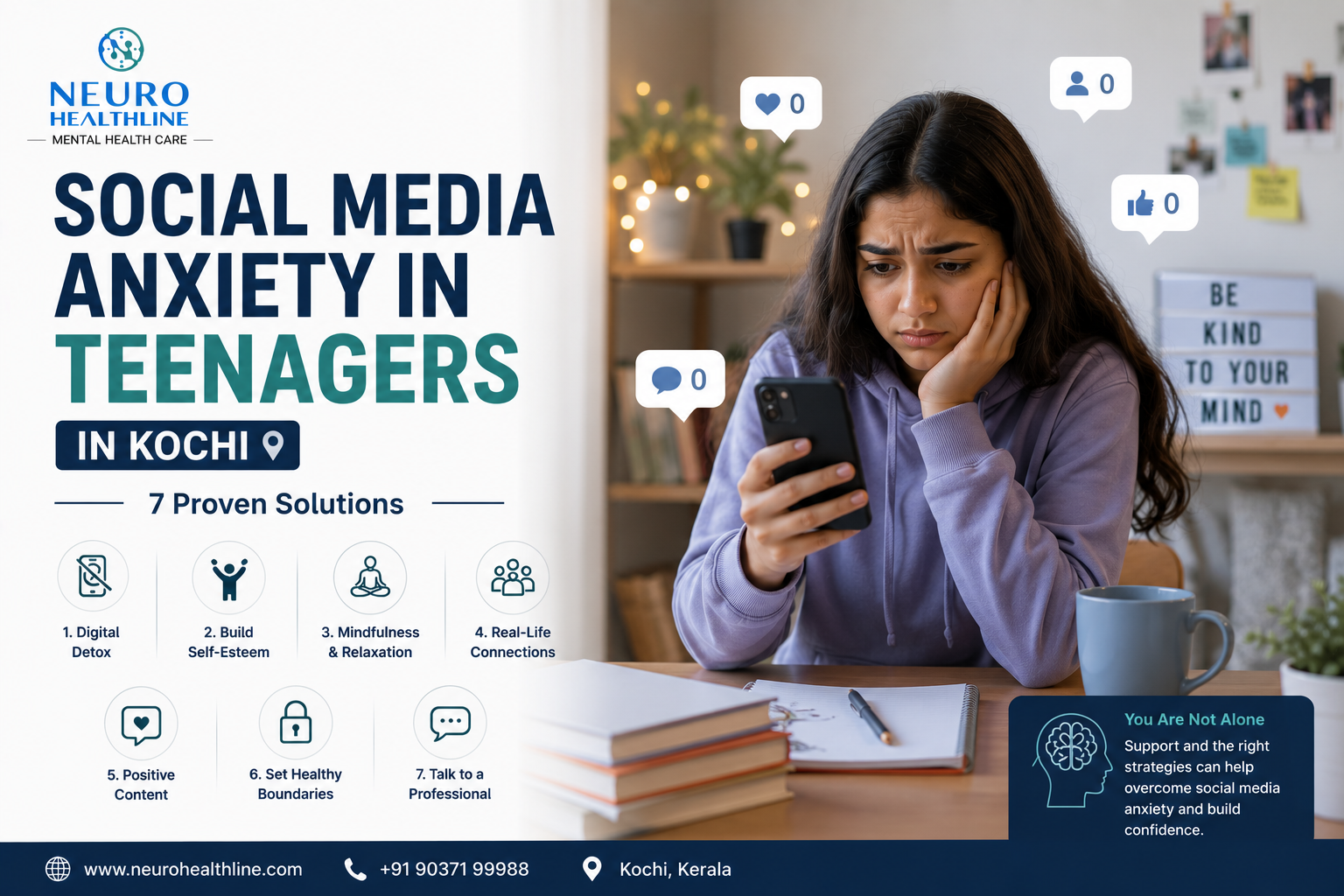
Kochi’s teenagers are growing up in a world their parents’ generation could not have imagined — one in which social life, academic competition, self-worth, and identity formation all unfold simultaneously across Instagram, YouTube, Snapchat, and an ever-expanding landscape of digital platforms. For many teenagers in Kochi, social media is not simply entertainment — it is the primary arena in which they navigate belonging, comparison, validation, and the fundamental developmental question of who they are and how they measure up. Social media anxiety in teenagers in Kochi has emerged as one of the most pressing mental health concerns of our time — a condition that is genuinely distinct from pre-digital teenage anxiety in its mechanisms, its intensity, and the unique challenges it presents for treatment. At NeuroHealthline, we are seeing a growing number of Kochi’s teenagers presenting with anxiety that is directly driven and relentlessly amplified by social media exposure — and we have developed a clinically precise, neurologically grounded approach to addressing it.
Why Social Media Produces Anxiety in Teenagers — The Neuroscience
Understanding why social media produces such powerful anxiety in teenagers requires understanding both the specific neuroscience of the adolescent brain and the specific design features of social media platforms that make them particularly potent anxiety generators for this age group. The adolescent brain is characterised by a highly active reward system — the dopaminergic circuits that drive motivation, pleasure, and social reward-seeking — combined with a still-developing prefrontal cortex that has not yet achieved full regulatory capacity over these reward circuits. This developmental combination makes teenagers neurologically primed to be powerfully responsive to social reward signals and highly vulnerable to the anxiety produced when those signals are absent, uncertain, or negative.
Social media platforms are engineered precisely around these vulnerabilities. Variable reward schedules — the unpredictable pattern of likes, comments, and social validation — activate the dopamine system in the same way that slot machines do, creating compulsive checking behaviour. Social comparison — the constant, curated display of peers’ highlight reels against which teenagers inevitably measure their own unedited reality — activates the threat-detection system as the brain interprets falling short in social comparison as a genuine threat to social belonging and status. Fear of missing out — the awareness of social events, interactions, and experiences happening without you — produces genuine anxiety about social exclusion. And the permanence and reach of digital social judgment — the fact that a humiliating moment or a poorly received post can be seen and shared by hundreds simultaneously — amplifies the stakes of social evaluation beyond anything teenagers in previous generations faced.
Social media anxiety in teenagers in Kochi is therefore not simply a matter of spending too much time on screens — it reflects a genuine neurological impact of a social environment specifically designed to maximise engagement by exploiting the adolescent brain’s developmental vulnerabilities.
How Social Media Anxiety in Teenagers in Kochi Presents
Social media anxiety in teenagers in Kochi presents with a distinctive pattern that parents, teachers, and clinicians increasingly need to recognise. Common presentations include compulsive checking of social media platforms — particularly for likes, comments, and notification counts — with intense anxiety when responses are absent or fewer than expected; significant distress around the perception of being excluded from social events, groups, or conversations visible on social media; excessive time spent crafting posts, stories, and captions to manage social impression and minimise risk of negative evaluation; intense emotional reactions to negative comments, unfollowing, or reduced engagement; body image anxiety driven by comparison with heavily filtered and edited images of peers and influencers; sleep disruption from late-night social media use combined with the autonomic arousal that social comparison and social threat generate; withdrawal from face-to-face social interaction as online interaction feels more controllable but progressively less satisfying; and academic performance decline as cognitive resources are depleted by chronic social media-driven anxiety and sleep disruption.
Many parents seeking help for social media anxiety in teenagers in Kochi initially present the problem as screen time excess or mood changes — without recognising the specific anxiety mechanism that social media is driving in their teenager’s developing nervous system.
The Impact of Social Media Anxiety on Teenage Mental Health in Kerala
The broader mental health implications of social media anxiety in teenagers in Kochi extend well beyond the immediate anxiety experience. Chronic social media-driven anxiety in the adolescent years is associated with significantly increased risk of developing depression, as the persistent negative self-comparison and social exclusion anxiety that social media generates gradually erode self-worth and motivation. Sleep disruption from late-night social media use — and from the autonomic arousal that social anxiety generates — progressively impairs memory consolidation, emotional regulation, and cognitive performance in ways that directly impact academic outcomes. Body image concerns driven by social media exposure are strongly linked to disordered eating patterns and significantly reduced self-esteem, particularly in teenage girls. And the substitution of online social interaction for face-to-face connection progressively erodes the social skills, emotional intelligence, and capacity for genuine intimacy that are critical developmental achievements of the teenage years.
Addressing social media anxiety in teenagers in Kochi early — before these secondary consequences become entrenched — is one of the most important preventive mental health interventions available for this age group in Kerala today. According to NCBI PubMed, heavy social media use in adolescents is significantly associated with increased anxiety, depression, and sleep disruption — with the relationship between social media and anxiety being particularly strong among teenage girls navigating social comparison and body image pressures.
7 Proven Solutions for Social Media Anxiety in Teenagers in Kochi
1. Adolescent-Adapted QEEG Brain Mapping
Treatment for social media anxiety in teenagers in Kochi begins with an age-appropriate QEEG brain mapping assessment, identifying the specific neural patterns — amygdala hyperreactivity to social threat cues, reward circuit dysregulation, and prefrontal underregulation — that are driving each teenager’s specific social media anxiety presentation.
2. HEG Neurofeedback for Adolescent Prefrontal Development
HEG neurofeedback is particularly valuable for social media anxiety in teenagers in Kochi because it directly strengthens prefrontal cortex development and regulatory capacity — the neural system that is developmentally incomplete in teenagers and most critically targeted by social media’s exploitation of reward circuits. As prefrontal regulation improves, teenagers develop greater capacity to engage with social media deliberately rather than compulsively, and to evaluate social comparison without triggering acute anxiety responses.
3. HRV Biofeedback for Nervous System Regulation
HRV biofeedback therapy teaches teenagers a practical, portable nervous system regulation skill that can be applied in real-time social media situations — building the capacity to pause, regulate, and respond deliberately rather than reacting compulsively to social media triggers. This is one of the most practically applicable tools in treatment for social media anxiety in teenagers in Kochi.
4. Digital Behaviour Restructuring
Social media anxiety in teenagers in Kochi cannot be fully addressed without directly restructuring the digital behaviours that maintain it. Our program includes practical, developmentally appropriate digital behaviour restructuring — not blanket screen time restriction, which typically increases rather than decreases social media anxiety, but strategic, gradual restructuring of social media engagement patterns that reduces anxiety while preserving the genuine social connections that digital platforms facilitate.
5. Sleep Restoration
Given the critical role of social media-disrupted sleep in amplifying social media anxiety in teenagers in Kochi, sleep restoration is a core component of our treatment program — including circadian realignment, device-free bedtime protocols, and CES-supported sleep quality improvement that directly addresses the most measurably harmful consequence of social media overuse.
6. Functional Nutrition for Adolescent Brain Health
Nutritional deficiencies in omega-3 fatty acids, magnesium, zinc, and B vitamins — common among teenagers with irregular dietary patterns — significantly impair the developing brain’s anxiety regulation capacity. Our treatment for social media anxiety in teenagers in Kochi includes a targeted nutritional assessment identifying and correcting these deficiencies, supporting both anxiety regulation and healthy adolescent brain development.
7. Adolescent Neuropsychotherapy
Our neuropsychotherapy approach to social media anxiety in teenagers in Kochi addresses the specific cognitive and identity dynamics driving each teenager’s social media anxiety — including social comparison patterns, self-worth contingency on social validation, fear of negative social evaluation, and the development of a stable, internally anchored sense of identity that is less dependent on external social media feedback for self-regulation.
A Message for Parents of Teenagers with Social Media Anxiety in Kochi
If you are a parent reading this because you recognise signs of social media anxiety in your teenager, the most important thing to understand is that this is not simply a matter of weak willpower, poor self-discipline, or excessive screen indulgence. Social media anxiety in teenagers in Kochi is a genuine neurological response to an environment specifically engineered to produce compulsive engagement — and your teenager’s brain, still completing its developmental trajectory, is particularly vulnerable to these mechanisms by design. Effective support requires clinical intervention that addresses the neurological and physiological patterns involved, combined with a collaborative, non-judgmental family approach that reduces rather than amplifies shame around the condition.
At NeuroHealthline, our treatment for social media anxiety in teenagers in Kochi involves parents as collaborative partners in the recovery process — providing psychoeducation, practical family guidance, and communication strategies that create a home environment supportive of healthy digital behaviour change. Our broader anxiety treatment in Kochi program provides the clinical foundation within which social media anxiety treatment sits, while our anxiety in students program addresses the academic dimensions of social media anxiety that so frequently co-occur in Kochi’s competitive student population.
The World Health Organization identifies adolescent mental health — including the impact of digital technology on teenage wellbeing — as one of the most critical global health priorities of the current decade, emphasising the urgent need for evidence-based, accessible support for this age group.
Frequently Asked Questions About Social Media Anxiety in Teenagers in Kochi
How do I know if my teenager has social media anxiety rather than normal teenage moodiness?
Key indicators that distinguish social media anxiety in teenagers in Kochi from typical adolescent mood variation include significant distress specifically tied to social media interactions — intense reactions to likes, comments, or perceived exclusion; compulsive checking behaviour that the teenager struggles to control despite wanting to; sleep disruption linked to late-night social media use; and withdrawal from face-to-face social interaction in preference for online engagement.
Should I take away my teenager’s phone to treat social media anxiety in Kochi?
Blanket phone removal typically increases rather than resolves social media anxiety in teenagers in Kochi, as it removes the platform on which their social life operates without addressing the underlying anxiety. Our program advocates for structured, gradual digital behaviour restructuring rather than abrupt removal.
Is social media anxiety in teenagers in Kochi more common in girls than boys?
Research consistently shows that social media anxiety affects girls more acutely, particularly around body image comparison and social evaluation. However, boys in Kochi are increasingly presenting with social media anxiety driven by gaming status, masculinity comparison, and competitive online environments.
Can social media anxiety in teenagers in Kochi lead to depression if left untreated?
Yes. Chronic social media anxiety in teenagers is strongly associated with the development of depression through persistent negative self-comparison, social exclusion anxiety, sleep disruption, and progressive erosion of self-worth — making early treatment genuinely important.
How long does treatment for social media anxiety in teenagers in Kochi take?
Most teenagers undergoing treatment at NeuroHealthline report meaningful improvements in anxiety intensity and compulsive social media behaviour within 4 to 8 weeks, with more comprehensive nervous system and behavioural change consolidating over 3 to 5 months.