


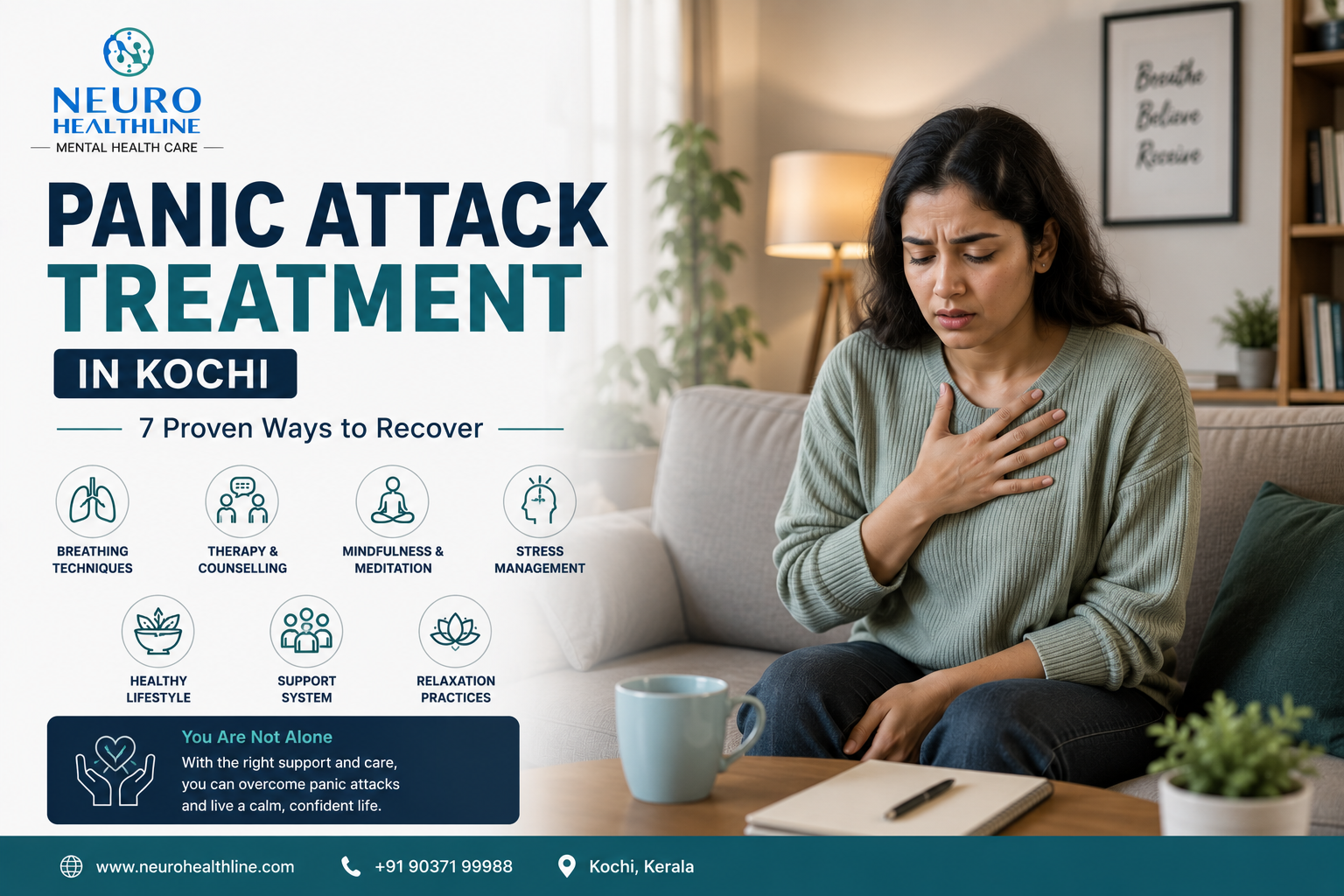
If you have experienced a panic attack, you already know how terrifying the experience can be. The sudden surge of overwhelming physical symptoms — a pounding heart, difficulty breathing, chest pain, dizziness, and a terrifying sense that something catastrophically wrong is happening — can feel indistinguishable from a cardiac emergency. Many people experiencing panic attacks for the first time in Kochi rush to emergency departments, only to be told that their heart and body are physically fine. While this news should be reassuring, it often isn’t — because the experience was so physically real and so intensely frightening that the fear of it happening again can itself become one of the most debilitating aspects of living with panic disorder. Panic attack treatment in Kochi at NeuroHealthline addresses both the neurological mechanisms generating panic attacks and the anticipatory anxiety that develops around them — delivering a comprehensive program designed to stop panic attacks at their source rather than simply teaching management strategies for when they occur.
What Is a Panic Attack? The Neuroscience Behind the Experience
A panic attack is a sudden, intense episode of acute fear accompanied by a cluster of physical symptoms arising from rapid, massive activation of the sympathetic nervous system. At a neurological level, panic attacks involve a sudden and dramatic misfiring of the amygdala — the brain’s threat-detection centre — which triggers a full-scale emergency physiological response in the absence of any actual physical threat. The body prepares for life-threatening danger that does not exist, producing a cascade of physical symptoms that, because they feel so genuinely dangerous, are themselves interpreted as confirmation that something is terribly wrong — creating a feedback loop that intensifies the attack.
Understanding this neurological mechanism is the foundation of effective panic attack treatment in Kochi — because it reveals why cognitive reassurance alone is insufficient, and why the treatment must directly address the neural and physiological systems generating the false alarm rather than simply teaching people to think differently about it. Research published on NCBI PubMed confirms that panic disorder involves measurable dysregulation of amygdala-prefrontal connectivity, supporting the need for neurologically targeted panic attack treatment in Kochi.
Recognising the Signs That Indicate a Need for Panic Attack Treatment in Kochi
Panic attacks vary in frequency, intensity, and context between individuals. Common signs that indicate a need for panic attack treatment in Kochi include recurrent, unexpected episodes of acute fear accompanied by physical symptoms such as racing heart, chest tightness, shortness of breath, dizziness, sweating, trembling, or nausea; a persistent fear of having another panic attack that causes significant changes in behaviour — avoiding places, situations, or activities associated with previous attacks; development of agoraphobia — avoidance of situations where escape would be difficult if a panic attack occurred; hypervigilance to physical sensations, constantly monitoring the body for signs that a panic attack is beginning; significant disruption to daily life, professional functioning, or social engagement due to panic-related avoidance; and nocturnal panic attacks that wake individuals from sleep with the acute physical symptoms of a full panic episode.
If these experiences are familiar, panic attack treatment in Kochi at NeuroHealthline provides a precisely targeted, evidence-based pathway to lasting recovery.
Why Panic Attacks Persist Without Proper Treatment
One of the most important things to understand about panic attacks is why they tend to persist and escalate without appropriate treatment. Each panic attack reinforces the amygdala’s association between specific triggers — locations, physical sensations, social contexts — and catastrophic danger, progressively lowering the threshold at which future panic responses are triggered. The avoidance behaviours that develop around panic attacks, while providing immediate temporary relief, reinforce the amygdala’s assessment that the avoided situations are genuinely dangerous — further entrenching the panic cycle rather than resolving it.
Without panic attack treatment in Kochi that directly retrains this neural circuit, the natural trajectory of untreated panic disorder is a progressive narrowing of life as avoidance expands to encompass more and more situations, places, and activities. Effective panic attack treatment in Kochi reverses this trajectory by directly addressing the amygdala’s misfiring threshold and rebuilding prefrontal regulatory control — rather than simply providing tools to manage panic when it occurs.
7 Proven Solutions in Our Panic Attack Treatment in Kochi Program
1. QEEG Brain Mapping
Panic attack treatment in Kochi at NeuroHealthline begins with a QEEG brain map identifying the specific neural patterns underlying your panic attacks — the particular amygdala-prefrontal connectivity dysregulation and autonomic nervous system imbalances that generate your specific panic presentation. This data ensures every subsequent intervention is precisely targeted to your brain’s individual patterns.
2. HEG Neurofeedback
HEG neurofeedback is the cornerstone of panic attack treatment in Kochi — directly strengthening prefrontal cortex activation and its regulatory control over amygdala reactivity. As prefrontal regulation improves over successive neurofeedback sessions, the amygdala’s threshold for triggering a full-scale panic response rises progressively, reducing both the frequency and the intensity of panic attacks.
3. HRV Biofeedback
HRV biofeedback therapy is critical in panic attack treatment in Kochi because it directly trains the autonomic nervous system — the physiological system responsible for the overwhelming physical symptoms of panic — to regulate more efficiently. Clients learn a breathing-based self-regulation skill that can be deployed at the first signs of a building panic response, dramatically reducing the escalation from early anxiety to full panic attack.
4. Cranioelectrical Stimulation (CES)
CES reduces the baseline level of nervous system activation that makes panic attacks more likely — lowering the overall sympathetic arousal threshold from which panic attacks emerge. Within panic attack treatment in Kochi, CES provides meaningful reduction in background anxiety between sessions, creating a physiological environment less conducive to panic generation.
5. Vibroacoustic Therapy
The deep physiological calm produced by vibroacoustic therapy directly counteracts the chronic sympathetic overactivation underlying panic disorder. For individuals whose panic attacks are strongly somatically driven — triggered by physical sensations being misinterpreted as dangerous — vibroacoustic therapy’s ability to produce a deeply felt experience of physical safety is a particularly important component of panic attack treatment in Kochi.
6. Interoceptive Exposure Within Neuropsychotherapy
A critical and often overlooked component of panic attack treatment in Kochi is addressing the catastrophic misinterpretation of physical sensations that drives the panic feedback loop. Our neuropsychotherapy approach incorporates interoceptive exposure — gradually and safely learning to experience physical sensations associated with anxiety without triggering the catastrophic misinterpretation that escalates them into full panic — conducted with the nervous system already supported through physiological regulation.
7. Functional Nutrition for Nervous System Stability
Nutritional deficiencies — particularly in magnesium, B vitamins, and omega-3 fatty acids — significantly lower the threshold at which the nervous system triggers panic responses. Panic attack treatment in Kochi at NeuroHealthline includes a targeted functional nutrition assessment identifying and correcting these deficiencies, providing a physiological foundation that reduces baseline vulnerability to panic.
Panic Attacks in Kochi’s Younger Population — A Growing Concern
It is important to acknowledge that panic attacks are increasingly affecting Kochi’s younger population — teenagers, university students, and young professionals navigating the combined pressures of academic competition, social media comparison, career uncertainty, and a rapidly changing social landscape. For this group, panic attack treatment in Kochi requires particular sensitivity to the specific stressors and developmental context driving their panic — including the role of social media in amplifying social comparison anxiety and the unique pressures of Kerala’s competitive academic culture.
At NeuroHealthline, our panic attack treatment in Kochi is fully adapted for younger clients, with age-appropriate neurofeedback protocols, practically relevant neuropsychotherapy, and a stigma-free approach that makes seeking help feel genuinely accessible rather than threatening for young people. Our broader anxiety treatment in Kochi program provides the clinical foundation within which panic-specific treatment sits, while our anxiety in students program addresses the specific academic context in which panic attacks so frequently emerge for younger clients in Kochi.
The World Health Organization identifies panic disorder and anxiety as among the most prevalent mental health conditions affecting young people globally — making accessible, stigma-free panic attack treatment in Kochi an urgent clinical and public health priority.
Frequently Asked Questions About Panic Attack Treatment in Kochi
How quickly does panic attack treatment in Kochi produce results?
Many clients undergoing panic attack treatment in Kochi report a noticeable reduction in panic attack frequency and intensity within the first 4 to 8 weeks of treatment, as HRV biofeedback and neurofeedback begin to raise the amygdala’s panic threshold and improve autonomic regulation.
Can panic attack treatment in Kochi help if I have had panic attacks for many years?
Yes. While longstanding panic disorder reflects more deeply entrenched neural patterns, these remain fully responsive to targeted neurological and physiological intervention regardless of how long panic attacks have been occurring.
Is medication necessary for panic attack treatment in Kochi?
No. NeuroHealthline’s panic attack treatment in Kochi relies entirely on non-pharmacological approaches including neurofeedback, biofeedback, CES, vibroacoustic therapy, and neuropsychotherapy — producing lasting neural circuit change without pharmaceutical dependency.
Can panic attack treatment in Kochi help with agoraphobia that has developed as a result of panic disorder?
Yes. Our program specifically addresses the avoidance behaviours that develop around panic attacks — including agoraphobia — through a carefully paced, neurologically supported exposure approach that rebuilds confidence and safety progressively.
Are panic attacks dangerous?
Panic attacks are not medically dangerous when cardiac and other organic causes have been ruled out — though they feel intensely threatening during the episode. However, the progressive life restriction that develops around untreated panic disorder makes early, effective panic attack treatment in Kochi genuinely important for long-term functioning and wellbeing.