


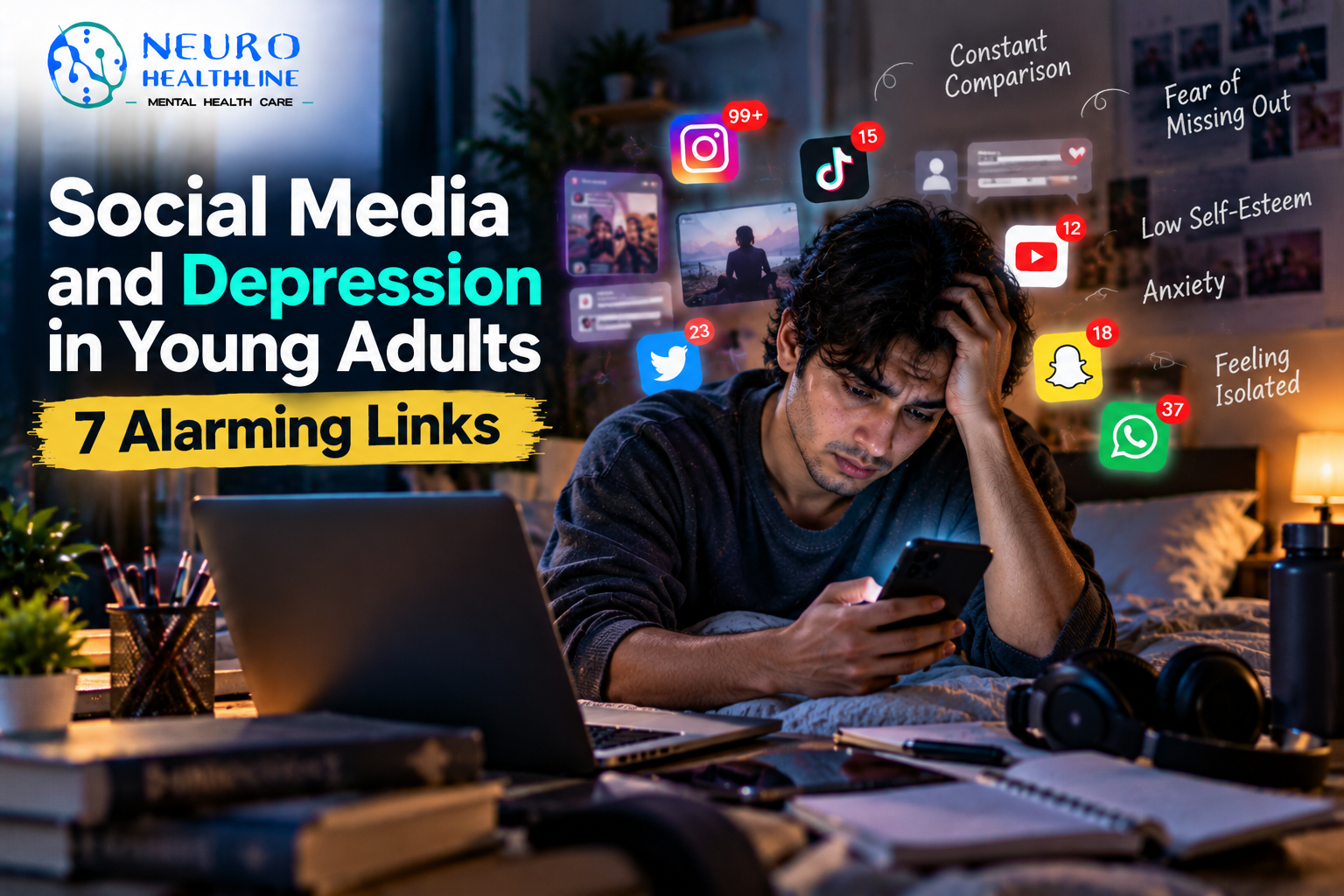
In 2017, Jean Twenge — a psychology professor who has studied generational trends for two decades — published a landmark analysis in The Atlantic with a title that has become one of the most discussed questions in contemporary mental health: “Have Smartphones Destroyed a Generation?” Her data showed that the sudden, dramatic rise in teenage depression, anxiety, loneliness, and suicide rates that began around 2012 — precisely when smartphone ownership and social media use became ubiquitous among adolescents — was not a coincidence. It was a causal relationship. The link between social media and depression in teenagers is no longer a parental anxiety or a media moral panic — it is one of the most consistently replicated findings in adolescent mental health research, documented across dozens of countries, hundreds of studies, and millions of teenagers whose mental health has measurably deteriorated in the social media era.
In Kerala, where smartphone penetration is among the highest in India and where the combination of social media saturation, academic pressure, and cultural constraints on emotional expression creates uniquely fertile conditions for social media-driven depression in teenagers, understanding this relationship is not simply academically interesting. It is a clinical and parenting emergency that demands informed, evidence-based response from every family, school, and mental health system in the state.
How Social Media Causes Depression in Teenagers — The Mechanisms
The relationship between social media and depression in teenagers operates through several specific psychological and neurological mechanisms — each of which would be concerning in isolation, and which together create a depression risk environment of extraordinary power for the adolescent brain.
Social comparison is the most fundamental mechanism. Teenagers have always compared themselves to peers — it is a natural and developmentally normal part of the identity formation process of adolescence. What social media has done is make that comparison continuous, algorithmic, global in scope, and systematically tilted toward the most aspirationally challenging content. The Instagram feed of a Kerala teenager in 2026 presents them with curated highlights of hundreds of peers’ and influencers’ most successful, most attractive, most socially enviable moments — creating a comparison baseline that no naturally occurring social environment in human history has ever produced. The brain processes this comparison through the same social threat and status evaluation circuits it would use to assess standing in a real social group — generating the cortisol, amygdala activation, and mood depression of genuine social threat in response to algorithmically constructed inferiority.
The displacement effect represents a second critical mechanism in the social media and depression in teenagers relationship — the progressive substitution of genuine face-to-face social interaction, physical activity, creative engagement, and real-world experience by screen-based social media consumption. Research has consistently shown that the activities most associated with adolescent wellbeing and depression protection — in-person socialising, physical activity, sleep, and direct creative engagement — are precisely the activities that heavy social media use most consistently displaces. The smartphone-using teenager who might otherwise have spent an evening in genuine social interaction or physical activity spends it scrolling instead — losing both the benefits of the displaced activity and gaining the comparison anxiety and dopaminergic dysregulation of the replacement one.
The sleep disruption pathway is the third major mechanism in social media and depression in teenagers — with late-night social media use producing both direct melatonin suppression and the psychological arousal of social comparison that together systematically destroy the sleep architecture that depression resilience requires. According to NCBI PubMed, sleep deprivation is one of the most significant and most consistently identified risk factors for adolescent depression — making the social media-driven adolescent sleep crisis one of the most direct and most measurable pathways through which social media and depression in teenagers are connected.
7 Alarming Links Between Social Media and Depression in Teenagers
1. More Daily Social Media Time Directly Predicts More Depression
The dose-response relationship between social media use and depression in teenagers is one of the most consistent findings in the entire literature on this topic. Studies across multiple countries show that teenagers spending more than three hours per day on social media show significantly higher rates of depression, anxiety, and loneliness than those spending less — with the relationship being dose-dependent, meaning that risk increases progressively with additional use.
2. Passive Scrolling Is More Damaging Than Active Engagement
Not all social media use is equally harmful to teenage mental health. Research consistently distinguishes between passive scrolling — the consumption of other people’s content without active contribution — and active engagement — creating content, messaging friends, participating in communities. Social media and depression in teenagers is most strongly associated with passive consumption, which maximises social comparison exposure while minimising the genuine social reciprocity and creative expression that protect against depression.
3. Girls Are More Severely Affected Than Boys
The gender difference in social media and depression in teenagers reflects the different social media use patterns and comparison content most prevalent for each gender. Girls are significantly more affected — particularly by Instagram’s appearance-focused comparison content, the social exclusion dynamics of female peer groups on social media, and the body image dimension of social media comparison that drives eating disorder risk alongside depression in adolescent girls. The connection to our detailed exploration of eating disorders and social media is direct.
4. Cyberbullying Creates Severe and Lasting Depression
The social media and depression in teenagers relationship includes a particularly severe pathway through cyberbullying — online harassment, exclusion, and humiliation that, unlike school-based bullying, follows teenagers into their bedrooms, cannot be escaped at home, and creates a 24-hour threat environment whose psychological consequences include some of the most severe adolescent depression presentations seen in clinical practice. Kerala’s adolescent population is not protected from cyberbullying by cultural factors — online harassment is a universal feature of adolescent social media use that affects teenagers across every community.
5. Social Media Disrupts Real-World Friendship Quality
Paradoxically, social media — despite positioning itself as a social connection tool — is associated with reduced quality of real-world friendships among teenagers. The substitution of genuine face-to-face interaction with online social performance progressively erodes the social skills, emotional attunement, and interpersonal vulnerability that deep friendship requires — producing teenagers who are socially active on screen and progressively socially isolated in the real world. The resulting loneliness is one of the most powerful drivers of depression in teenagers that social media produces.
6. Social Media Amplifies Academic Pressure Into Depression
In Kerala’s academically intense environment, social media and depression in teenagers interact through a specific amplification of academic pressure that deserves particular attention. Social media makes peer academic performance continuously visible — creating a real-time academic comparison environment that extends the competitive anxiety of Kerala’s examination culture into every moment of every day. The NEET aspirant who might previously have known vaguely that peers were also studying now receives constant, real-time updates on their progress, achievements, and university acceptances — a comparison stream that the anxious, already-pressured adolescent brain processes as continuous academic threat.
7. Heavy Social Media Use Predicts Future Depression — Not Just Present
Among the most alarming findings in the social media and depression in teenagers literature is the longitudinal evidence that heavy adolescent social media use predicts depression not just in the present but in subsequent years — even after controlling for pre-existing depression levels. This finding suggests that social media is not simply correlated with depression in teenagers but is playing a causal role in shaping the neurological and psychological patterns that make future depression more likely — making early intervention in social media use patterns one of the most important depression prevention investments available for adolescents.
What NeuroHealthline Does About Social Media and Depression in Teenagers
NeuroHealthline’s clinical approach to social media and depression in teenagers recognises that the social media environment is not simply a background factor in adolescent depression — it is an active, ongoing clinical variable that must be directly addressed as part of any comprehensive treatment program. Our teen depression treatment in Kochi specifically incorporates digital behaviour assessment and restructuring alongside the neurological, physiological, and therapeutic dimensions of depression treatment — because treating the depression while leaving the social media environment unchanged produces consistently incomplete outcomes.
HEG neurofeedback directly addresses the prefrontal underactivation and reward circuit dysregulation that both social media use and depression share — producing neurological improvements that simultaneously reduce depression severity and strengthen the voluntary control over social media use that depression and digital addiction together impair. HRV biofeedback therapy rebuilds the nervous system regulation that social media-driven anxiety has depleted. Sleep restoration addresses the circadian damage that late-night social media use produces. And our neuropsychotherapy approach specifically addresses the social comparison patterns, self-worth contingency, and identity dimensions that make social media’s depression-generating mechanisms so clinically significant for each individual teenager.
Our social media anxiety in teenagers in Kochi, Instagram addiction and mental health, and depression among youngsters blogs provide additional depth on the individual dimensions of the social media and depression in teenagers relationship. The World Health Organization identifies digital technology’s impact on adolescent mental health as a global health priority of the current decade — and NeuroHealthline’s clinical response is built to meet that priority with the comprehensiveness and precision it demands.
FAQ — Social Media and Depression in Teenagers
Should I take my teenager’s phone away to prevent social media-driven depression?
Complete phone removal typically generates acute distress, damages trust, drives social media use underground, and addresses behaviour without underlying neurological drivers. A collaborative, graduated approach that reduces harmful social media patterns while preserving genuine social connection produces more durable and less conflictual outcomes.
How much social media use is safe for teenagers?
Research consistently identifies three hours per day as the threshold above which significant mental health risk increases. Below that threshold, the type of use matters more than the quantity — with passive scrolling being more harmful than active, reciprocal social engagement regardless of time spent.
Is the social media and depression in teenagers relationship reversible?
Yes. The neurological changes that social media-driven depression produces are neuroplastic rather than permanent — and clinical intervention addressing both the depression and the digital behaviour patterns maintaining it consistently produces meaningful and lasting improvement.
Are some social media platforms more harmful than others for teenage depression?
Yes. Instagram and TikTok — which prioritise visual content and algorithmic amplification of aspirational comparison content — show the strongest associations with teenage depression in research. Platforms supporting more direct, reciprocal social communication show weaker associations.
How do I talk to my teenager about the social media and depression link without causing conflict?
By approaching the conversation with curiosity rather than prescription — sharing what you have read, asking what their own experience of social media’s emotional effects is, and focusing on their wellbeing rather than the platform itself. Teenagers are more receptive to conversations that acknowledge the genuine social value of social media alongside its mental health risks than to blanket condemnation that feels disconnected from their actual experience.