


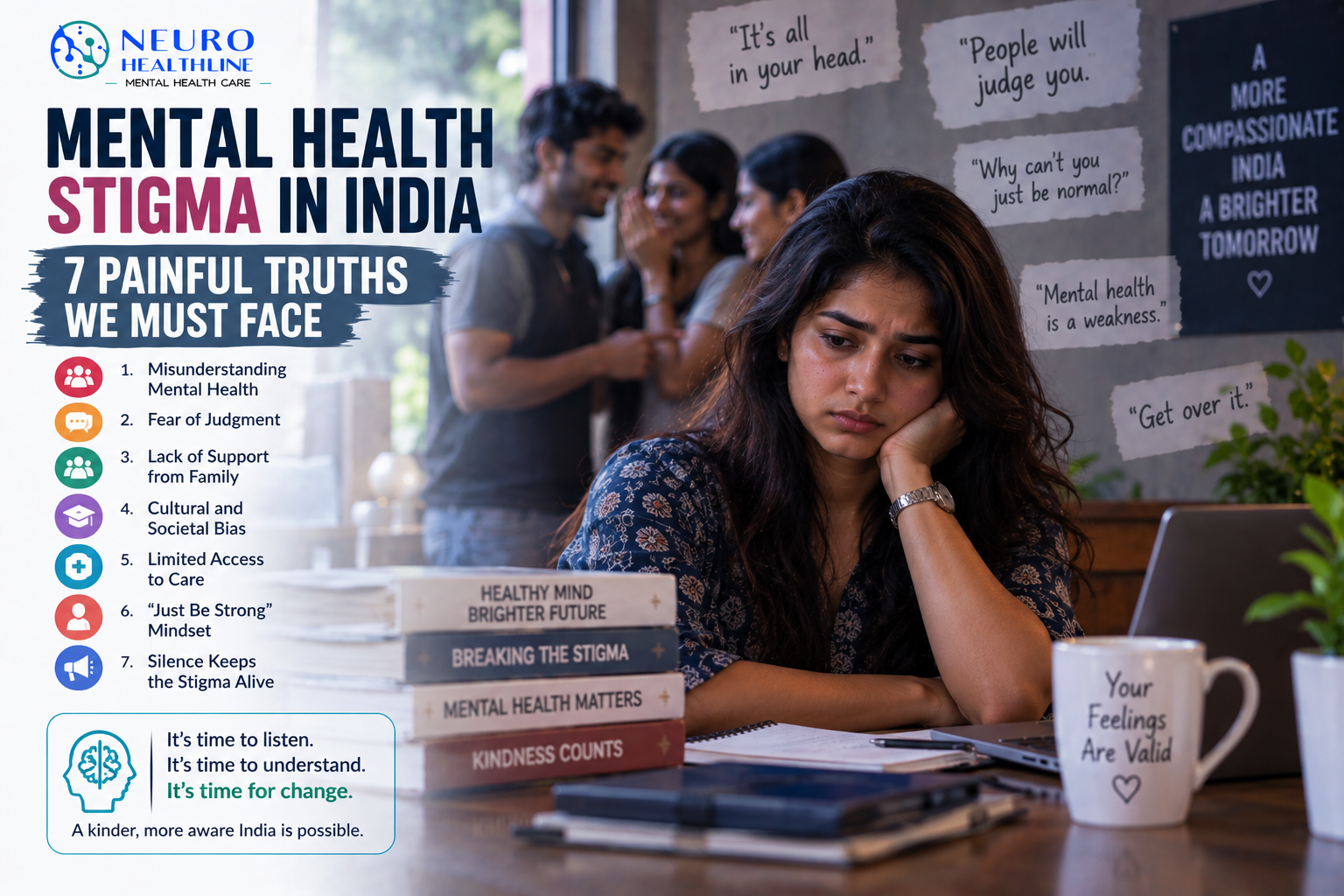
India has a mental health crisis hiding in plain sight. With an estimated 197 million people experiencing mental health conditions — approximately 14% of the population — and a treatment gap of over 80% between those who need care and those who receive it, India faces one of the largest and most consequential mental health challenges of any country in the world. And yet the conversation remains, in most homes, most workplaces, and most communities across the country, profoundly, persistently, and sometimes lethally silent. Mental health stigma in India is not simply a cultural attitude that makes conversations uncomfortable — it is a structural force that prevents people from seeking help they genuinely need, that drives mental health conditions underground where they worsen without treatment, and that contributes directly to suicide rates that have made India one of the countries with the highest proportion of global suicide deaths.
Understanding mental health stigma in India — why it exists, what it costs, and how it can be challenged — is not simply an academic exercise. It is a clinical and social emergency that every individual, family, healthcare provider, and community leader in the country has a role in addressing. At NeuroHealthline, we encounter the consequences of mental health stigma in India in every clinical encounter — in the clients who spent years suffering in silence before seeking help, in the families who interpret mental health conditions as spiritual failures or character weaknesses, and in the young people who would rather endure unrelenting psychological pain than risk the social consequences of being seen to need support.
What Is Mental Health Stigma and Why Does It Persist in India?
Mental health stigma is a complex social phenomenon involving three distinct but interacting dimensions — public stigma, which reflects the negative attitudes, stereotypes, and discriminatory behaviour of the broader community toward people with mental health conditions; self-stigma, which reflects the internalisation of these negative attitudes by people experiencing mental health challenges, producing shame, self-rejection, and reluctance to seek help; and structural stigma, which reflects the systematic underinvestment in mental health resources, the inadequate representation of mental health in educational curricula and healthcare systems, and the legal and social frameworks that have historically treated mental illness as a social problem rather than a healthcare need.
Mental health stigma in India persists through a specific combination of cultural, religious, historical, and systemic factors. Culturally, mental health conditions are frequently interpreted through frameworks of supernatural causation — as the consequence of past karma, evil eye, divine punishment, or spiritual inadequacy — that locate the problem outside the domain of medical treatment and within the domain of religious or spiritual remedy. Socially, mental health conditions are associated with consequences that in the Indian context are genuinely severe — affecting marriage prospects, employment opportunities, family reputation, and community standing in ways that create powerful rational incentives for concealment even when the psychological cost is significant. Historically, the institutional treatment of severe mental illness through asylum-style care has generated a cultural association between mental health treatment and permanent institutionalisation that continues to deter help-seeking even as mental healthcare has evolved dramatically. And structurally, India’s ratio of mental health professionals to population remains critically inadequate — with fewer than one psychiatrist per 100,000 people in most states — reflecting a historical underinvestment that simultaneously reflects and reinforces the stigma that deprioritises mental health care.
The Cost of Mental Health Stigma in India — What Silence Is Killing
The consequences of mental health stigma in India are measurable, serious, and in the most extreme cases, fatal. India accounts for approximately 17% of global suicide deaths — a staggering proportion for a country with 17% of the world’s population, but one that reflects the cumulative consequence of mental health conditions that go unrecognised, untreated, and unsupported across a population of 1.4 billion people. The relationship between mental health stigma in India and suicide rates is direct — stigma prevents help-seeking, untreated mental health conditions worsen, and the most severe untreated presentations produce the suicidal crises that stigma-driven silence makes less likely to receive timely intervention.
Beyond its most extreme consequences, mental health stigma in India produces a wide spectrum of costs — economic productivity losses from mental health conditions that impair professional functioning but are never treated; relationship and family system deterioration from mental health challenges that are denied, minimised, or managed through harmful coping strategies rather than addressed clinically; physical health consequences from the sustained physiological stress of mental health conditions that never receive treatment; and the profound human cost of years or decades of unnecessary suffering experienced by people whose conditions are entirely treatable but who never reach treatment because stigma made seeking it feel impossible. According to NCBI PubMed, mental health stigma is one of the most significant structural barriers to mental health treatment globally — with self-stigma specifically identified as the most powerful predictor of treatment avoidance among people experiencing mental health conditions.
7 Painful Truths About Mental Health Stigma in India We Must Face
1. Stigma Kills — And That Is Not an Exaggeration
The most important truth about mental health stigma in India is that it has direct, measurable mortality consequences. Every person who does not seek treatment for depression because of the shame of being seen as mentally ill is a person whose depression progresses without intervention. Every family that interprets a family member’s suicidal crisis as a spiritual problem rather than a medical emergency is a family that may not reach the appropriate clinical support in time. Mental health stigma in India does not simply make life harder for people with mental health conditions — it ends lives that appropriate, destigmatised treatment would have saved.
2. Kerala Is Not Protected — Despite Its Education
One of the most persistent and most dangerous myths about mental health stigma in India in the Kerala context is that the state’s exceptional literacy rates and educated population provide some protection against the stigma that affects less educated populations elsewhere. The clinical and epidemiological evidence does not support this assumption. Kerala’s suicide rate is among the highest of any Indian state — a public health reality that directly contradicts the assumption that education and literacy are sufficient protection against the consequences of mental health stigma. Mental health stigma in India operates through cultural and social mechanisms that education alone does not override — and Kerala’s mental health community bears a particular responsibility to confront this reality honestly.
3. Men Are Dying in the Silence That Stigma Creates
Mental health stigma in India falls particularly heavily on men — who are socialised from childhood to equate emotional expression with weakness, stoicism with strength, and the acknowledgment of psychological struggle with an inadequacy that is incompatible with the masculine identity they are expected to maintain. The result is a population of men across India who endure depression, anxiety, trauma, and suicidal ideation in silence — not because their conditions are less severe but because the cultural cost of acknowledging them feels higher than the psychological cost of concealment. India’s male suicide rate reflects this silence with devastating clarity.
4. Families Are Often the Biggest Barrier to Treatment
In the Indian family context — where family reputation, marriage prospects, and community standing are closely intertwined — the family system is frequently the most powerful force preventing mental health treatment access. Family members who discourage or actively prevent help-seeking because of concerns about community judgment, who minimise or deny mental health symptoms to avoid the stigma attached to having “a mental case” in the family, or who insist on religious or traditional remedies in preference to clinical treatment represent one of the most clinically significant expressions of mental health stigma in India that NeuroHealthline’s clinical team encounters regularly in Kerala.
5. Social Media Is Both a Problem and a Solution
Mental health stigma in India is being challenged — and sometimes worsened — by social media simultaneously. On one side, celebrity mental health disclosures, mental health awareness content, and the normalisation of help-seeking among Gen Z on platforms including Instagram and YouTube are genuinely shifting the cultural conversation in ways that encourage more people to seek support. On the other side, social media’s persistent association of mental health conditions with drama, weakness, and attention-seeking in comment sections, meme culture, and dismissive responses to mental health content reinforces the stigma it claims to challenge. The net effect on mental health stigma in India is complex — and the Gen Z mental health conversation is its most actively evolving frontier.
6. The Treatment Gap Is an Indictment — Not an Inevitability
The 80% treatment gap in India — the proportion of people with mental health conditions who need but do not receive clinical care — is not simply the result of stigma alone. It also reflects a systemic failure of investment, infrastructure, and policy priority that has left India with catastrophically inadequate mental health resources relative to need. Mental health stigma in India and structural underinvestment are mutually reinforcing — stigma reduces political will to invest in mental healthcare, and inadequate mental health resources make help-seeking more difficult and more stigmatised. Breaking this cycle requires both cultural change at the community level and policy change at the systemic level.
7. Destigmatisation Starts With Reframing — Not Just Awareness
The final and most important truth about mental health stigma in India is that raising awareness about mental health without changing the framework through which mental health conditions are understood does not effectively reduce stigma. Campaigns that increase awareness of mental health prevalence while leaving unchanged the moral, spiritual, and characterological frameworks through which conditions are interpreted can paradoxically increase the social consequences of disclosure. Effective destigmatisation requires a fundamental reframing — from mental health conditions as personal failures, spiritual deficits, or character weaknesses to mental health conditions as neurological and physiological states that are as medically real, as deserving of clinical treatment, and as independent of personal virtue as diabetes or hypertension. This is precisely the clinical and educational framework that NeuroHealthline’s stigma-free, label-free approach to mental health care in Kochi and Kerala is built on — and why our counseling centers in Kochi are designed to feel fundamentally different from the institutional mental health environments that stigma has made so threatening.
What NeuroHealthline Is Doing to Break Mental Health Stigma in Kerala
NeuroHealthline’s contribution to breaking mental health stigma in India begins with the clinical environment we have built in Kochi — one that is explicitly, deliberately, and comprehensively stigma-free. Our approach frames mental health conditions as neurological and physiological realities rather than personal failures, treats every client with the same dignity and clinical seriousness as any other healthcare condition, uses neuroscience-based assessment and treatment that grounds mental health care in the objective, measurable reality of brain function, and maintains complete clinical confidentiality that allows professionals, students, and families to seek help without the social exposure that mental health stigma in India has made so threatening.
Our anxiety treatment in Kochi, depression treatment in Kochi, and PTSD treatment in Kochi programs are all designed to be as clinically robust and as dignity-preserving as the most advanced international mental healthcare standards — because mental health stigma in India is most effectively challenged not through awareness campaigns alone but through the lived experience of clinical care that treats people with the respect and seriousness their conditions genuinely deserve. The World Health Organization identifies mental health stigma as the most significant global barrier to mental health care access — and NeuroHealthline’s clinical practice in Kerala is built as a direct, practical response to that identification.
FAQ — Mental Health Stigma in India
Why is mental health stigma particularly severe in India compared to other countries?
Mental health stigma in India reflects a specific convergence of cultural frameworks — including karma, spiritual causation, and family reputation — social consequences including marriage and employment impact, historical institutional care associations, and structural underinvestment in mental health resources, that together create one of the most complex and most entrenched stigma environments globally.
How can individuals challenge mental health stigma in India in their own communities?
Through honest personal disclosure where safe to do so; through language choices that use accurate, medical rather than dismissive or derogatory terminology; through actively challenging stigmatising statements in family and social contexts; and through seeking clinical help for their own mental health conditions — because normalising help-seeking is one of the most powerful individual acts of stigma reduction available.
Is mental health stigma in India different in urban versus rural areas?
Yes, though stigma is present in both. Urban areas — particularly in cities with significant educated professional populations like Kochi — generally show somewhat reduced stigma intensity, though mental health stigma in India remains significant even in the most educated urban contexts. Rural stigma is often more severe and more likely to involve supernatural causation frameworks.
How does mental health stigma in India affect children and adolescents specifically?
Particularly severely. Children and adolescents are frequently the least able to self-identify mental health conditions, the most dependent on adult recognition and support for accessing treatment, and the most affected when family stigma prevents help-seeking — making the childhood and adolescent consequences of mental health stigma in India both disproportionately severe and disproportionately preventable.
What is the most effective way to support someone in India who is experiencing mental health stigma?
By consistently communicating that their experience is medically real and clinically treatable; by separating their worth as a person from their mental health condition; by practically supporting access to clinical help; and by maintaining confidentiality in a way that demonstrates that seeking help will not increase social exposure.