


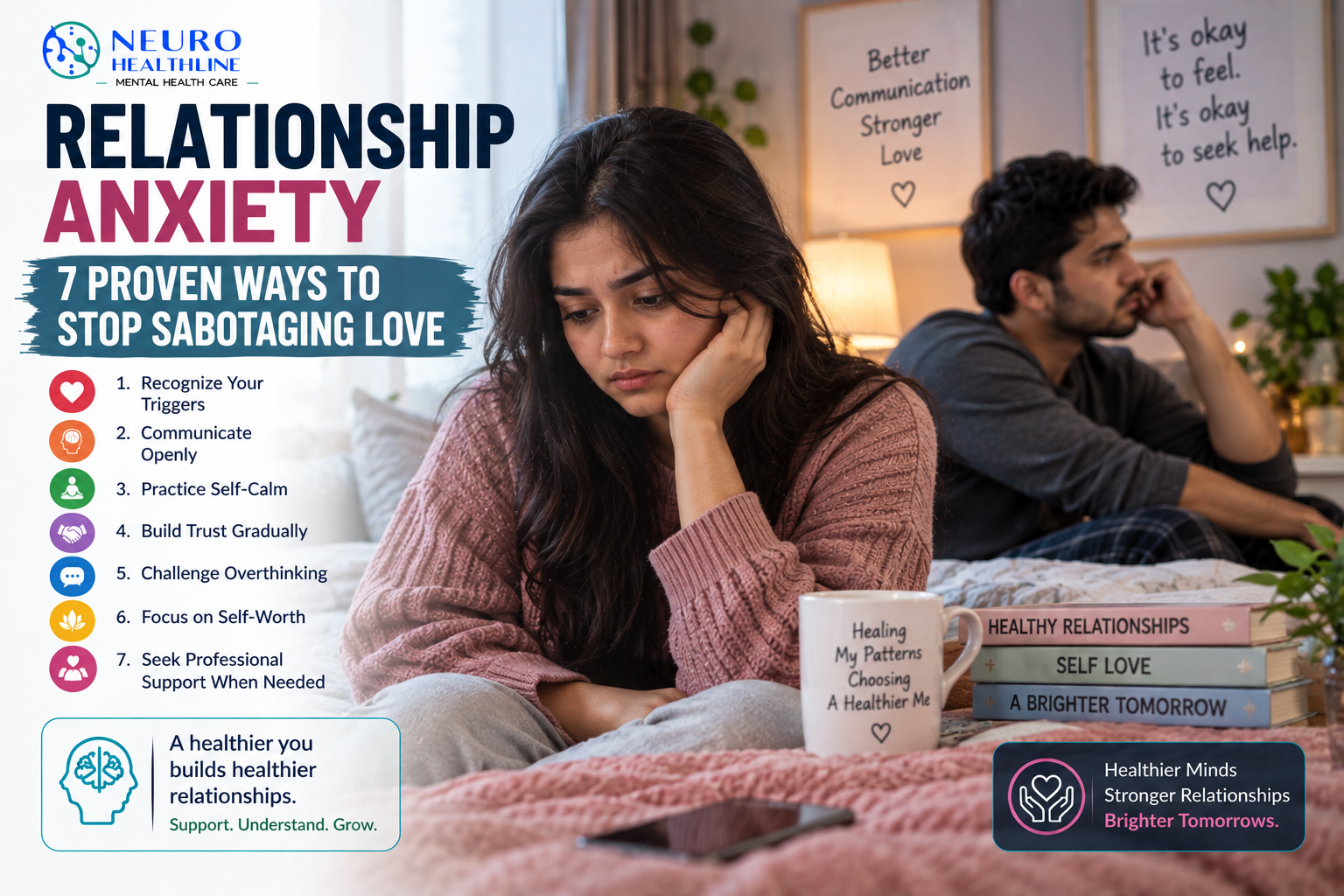
You finally meet someone who genuinely likes you — and immediately your mind starts working against you. Does this person really mean what they say? Why haven’t they texted back yet? Am I too much for them? Are they losing interest? What if this ends and I am humiliated? What if I fall in love and they leave? The questions spiral faster than any reassurance can quiet them — and before long, the anxiety that is supposed to protect you from getting hurt is doing the one thing most likely to cause the outcome you fear: pushing away the person you most want to keep. Relationship anxiety is one of the most prevalent, most painful, and most underrecognised forms of anxiety affecting young adults across India today — and one of the most clinically meaningful, because it sits at the precise intersection of neuroscience, attachment psychology, and the deep human need for genuine connection that defines so much of what makes a life feel worth living. At NeuroHealthline, relationship anxiety is understood not as a personality flaw or an emotional immaturity but as a measurable neurological condition rooted in the brain’s threat-detection system, the nervous system’s attachment-shaped regulatory patterns, and a developmental history that has taught the brain to experience closeness as a source of potential danger rather than genuine safety.
What Is Relationship Anxiety? Understanding the Neuroscience
Relationship anxiety is a persistent pattern of excessive worry, insecurity, and fear within or about romantic relationships — one that goes beyond the normal nervousness of new connection and instead creates chronic distress that significantly impairs the quality and stability of intimate relationships. At a neurological level, relationship anxiety involves hyperactivation of the amygdala’s threat-detection response in the specific context of romantic closeness — treating the vulnerability, uncertainty, and dependency that genuine intimacy requires as neurological danger signals rather than as the natural features of genuine human connection.
The attachment system — the neurological system that governs the experience of closeness, security, and separation in relationship — is formed through early childhood experiences with primary caregivers. When early attachment experiences provide consistent, reliable, emotionally attuned care, the attachment system develops a secure baseline — an internal model of relationships as fundamentally safe, reciprocal, and navigable. When early attachment experiences are inconsistent, unpredictable, dismissive, or frightening, the attachment system develops an anxious, avoidant, or disorganised baseline — internal models of relationships as unpredictable, potentially abandoning, or requiring constant vigilance to maintain. Relationship anxiety is, in the majority of cases, the adult manifestation of an anxiously or disorganisedly attached nervous system — one whose early experiences have calibrated the relational threat-detection system toward hypervigilance in the precise domain of emotional closeness.
Research published on NCBI PubMed confirms that anxious attachment is associated with measurable hyperactivation of threat-detection neural circuits specifically in response to relationship-relevant stimuli — supporting the need for neurologically targeted treatment that addresses the brain’s relational threat calibration directly, rather than cognitive strategies alone.
How Relationship Anxiety Destroys the Connections It Fears Losing
The most painful and most clinically significant feature of relationship anxiety is its self-defeating character — the way in which the behaviours it generates are precisely the behaviours most likely to produce the relationship outcomes it fears. Reassurance seeking — the repeated requests for confirmation of love, commitment, and continued interest that relationship anxiety generates — provides temporary relief that lasts only until the next wave of doubt, while progressively exhausting partners who eventually struggle to understand why the same reassurance is needed repeatedly without producing lasting security. Hypervigilance to relationship signals — the constant monitoring of a partner’s tone, timing of responses, facial expressions, and social media activity for evidence of declining interest — misreads neutral or positive signals as threatening, generates conflict from imagined slights, and creates the emotional reactivity that makes the anxiously attached person feel difficult to be with. Protest behaviours — the emotional withdrawal, sudden anger, or manufactured conflict that relationship anxiety generates when closeness feels threatened — create precisely the relational distance that triggered the anxiety in the first place.
Relationship anxiety is therefore not simply painful to experience — it is actively self-destructive in its relational consequences, creating a pattern in which the most feared outcome — rejection, abandonment, loss of connection — is progressively approached through the very behaviours that the anxiety generates in its attempt to prevent it. Breaking this cycle requires directly addressing the neurological and attachment-system patterns driving it — not simply developing better communication skills or cognitive reassurance strategies that operate at the surface level of a pattern rooted in the nervous system.
Who Is Most Affected by Relationship Anxiety in Kerala and India?
Relationship anxiety affects people across all ages and relationship histories, but certain patterns are particularly prevalent in the Indian context. Young adults navigating the transition between family-arranged relationship frameworks and independent romantic partnership selection often experience relationship anxiety amplified by the cultural stakes attached to relationship success — where choosing one’s own partner carries the additional weight of vindicating that choice against family expectation. Dating app culture — which has created an unprecedented paradox of choice, social comparison between potential partners, and the gamification of romantic selection — systematically amplifies relationship anxiety by making every relationship feel contingent, temporary, and replaceable. And the attachment disruptions produced by Kerala’s historically high migration rates — families separated by Gulf employment, children raised with absent fathers or mothers — have created a significant population of adults whose attachment systems were shaped by early experiences of meaningful relationship figures being physically unavailable or emotionally inconsistent.
The connection to our broader anxiety treatment in Kochi and social anxiety treatment in Kochi programs is direct — relationship anxiety is frequently one specific manifestation of a broader anxiety presentation whose neurological roots require comprehensive clinical treatment rather than relationship-focused advice alone.
7 Proven Ways NeuroHealthline Treats Relationship Anxiety
1. Attachment and Nervous System Assessment
Relationship anxiety treatment begins with a comprehensive assessment mapping the specific attachment patterns, early relational experiences, and current nervous system regulatory capacity underlying each individual’s relationship anxiety — alongside QEEG brain mapping to identify the specific neural hyperactivation patterns characterising their relational threat-detection response.
2. HEG Neurofeedback for Relational Threat Reduction
HEG neurofeedback directly strengthens prefrontal cortex regulation of the amygdala’s threat-detection response — reducing the hyperactivation of relational threat circuits that produces the reassurance-seeking, hypervigilance, and protest behaviours of relationship anxiety. As prefrontal regulation improves through successive sessions, the automatic threat interpretation of closeness, uncertainty, and normal relationship variation progressively diminishes.
3. HRV Biofeedback for Nervous System Safety
HRV biofeedback therapy directly builds the autonomic nervous system regulatory capacity that underpins genuine relational security — the physiological capacity to remain regulated and emotionally available in the face of the normal uncertainty, conflict, and vulnerability that authentic intimacy requires. High HRV is specifically associated with greater social engagement, more accurate relational cognition, and better relationship quality — making it one of the most directly applicable tools in relationship anxiety treatment.
4. Attachment-Focused Neuropsychotherapy
Relationship anxiety cannot be fully resolved through cognitive strategies that operate at the surface level of a pattern rooted in the nervous system’s early relational learning. Attachment-focused neuropsychotherapy specifically addresses the internal relational models — the implicit beliefs about the reliability, safety, and reciprocity of intimate relationship that early attachment experiences installed — and provides the corrective relational experience that gradually updates these models toward security.
5. Regulation of Reassurance-Seeking Behaviour
Relationship anxiety treatment specifically addresses the reassurance-seeking cycle — using a graduated, neurologically supported approach to reducing the frequency of reassurance-seeking while simultaneously building the internal regulatory capacity that makes external reassurance less neurologically necessary. This is one of the most practically impactful and most clinically delicate components of relationship anxiety treatment.
6. Functional Nutrition for Relational Nervous System Support
The neurochemical underpinnings of attachment security — particularly oxytocin receptor sensitivity, serotonin system integrity, and the dopaminergic regulation of social reward — are directly supported by specific nutritional interventions that our functional nutrition assessment identifies and targets. Correcting deficiencies in omega-3 fatty acids, magnesium, B vitamins, and zinc provides the biochemical substrate for the nervous system regulatory capacity that relationship security requires.
7. Partner and Relational Psychoeducation
Where clients are in active relationships, relationship anxiety treatment includes psychoeducation for both partners — helping the non-anxious partner understand the neurological reality of relationship anxiety rather than interpreting it as neediness, manipulation, or emotional immaturity, while collaboratively developing communication patterns that support recovery rather than reinforcing the reassurance cycle.
Why Relationship Anxiety Treatment Matters Beyond the Relationship
The nervous system patterns underlying relationship anxiety — the hypervigilant threat-detection, the chronic physiological arousal in social contexts, the internal models of relationship as fundamentally unsafe — do not confine their consequences to romantic relationships alone. They shape professional relationships, family dynamics, friendships, and the individual’s fundamental sense of safety in the world. Treating relationship anxiety therefore produces benefits that extend far beyond any specific relationship — improving the quality of social functioning across every domain of life, and addressing the chronic physiological stress that relational hypervigilance produces in the body. Our generalised anxiety disorder treatment and counseling centers in Kochi programs provide the broader clinical frameworks within which relationship anxiety treatment sits — recognising that genuine recovery from relationship anxiety requires the same clinical depth and neurological precision as any other anxiety presentation. The World Health Organization recognises the profound relationship between social connection quality and mental health outcomes — and NeuroHealthline’s treatment of relationship anxiety is built on this recognition.
FAQ — Relationship Anxiety
Is relationship anxiety the same as being insecure?
No. While insecurity and relationship anxiety can co-occur, relationship anxiety is a specific clinical pattern involving neurological hyperactivation of threat-detection circuits in relational contexts — rooted in attachment history and requiring targeted clinical treatment, not simply increased self-confidence or reassurance.
Can relationship anxiety be treated if I am currently in a relationship?
Yes. Treatment can be conducted within an active relationship — and often produces more rapid and more durable outcomes when both partners understand and collaboratively support the recovery process.
Is relationship anxiety more common in people who have experienced past relationship trauma?
Significantly. Previous experiences of infidelity, abandonment, emotional manipulation, or sudden relationship endings are among the most common triggers of relationship anxiety — directly activating and reinforcing the amygdala’s relational threat-detection patterns.
Can relationship anxiety cause physical symptoms?
Yes. Relationship anxiety produces the same physiological stress response as other anxiety presentations — racing heart, nausea, chest tightness, disrupted sleep, and chronic muscular tension are all commonly reported physical symptoms of relationship anxiety
How long does relationship anxiety treatment typically take?
Most clients report meaningful reduction in reassurance-seeking frequency and relational hypervigilance within 6 to 10 weeks of beginning treatment, with more fundamental attachment security development consolidating over 4 to 8 months of consistent clinical work.