


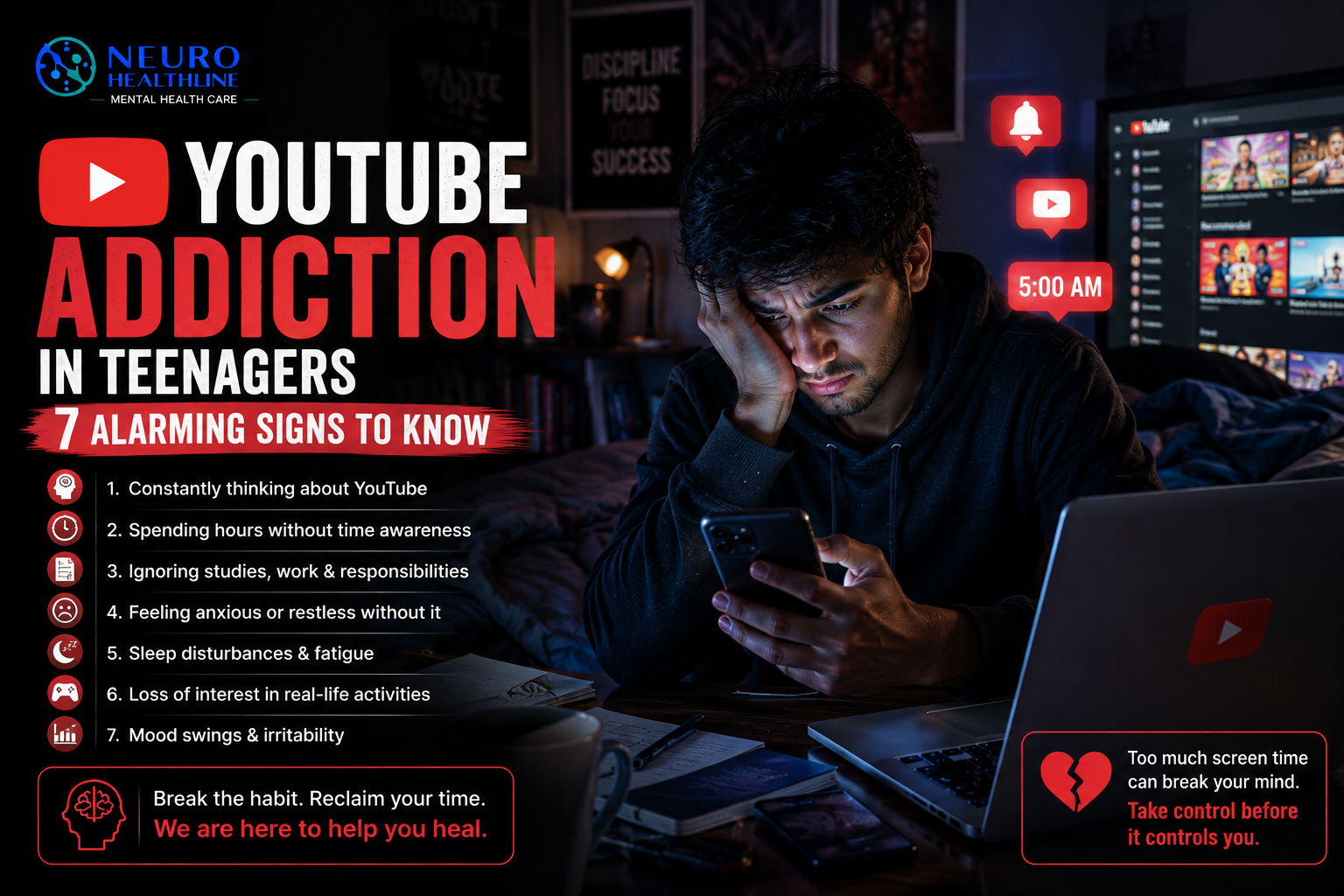
Your teenager disappeared into their bedroom three hours ago. You assumed they were studying. You just discovered they have been watching YouTube — jumping from one video to the next across gaming, pranks, conspiracy theories, and reaction content — in a state of glazed, compulsive consumption that they barely look up from when you walk in. Sound familiar? YouTube addiction in teenagers has quietly become one of the most significant and most underestimated mental health challenges facing families across India today. While Instagram gets most of the headlines and TikTok most of the moral panic, YouTube — with its autoplay algorithm, its infinite content library, its seamless transition from one video to the next — has created a content consumption environment that is, in many ways, more neurologically compelling and more difficult to disengage from than any other platform. YouTube addiction in teenagers is not about a lack of discipline or poor parenting — it is about the collision between a developing adolescent brain and a platform engineered by some of the world’s most sophisticated artificial intelligence to maximise watch time at any cost to the viewer’s wellbeing. At NeuroHealthline, we are seeing its mental health consequences across a growing number of teenagers in Kerala and Kochi — and the clinical picture demands urgent attention.
Why YouTube Is Particularly Addictive for the Teenage Brain
To understand YouTube addiction in teenagers, you need to understand both the specific vulnerability of the adolescent brain and the specific mechanisms YouTube uses to exploit it. The teenage brain is characterised by a highly responsive dopaminergic reward system — one that is significantly more sensitive to reward cues and significantly less effectively regulated by the prefrontal cortex than the adult brain. This developmental combination makes teenagers neurologically primed to be powerfully engaged by YouTube’s content delivery system in ways that adults, with their more developed prefrontal regulation, are somewhat better equipped to moderate.
YouTube’s recommendation algorithm is one of the most sophisticated engagement maximisation systems ever built. It does not recommend content it thinks you will find valuable — it recommends content it calculates will keep you watching for the longest possible time. For teenagers, this means the algorithm rapidly learns and exploits each individual’s specific engagement vulnerabilities — the emotional states, content categories, and narrative patterns that produce the most compulsive consumption — and serves an infinite, seamlessly autoplay-ing stream of precisely targeted content that makes every moment of disengagement feel like a loss. YouTube addiction in teenagers is therefore not about liking YouTube too much — it is about a developing brain being continuously outmanoeuvred by an algorithm that has had years of data and billions of dollars of engineering invested in learning how to keep exactly that brain watching.
7 Alarming Signs of YouTube Addiction in Teenagers
1. Loss of Time Awareness
One of the most universally reported signs of YouTube addiction in teenagers is a dramatic distortion of time perception during viewing — teenagers consistently report intending to watch “one video” and finding, without clear awareness of how it happened, that hours have passed. This time distortion reflects the deep attentional capture that YouTube’s autoplay and recommendation system produces — a state of partial dissociation from environmental awareness that is neurologically similar to flow states but produced by passive consumption rather than active engagement.
2. Irritability and Aggression When Interrupted
A teenager with YouTube addiction who is interrupted during viewing — for meals, family interaction, study, or sleep — frequently responds with disproportionate irritability, anger, or emotional dysregulation. This response reflects the same withdrawal-like irritability seen in other behavioural addictions — the abrupt interruption of a dopaminergic engagement state producing a sudden negative shift in emotional regulation that the incompletely developed adolescent prefrontal cortex struggles to modulate. YouTube addiction in teenagers that has progressed to this stage is producing measurable neurological dysregulation.
3. Declining Academic Performance
YouTube addiction in teenagers consistently produces academic performance decline — through multiple simultaneous mechanisms. Homework time is displaced by viewing time. Sleep is sacrificed for late-night content consumption. The attention fragmentation produced by habitual high-speed content switching reduces the capacity for the sustained, deep focus that effective studying requires. And the cognitive fatigue of prolonged passive screen consumption leaves teenagers with genuinely reduced working memory capacity and learning efficiency during the study time that does occur.
4. Social Withdrawal and Isolation
As YouTube addiction in teenagers deepens, face-to-face social interaction — with its demands for reciprocity, emotional attunement, and the management of social ambiguity — increasingly feels effortful and unrewarding compared to the frictionless, entertaining, and emotionally stimulating experience of YouTube consumption. Teenagers progressively withdraw from family interaction, peer socialisation, and extracurricular engagement — not from social anxiety primarily, but from a reward system recalibrated by YouTube’s stimulation to find real-world social interaction comparatively understimulating.
5. Inability to Enjoy Offline Activities
YouTube addiction in teenagers produces a well-documented phenomenon of anhedonia toward offline activities — the progressive inability to experience genuine enjoyment from activities that do not involve screen-based stimulation. Hobbies, physical activity, creative pursuits, and social activities that previously brought pleasure begin to feel boring, effortful, and unrewarding as the dopamine system’s reward threshold is progressively raised by YouTube’s high-stimulation content environment. This is one of the most clinically significant signs of YouTube addiction in teenagers — reflecting genuine neurological change rather than simple preference. According to NCBI PubMed, excessive screen-based media consumption in adolescents is significantly associated with dopamine system dysregulation and reduced reward sensitivity to non-screen activities — precisely the mechanism underlying this symptom.
6. Sleep Disruption and Chronic Fatigue
YouTube addiction in teenagers reliably produces severe sleep disruption — through both the direct melatonin-suppressing effect of screen light and the psychological arousal generated by content that ranges from emotionally stimulating to mildly threatening to viscerally engaging. The sleep disruption produces cascading consequences — chronic fatigue, reduced cognitive performance, heightened emotional reactivity, and progressive erosion of the nervous system resilience that protects against anxiety and depression. Many teenagers presenting with what appears to be clinical depression at NeuroHealthline are, on thorough assessment, experiencing the depressive symptoms of chronic sleep deprivation driven primarily by late-night YouTube consumption. This mirrors the broader pattern we explored in our blog on sleep disorders in teenagers in Kochi — where social media and screen use are the primary drivers of the adolescent sleep crisis.
7. Using YouTube to Regulate Emotional States
The most clinically significant sign of YouTube addiction in teenagers is when the platform becomes the teenager’s primary — or sole — coping strategy for managing negative emotional states. Boredom, anxiety, loneliness, frustration, sadness, and stress all become triggers for YouTube consumption rather than opportunities to develop the genuine emotional regulation skills that adolescent development requires. YouTube addiction in teenagers that has reached this stage is producing a genuine developmental deficit — preventing the acquisition of the internal emotional regulation capacity that mental health in adulthood depends upon, in ways that are directly connected to the Gen Z mental health crisis we are seeing across Kerala today.
How YouTube Addiction Affects the Developing Teen Brain
The neurological consequences of YouTube addiction in teenagers are most damaging precisely because they are occurring during the critical developmental window in which the adolescent brain is building the neural architecture that will define its functioning for the rest of life. The habitual passive consumption of high-speed, algorithmically curated content progressively fragments the attentional system — reducing the capacity for sustained focus, deep thinking, and creative engagement that higher education and professional life will demand. The chronic dopaminergic stimulation of YouTube’s reward loop progressively raises the brain’s reward threshold — making the slower, deeper rewards of learning, mastery, and genuine human connection feel increasingly inadequate by comparison. And the progressive displacement of active, engaged experience by passive content consumption stunts the development of the executive function, creative thinking, and social intelligence that active engagement with the real world is specifically designed to build.
Understanding these neurological consequences is what makes YouTube addiction in teenagers not simply a parenting challenge or a screen time management problem — but a genuine clinical mental health concern that warrants the same evidence-based, neuroscience-grounded intervention as any other condition producing measurable brain and nervous system change.
What Parents Can Do — And What Actually Works
The most common parental responses to YouTube addiction in teenagers — confiscating devices, imposing screen time limits, confronting the teenager about their usage — are understandable but consistently produce conflict without sustained behavioural change, because they address the behaviour without addressing the neurological and psychological drivers maintaining it. Effective intervention in YouTube addiction in teenagers requires a different approach — one that combines clinical support for the neurological dysregulation the addiction has produced, collaborative family work that reduces shame and increases genuine engagement, and practical digital behaviour restructuring that is realistic within the teenager’s social and peer context.
At NeuroHealthline, our approach to YouTube addiction in teenagers combines HEG neurofeedback to directly retrain prefrontal regulatory capacity and reward circuit dysregulation; HRV biofeedback therapy to build the genuine emotional regulation capacity that YouTube has been substituting for; sleep restoration to address the cognitive and emotional consequences of chronic YouTube-driven sleep disruption; and adolescent neuropsychotherapy to address the emotional regulation, identity, and boredom tolerance dimensions of the addiction in a developmentally appropriate, non-shaming way. Our broader social media addiction treatment program addresses YouTube addiction within the full context of adolescent digital addiction — recognising that YouTube rarely exists in isolation but is typically one component of a broader pattern of compulsive digital engagement. The World Health Organization identifies problematic digital media use as a significant and growing adolescent mental health concern — and YouTube addiction in teenagers is among its most prevalent and most clinically significant manifestations.
Frequently Asked Questions About YouTube Addiction in Teenagers
How many hours of YouTube per day indicates addiction in teenagers?
There is no single threshold — what matters more than quantity is the quality of control and the functional impact. YouTube addiction in teenagers is indicated not by a specific number of hours but by the inability to stop voluntarily when intended, the presence of withdrawal-like distress when prevented from watching, and the measurable impact on sleep, academic performance, mood, and social engagement.
Is YouTube addiction in teenagers different from other screen addictions?
YouTube has several features that make it particularly addictive compared to other platforms — including its autoplay mechanism, its infinite content library spanning virtually every interest, its seamless cross-category recommendation algorithm, and the long-form content format that makes conscious disengagement harder than the quick-hit format of Instagram or TikTok. These features combine to produce a content consumption pattern that is, in clinical experience, among the most difficult digital addictions to interrupt voluntarily.
Can YouTube addiction in teenagers cause depression?
Yes. YouTube addiction in teenagers creates multiple pathways to depression — through sleep disruption, dopamine system dysregulation, progressive social withdrawal, displacement of meaningful offline activities, and the anhedonia toward real-world experience that chronic high-stimulation content consumption produces over time.
Should I completely ban YouTube to treat my teenager’s addiction?
Complete bans typically produce conflict, covert use, and increased preoccupation with the restricted content — escalating the addiction dynamic rather than resolving it. The goal of treatment is not elimination but the restoration of voluntary control and the development of a healthy, intentional relationship with YouTube and digital content more broadly.
At what point should parents seek professional help for YouTube addiction in teenagers?
Professional support is warranted when YouTube addiction in teenagers is significantly affecting academic performance, sleep, mood, or family relationships; when the teenager has been unable to reduce their usage despite genuine motivation to do so; or when the teenager is using YouTube as their primary coping mechanism for anxiety, depression, or emotional dysregulation.