


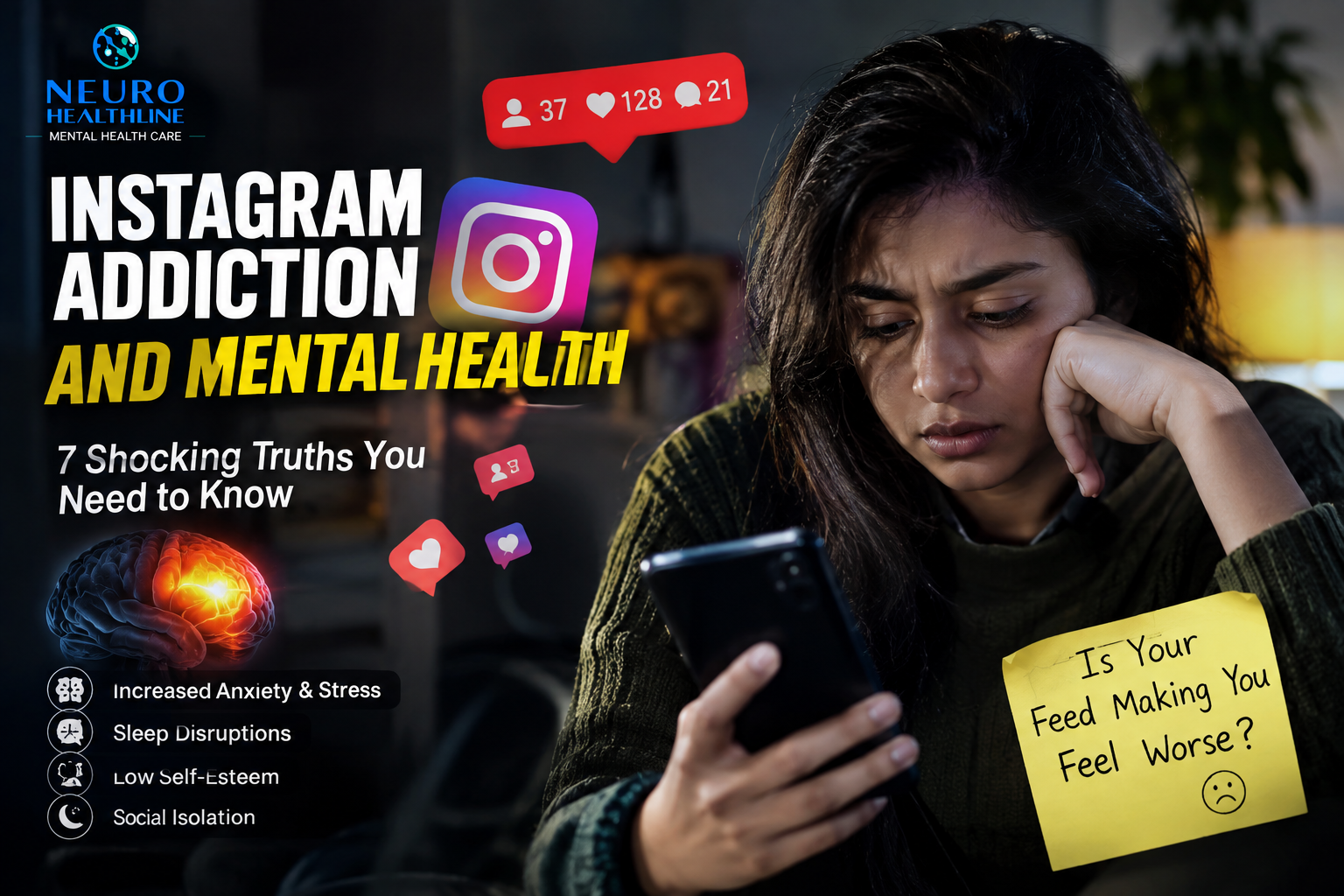
You open Instagram to check one notification. Twenty-three minutes later you are still scrolling — comparing your body to a fitness influencer, watching a stranger’s vacation highlight reel, and feeling a vague but persistent sense that your own life is somehow falling short. Sound familiar? Instagram addiction and mental health are now so deeply intertwined that neuroscientists, psychologists, and public health researchers around the world are sounding the alarm — and the evidence is becoming impossible to ignore. This is not about being weak-willed or easily distracted. Instagram was engineered by some of the world’s most sophisticated behavioural scientists to be as neurologically compelling as possible — and it is succeeding, at a measurable cost to the mental health of hundreds of millions of users globally, including a rapidly growing number of people across Kerala and Kochi who are beginning to recognise the connection between their Instagram use and their anxiety, depression, sleep disorders, and declining self-worth.
What Makes Instagram So Addictive — The Neuroscience
Understanding Instagram addiction and mental health begins with understanding why Instagram is so neurologically powerful. Instagram was built around the core mechanism of variable reward — the same psychological principle that makes slot machines so compulsively engaging. Every time you open the app, you don’t know what you will find — a post that makes you laugh, one that makes you feel inadequate, a notification of a new follower, a comment on your photo. This unpredictability is the key. The brain’s dopaminergic reward system fires not in response to the reward itself but in anticipation of a possible reward — which is precisely why checking Instagram feels compulsive even when you know, from experience, that it rarely makes you feel genuinely better.
The like button is perhaps the most psychologically sophisticated piece of user interface design in history. It converts social validation — one of the most powerful human psychological needs, deeply rooted in our evolutionary history as social primates for whom belonging to the group was literally a matter of survival — into a quantified, instantly visible metric that fluctuates unpredictably and is permanently publicly visible. The result is that Instagram addiction and mental health consequences are not incidental side effects of poor design — they are the predictable outcomes of an engagement maximisation system that deliberately exploits the deepest vulnerabilities of the human brain’s social reward circuitry.
7 Shocking Truths About Instagram Addiction and Mental Health
1. Instagram Rewires the Adolescent Brain
The relationship between Instagram addiction and mental health is significantly more damaging during adolescence than in adulthood — because the adolescent brain is still developing the prefrontal regulatory capacity that would allow it to engage with Instagram’s dopaminergic stimulation without being reshaped by it. Research published on NCBI PubMed confirms that heavy social media use during adolescence produces measurable changes in brain structure and function — including altered reward circuit sensitivity, reduced prefrontal regulatory capacity, and heightened social threat reactivity — changes that persist into adulthood and increase long-term vulnerability to anxiety and depression. The teenage brain is being neurologically shaped by Instagram in ways that will define its functioning for decades.
2. Instagram Comparison Is Neurologically Identical to Physical Threat
When you scroll through Instagram and encounter images that trigger social comparison — someone more attractive, more successful, more socially connected — your amygdala responds in the same way it responds to physical danger. Instagram addiction and mental health are intertwined because the social comparison that Instagram systematically generates activates a genuine neurological threat response, flooding the body with cortisol and adrenaline, disrupting prefrontal regulatory capacity, and maintaining a state of chronic low-grade social threat that progressively exhausts the stress response system. You are not being oversensitive — you are having a physiologically real threat response to content specifically designed to trigger it.
3. Instagram is Making Anxiety Worse — By Design
The fear of missing out — the awareness, uniquely enabled by Instagram, of social events happening without you, relationships developing in your absence, and experiences being had by others that your life currently does not include — is not an accidental consequence of social media use. It is a design feature. Instagram’s Stories format, its real-time posting culture, and its algorithmic amplification of aspirational content together create a continuous stream of potentially exclusionary information that keeps the social threat-detection system chronically activated. The relationship between Instagram addiction and mental health outcomes for anxiety is not correlation — it is mechanism.
4. Instagram Destroys Sleep — And Poor Sleep Destroys Mental Health
The relationship between Instagram addiction and mental health includes a particularly damaging pathway through sleep. Late-night Instagram use suppresses melatonin production through blue light exposure while simultaneously generating the psychological arousal — social comparison anxiety, FOMO, the dopaminergic stimulation of content consumption — that maintains neural alertness incompatible with sleep onset. The result is a generation sleeping progressively less, with progressively worse sleep quality, and experiencing the cascading mental health consequences — increased anxiety, reduced emotional regulation, impaired cognitive performance, heightened depression vulnerability — that chronic sleep deprivation systematically produces.
5. Instagram Body Image Damage Is Clinically Significant
The relationship between Instagram addiction and mental health is particularly acute around body image — especially for young women but increasingly for young men navigating the algorithmically amplified body ideals of fitness influencer culture. Instagram’s visual format combined with its algorithmic preferencing of physically idealized content creates a uniquely potent body comparison environment that clinical research consistently links to body dissatisfaction, disordered eating attitudes, and reduced self-esteem. This is not about individual insecurity — it is about a content environment systematically engineered to make users feel inadequate in order to drive engagement with aspirational products and services.
6. Instagram Addiction Reduces Real-World Connection
One of the most painful paradoxes of Instagram addiction and mental health is that a platform designed around social connection is making people feel more isolated. The substitution of curated online social performance for genuine face-to-face connection — with its messiness, reciprocity, vulnerability, and real intimacy — progressively atrophies the social skills, emotional attunement, and capacity for genuine relationship that sustained mental health genuinely requires. Users of Instagram addictively report higher rates of loneliness than light users — a finding that directly contradicts the platform’s social connection narrative.
7. Instagram Addiction is Treatable — But Willpower Alone Is Not Enough
The most important truth about Instagram addiction and mental health is that the compulsive use pattern that Instagram produces is not a character flaw or a discipline problem — it is a neurological condition driven by genuine reward circuit dysregulation that responds poorly to willpower-based approaches alone. At NeuroHealthline, we see a growing number of clients in Kochi and across Kerala whose anxiety, depression, sleep disorders, and self-esteem challenges are significantly driven and maintained by Instagram addiction — and for whom effective treatment requires directly addressing the neurological patterns that Instagram’s design has exploited and entrenched. Our social media addiction treatment program addresses Instagram addiction specifically — using neurofeedback to retrain reward circuit regulation, HRV biofeedback to rebuild genuine nervous system resilience, and neuropsychotherapy to address the identity, validation, and connection needs that Instagram is meeting in unsatisfying but compelling ways.
The Instagram Addiction and Mental Health Crisis in Kerala
Kerala’s young population is among the heaviest social media users in India — with smartphone penetration, high-speed internet access, and a digitally connected youth culture creating the conditions for Instagram addiction and mental health consequences that are rapidly becoming one of the state’s most significant emerging public health challenges. Across Kochi’s schools, colleges, and tech campuses, the clinical presentations most directly linked to Instagram addiction and mental health impact — anxiety, body image distress, sleep disorders, social comparison depression, and FOMO-driven social isolation — are among the fastest-growing concerns that parents, teachers, and mental health professionals are encountering.
The connection to broader Gen Z mental health in Kochi is direct and significant — Instagram addiction is one of the primary mechanisms through which the Gen Z mental health crisis is being maintained and amplified, making it a clinical priority that cannot be separated from the broader context of youth mental health support in Kerala. The World Health Organization identifies social media’s impact on adolescent mental health as one of the most urgent global public health concerns of the current decade — and the evidence linking Instagram addiction and mental health outcomes is among the strongest and most consistent in the field.
Breaking Free — What Effective Treatment for Instagram Addiction Looks Like
Effective treatment for Instagram addiction and mental health consequences is not about deleting the app — which typically lasts days before reinstallation — or setting screen time limits that are easily bypassed. It is about directly addressing the neurological and psychological mechanisms that Instagram has entrenched. This means retraining reward circuit regulation so that the variable reward mechanism loses its compulsive grip; rebuilding genuine nervous system resilience so that anxiety and boredom — the two most powerful triggers of compulsive Instagram use — are regulated internally rather than through external stimulation; restoring genuine sleep architecture so that the cognitive and emotional regulatory capacity that Instagram use has degraded is systematically rebuilt; and developing a stable, internally anchored sense of self-worth that is no longer contingent on the external validation that Instagram provides in unreliable, insufficient quantities.
Our anxiety treatment in Kochi and social media anxiety treatment programs address the anxiety dimensions of Instagram addiction directly — recognising that for the majority of individuals struggling with Instagram addiction and mental health consequences, the anxiety and the addiction are not separate problems but two dimensions of the same underlying neurological dysregulation.
Frequently Asked Questions About Instagram Addiction and Mental Health
How do I know if I have Instagram addiction rather than just enjoying social media?
Key indicators of Instagram addiction rather than healthy social media use include spending significantly more time on Instagram than intended despite repeated intentions to cut back; experiencing genuine anxiety, irritability, or restlessness when unable to check Instagram; noticing that Instagram use consistently worsens rather than improves your mood; and finding that Instagram use is affecting your sleep, relationships, work, or academic performance in ways you recognise but feel unable to change.
Can Instagram addiction cause clinical depression?
Yes. The relationship between Instagram addiction and mental health includes a well-documented pathway to clinical depression — through persistent negative social comparison, progressive erosion of self-worth, sleep disruption, displacement of real-world sources of meaning and connection, and the dopamine system downregulation that chronic Instagram overuse produces over time.
Is Instagram addiction worse for teenagers than adults?
Significantly. The adolescent brain’s still-developing prefrontal regulatory capacity and heightened social reward sensitivity make it substantially more vulnerable to Instagram’s neurological impact — both in terms of the immediate mental health consequences and the long-term neurological reshaping that heavy adolescent Instagram use produces.
Can Instagram addiction be treated without deleting the app permanently?
Yes. Effective treatment aims to restore deliberate, values-aligned engagement with Instagram rather than requiring permanent elimination — which is neither realistic nor necessary. The goal is reestablishing voluntary control over Instagram use rather than complete abstinence.
How does NeuroHealthline treat Instagram addiction and its mental health consequences?
Through a combination of neurofeedback to retrain reward circuit regulation, HRV biofeedback to build genuine nervous system resilience, functional nutrition to support dopamine system restoration, sleep restoration, and neuropsychotherapy addressing the identity and validation needs that Instagram is meeting inadequately — producing lasting neurological change rather than relying on willpower or screen time rules alone.