


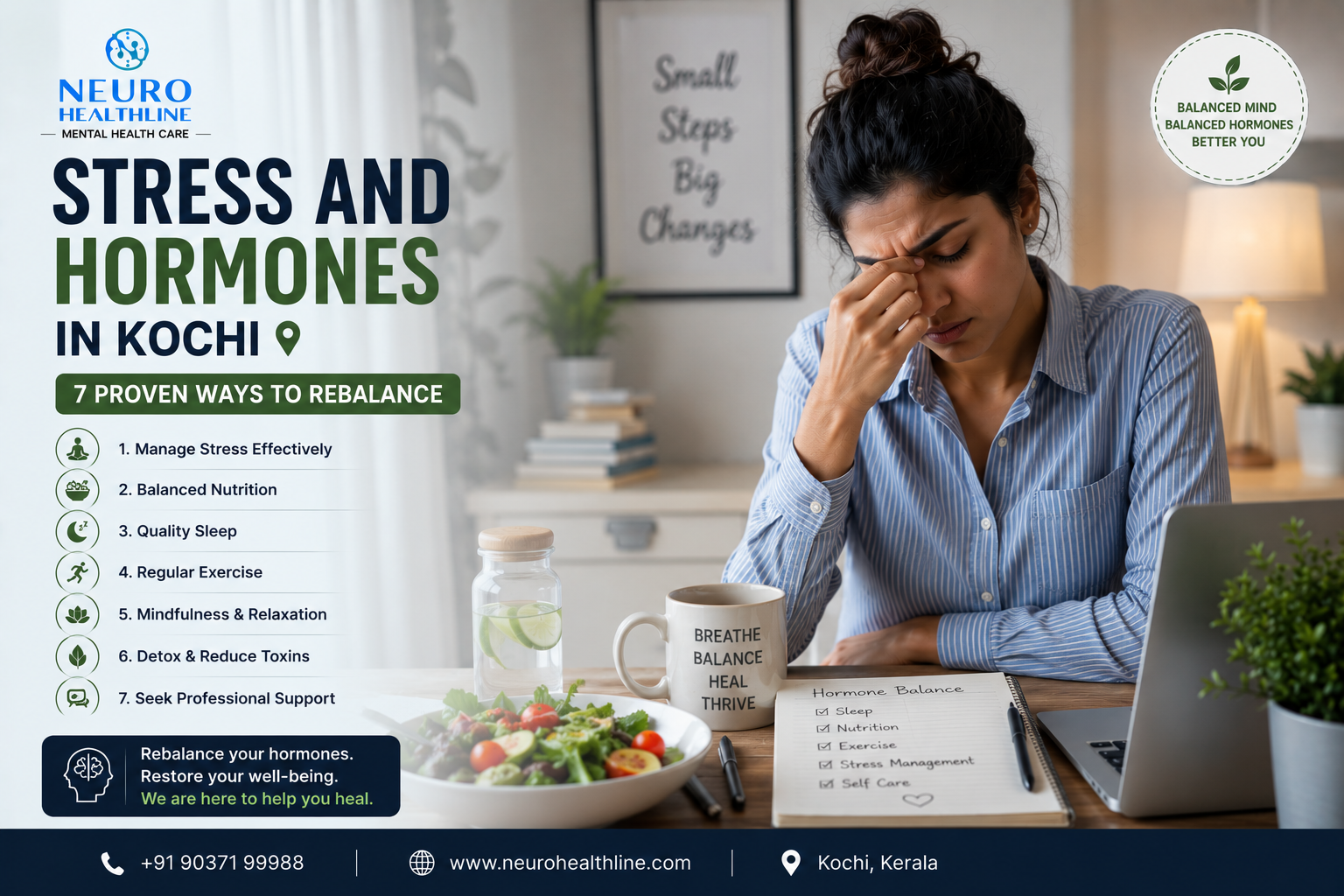
If you have been experiencing unexplained weight gain, persistent fatigue that sleep does not resolve, irregular menstrual cycles, reduced libido, brain fog, mood instability, hair thinning, or a thyroid diagnosis that emerged during or after a period of intense professional or personal pressure — the relationship between stress and hormones in Kochi may be the missing clinical piece that explains what is happening in your body. Hormonal health and stress are not separate physiological domains — they are intimately interconnected systems in which the stress response directly modulates the production, transport, and reception of virtually every major hormone in the body. At NeuroHealthline, stress and hormones in Kochi are addressed as the inseparable physiological partnership they genuinely are — through a comprehensive functional medicine and neuroscience-based program that identifies and corrects the specific hormonal dysregulations your stress pattern has produced.
How Stress Disrupts Hormonal Balance — The Physiological Mechanism
The connection between stress and hormones in Kochi begins with the HPA axis — the hypothalamic-pituitary-adrenal system that governs the body’s stress response. When the brain perceives a threat, the hypothalamus releases corticotropin-releasing hormone, which triggers the pituitary to release ACTH, which stimulates the adrenal glands to produce cortisol — the body’s primary stress hormone. This cascade is extraordinarily efficient and, in acute stress situations, precisely what the body needs. The problem emerges when chronic stress keeps this cascade persistently activated — producing a sustained elevation of cortisol that directly disrupts the production and regulation of virtually every other hormonal system in the body.
Cortisol and the sex hormones — oestrogen, progesterone, and testosterone — compete for the same biochemical precursors. Under chronic stress, cortisol production is prioritised at the expense of sex hormone synthesis — producing a phenomenon sometimes called the cortisol steal — reducing oestrogen and progesterone in women and testosterone in men to levels that impair reproductive function, mood regulation, bone density, and metabolic health. Chronic cortisol elevation also directly suppresses thyroid function — reducing the conversion of inactive T4 to active T3, the form of thyroid hormone that cells can actually use — producing thyroid-like symptoms of fatigue, cognitive slowing, weight gain, and temperature dysregulation even when thyroid hormone levels appear within normal ranges on standard blood testing.
The adrenal glands themselves, under prolonged chronic stress activation, progressively lose their capacity to maintain adequate cortisol production — producing the pattern of adrenal fatigue characterised by abnormally low morning cortisol, persistent exhaustion, salt cravings, and dramatically reduced stress tolerance. Research published on NCBI PubMed confirms that chronic psychological stress produces measurable dysregulation of the HPA axis, thyroid axis, and gonadal hormone systems simultaneously — supporting the need for integrated assessment and treatment of stress and hormones in Kochi rather than addressing each hormonal disruption in isolation.
Stress and Hormones in Kochi — Who Is Most Affected?
While the relationship between stress and hormones affects everyone experiencing chronic stress, certain populations in Kochi carry particularly significant risk of stress-driven hormonal disruption. Working women in Kochi navigating the combined demands of professional careers, family responsibilities, and social expectations face a particularly intense hormonal burden — with chronic stress directly disrupting the menstrual cycle, amplifying premenstrual syndrome symptoms, accelerating perimenopause onset, and contributing to conditions including polycystic ovarian syndrome that are increasingly prevalent among Kochi’s working female population.
Corporate executives and senior managers — both male and female — experience the testosterone dysregulation that chronic cortisol elevation produces in high-pressure leadership roles, impairing the drive, confidence, cognitive clarity, and physical vitality that sustained professional performance requires. Healthcare professionals in Kochi’s demanding medical institutions carry the particular hormonal burden of shift work — which directly disrupts the circadian cortisol rhythm alongside the sex hormone cycles that circadian timing regulates. And Kochi’s student population, navigating the extraordinary academic pressure of competitive examinations during the developmental years when the HPA axis is still consolidating its regulatory patterns, is increasingly presenting with the stress and hormones in Kochi challenges that would previously have been seen only in older adults.
Signs That Stress Is Disrupting Your Hormones in Kochi
Many people experiencing stress-driven hormonal dysregulation in Kochi seek investigation and treatment for individual hormonal symptoms without connecting them to the chronic stress pattern that is driving them. Common signs that indicate a significant stress and hormones in Kochi presentation include persistent, disproportionate fatigue that does not respond to adequate sleep — reflecting both cortisol rhythm disruption and subclinical thyroid suppression; unexplained weight gain — particularly abdominal — reflecting cortisol’s direct effects on fat storage and insulin resistance; irregular, absent, or severely symptomatic menstrual cycles in women — reflecting the impact of cortisol steal on progesterone and oestrogen production; reduced libido and sexual function in both sexes — reflecting testosterone depletion under chronic cortisol elevation; hair thinning and skin changes — reflecting the combined hormonal dysregulation that chronic stress produces; mood instability, irritability, and anxiety that worsen at specific points in the menstrual cycle — reflecting the amplified hormonal fluctuations that stress-driven progesterone depletion creates; brain fog and cognitive slowing — reflecting the cognitive consequences of subclinical thyroid suppression and cortisol-driven hippocampal impairment; and temperature dysregulation, cold intolerance, and low basal body temperature — reflecting the active T3 reduction produced by chronic stress on thyroid conversion.
7 Proven Ways NeuroHealthline Addresses Stress and Hormones in Kochi
1. Comprehensive Hormonal and Stress Assessment
Treatment for stress and hormones in Kochi begins with a thorough functional assessment mapping both the HPA axis dysregulation and the downstream hormonal consequences it has produced — including cortisol rhythm profiling, thyroid function including active T3 assessment, sex hormone panel, QEEG brain mapping, and HRV profiling. This comprehensive picture provides the clinical foundation for genuinely targeted treatment rather than addressing individual hormonal symptoms in isolation.
2. HPA Axis Regulation Through HRV Biofeedback
Since the HPA axis dysregulation driving stress-related hormonal disruption originates in the nervous system’s stress response, HRV biofeedback therapy is a foundational component of stress and hormones in Kochi treatment — directly retraining the autonomic nervous system to reduce chronic HPA axis activation, allowing cortisol production to normalise and the downstream hormonal disruptions it has caused to progressively resolve.
3. Adrenal Support and Cortisol Rhythm Restoration
Where adrenal fatigue pattern has been identified — abnormally low cortisol with severely reduced stress tolerance — stress and hormones in Kochi treatment includes targeted adrenal support protocols using adaptogenic nutrients, specific nutritional cofactors for adrenal hormone synthesis, and structured lifestyle interventions that reduce adrenal demand while supporting adrenal recovery.
4. Thyroid Support and Active T3 Optimisation
For clients whose stress and hormones in Kochi presentation includes evidence of stress-driven thyroid suppression — particularly reduced T4 to T3 conversion — our functional nutrition and lifestyle protocols specifically support the conversion pathway, reducing the reverse T3 production that chronic stress promotes and optimising the active thyroid hormone availability that energy, cognition, and metabolic function require.
5. Sex Hormone Rebalancing Through Functional Nutrition
Stress and hormones in Kochi treatment includes targeted nutritional support for sex hormone rebalancing — including the precursor nutrients required for oestrogen, progesterone, and testosterone synthesis; phytoestrogen and adaptogenic support where clinically appropriate; and dietary anti-inflammatory protocols that reduce the inflammatory burden that chronic stress-driven hormonal disruption produces on the reproductive system.
6. HEG Neurofeedback for Stress System Downregulation
By directly strengthening prefrontal cortex regulation of the stress response, HEG neurofeedback reduces the chronically elevated HPA axis activation that drives hormonal disruption — working top-down from the neural level to produce downstream hormonal normalisation that complements the functional nutrition and lifestyle interventions addressing hormonal balance from the physiological level upward. This dual-direction approach to stress and hormones in Kochi treatment consistently produces more comprehensive hormonal recovery than either approach alone.
7. Circadian Rhythm Restoration for Hormonal Timing
Virtually every major hormone in the body — cortisol, thyroid, oestrogen, progesterone, testosterone, melatonin, growth hormone — follows a circadian rhythm that chronic stress progressively disrupts. Stress and hormones in Kochi treatment at NeuroHealthline includes structured circadian realignment — through strategic light exposure, consistent sleep-wake timing, and meal timing protocols — restoring the circadian framework within which healthy hormonal rhythms can re-establish themselves.
Why Integrated Stress and Hormones Treatment in Kochi Produces Better Outcomes
The most significant limitation of conventional approaches to stress-driven hormonal disruption in Kochi is the specialist siloing that addresses each hormonal symptom through a separate medical specialist — the gynaecologist for menstrual irregularities, the endocrinologist for thyroid symptoms, the general physician for fatigue — without any single clinician mapping the chronic stress pattern driving all of these presentations simultaneously. This siloed approach consistently produces incomplete outcomes because it addresses symptoms while leaving the physiological root cause — the chronic stress-driven HPA axis dysregulation — intact and continuing to generate hormonal disruption despite symptomatic treatment.
NeuroHealthline’s integrated approach to stress and hormones in Kochi addresses this limitation by treating the stress-driven HPA axis dysregulation and its hormonal consequences as a single, interconnected clinical presentation — delivering more comprehensive and more durable outcomes than specialist-siloed approaches can achieve. Our comprehensive stress treatment in Kochi program provides the clinical framework within which stress and hormones treatment sits, while our chronic stress treatment in Kochi and occupational stress treatment in Kochi programs address the specific stress contexts most commonly driving hormonal disruption in Kochi’s professional population. The World Health Organization recognises the systemic, whole-body consequences of chronic stress — and NeuroHealthline’s stress and hormones in Kochi program reflects this recognition in its genuinely integrated clinical design.
Frequently Asked Questions About Stress and Hormones in Kochi
Can stress alone cause thyroid problems in Kochi?
Yes. Chronic stress directly suppresses thyroid function through cortisol’s inhibitory effect on T4 to T3 conversion. Many thyroid presentations in Kochi that emerge during sustained stress reflect stress-driven suppression rather than primary thyroid pathology.
Can stress cause hormonal imbalance without abnormal blood test results?
Yes. Stress-driven hormonal disruption frequently produces significant clinical symptoms while blood tests remain within conventional normal ranges — particularly for thyroid function. Our functional assessment captures subclinical dysregulation that standard testing misses.
Is stress and hormones treatment in Kochi suitable for women with PCOS?
Yes. Chronic stress is a significant driver of PCOS symptom severity. Our program addresses these mechanisms specifically, working alongside conventional PCOS management to reduce the stress-driven component of symptom severity.
How long does it take for hormones to rebalance after stress treatment in Kochi?
Most clients notice initial improvements in energy, mood stability, and sleep within 4 to 8 weeks, with more comprehensive hormonal normalisation consolidating over 3 to 6 months as HPA axis regulation is restored.
Is stress and hormones treatment in Kochi suitable for men as well as women?
Yes. Men experience equally significant stress-driven hormonal disruption — particularly testosterone suppression, cortisol dysregulation, and subclinical thyroid suppression — that directly impairs energy, cognitive performance, and vitality.