


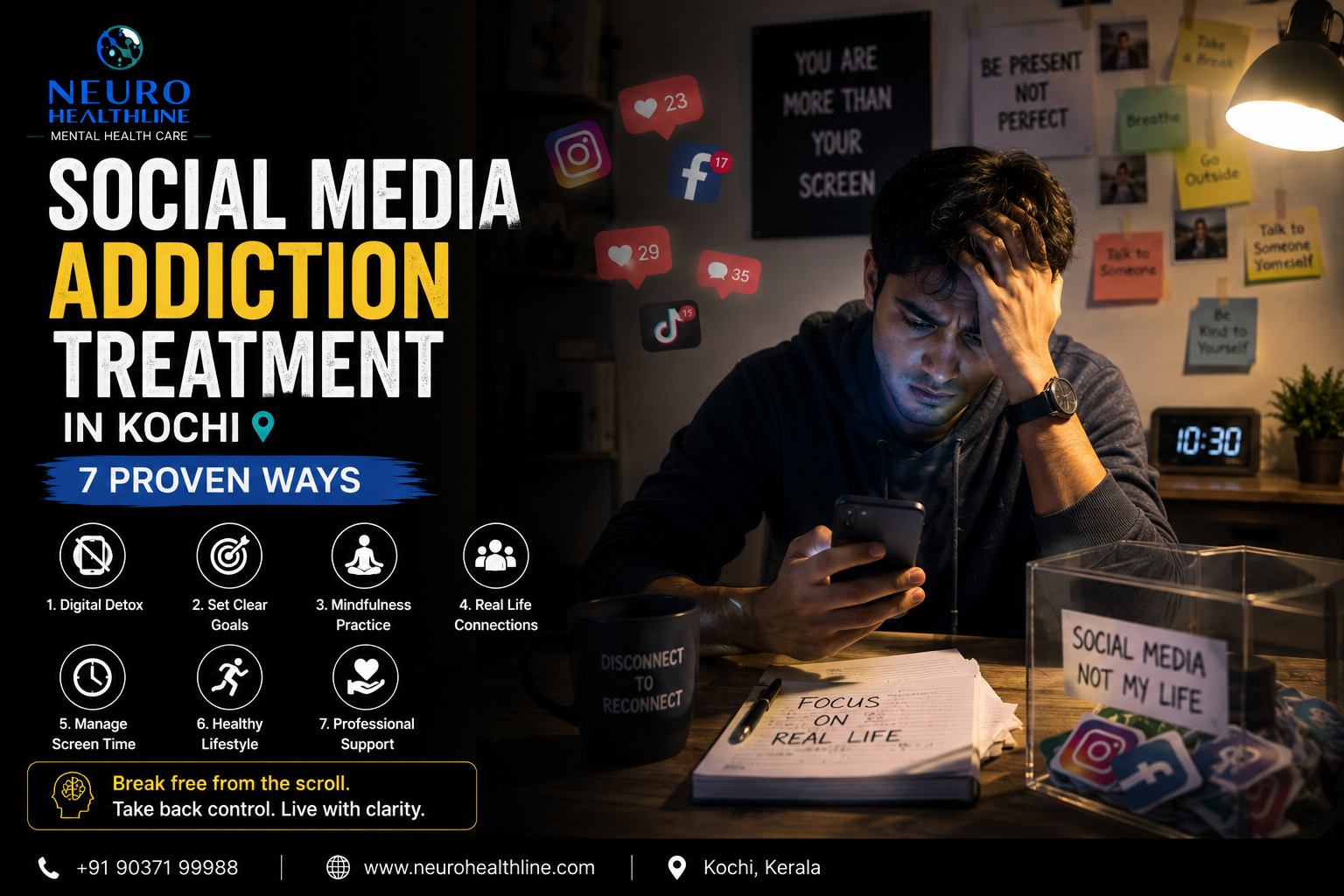
If you find yourself reaching for your phone within minutes of waking up, spending hours scrolling through content you don’t even particularly enjoy, feeling genuine anxiety when you are unable to check social media, or repeatedly failing to cut back despite recognising that your social media use is affecting your sleep, relationships, and mental health — you are not alone, and you are not simply lacking willpower. Social media addiction treatment in Kochi at NeuroHealthline addresses what is increasingly recognised as a genuine behavioural addiction — one driven not by personal weakness but by the deliberate neurological exploitation of the brain’s reward circuitry by platforms engineered to maximise engagement at any cost to user wellbeing. Across Kochi’s student population, corporate workforce, and professional community, social media addiction is quietly driving anxiety, depression, sleep disorders, attention difficulties, and relationship breakdown — and the demand for effective social media addiction treatment in Kochi has never been greater or more urgent.
Why Social Media Is Genuinely Addictive — The Neuroscience
Social media addiction is not a metaphor or an exaggeration — it reflects a genuine neurological process that shares core mechanisms with recognised substance and behavioural addictions. Understanding this neuroscience is the foundation of effective social media addiction treatment in Kochi, because it reveals why willpower alone is so consistently insufficient as a solution.
Social media platforms are engineered around the principle of variable reward — the same mechanism that makes slot machines so compulsively engaging. When you open Instagram, TikTok, or YouTube, you do not know what you will find — and this unpredictability is precisely what makes checking so compulsive. The dopaminergic reward system fires not in response to the reward itself but in anticipation of a possible reward — meaning the act of checking, not the content found, is what generates the compulsive neurological drive. Over time, with repeated activation, the dopamine system undergoes the same downregulation seen in substance addiction — requiring increasing amounts of stimulation to generate the same level of reward, while simultaneously reducing the capacity to experience satisfaction from the slower, richer rewards of face-to-face connection, creative work, and physical activity.
Social comparison, validation-seeking through likes and comments, and fear of missing out activate the brain’s social threat-detection system alongside the reward system — creating a combined neurological drive that is extraordinarily powerful and extraordinarily difficult to interrupt through cognitive effort alone. This is precisely why social media addiction treatment in Kochi at NeuroHealthline works directly with the brain’s reward and regulatory systems rather than relying on behavioural rules and restrictions alone.
How Social Media Addiction Presents in Kochi
Social media addiction in Kochi presents across a wide demographic spectrum — from teenagers and university students for whom social media is the primary arena of social life, to young professionals in Kochi’s IT and corporate sectors for whom social media use has blurred seamlessly into working hours, to adults whose social media consumption has gradually displaced the real-world activities and relationships that previously provided meaning and connection. Common presentations of social media addiction in Kochi that indicate a need for social media addiction treatment include spending significantly more time on social media than intended, with repeated unsuccessful attempts to cut back; experiencing genuine anxiety, irritability, or restlessness when unable to access social media; neglecting work, academic responsibilities, physical health, or important relationships due to social media use; using social media as the primary coping mechanism for negative emotions — boredom, loneliness, anxiety, or stress; significant sleep disruption from late-night social media use that the individual recognises as harmful but cannot consistently stop; and a progressive loss of interest in activities and relationships that don’t involve social media engagement.
As we explored in our blog on social media anxiety in teenagers in Kochi, the anxiety generated by social media and the compulsive checking behaviour that characterises social media addiction are deeply interconnected — each maintaining and amplifying the other in a cycle that requires clinical intervention to break effectively.
The Mental Health Consequences of Untreated Social Media Addiction in Kochi
The mental health consequences of untreated social media addiction in Kochi are significant and wide-ranging. Chronic social media overuse is strongly associated with increased anxiety — through social comparison, social threat activation, and the chronic low-grade arousal of constant notification monitoring; depression — through the progressive displacement of real-world sources of meaning, connection, and accomplishment by the hollow, transient rewards of social media engagement; attention fragmentation — through the habitual high-speed content consumption that progressively reduces the capacity for sustained, deep focus required for effective work, study, and creative engagement; sleep disruption — through both the direct effect of screen light on melatonin production and the psychological arousal generated by social media content in the hours before sleep; and relationship deterioration — through the physical presence but psychological absence that characterises social media addiction’s impact on face-to-face relationships.
The broader Gen Z mental health crisis in Kochi is substantially driven by social media addiction dynamics — and effective social media addiction treatment in Kochi therefore has implications not only for individual wellbeing but for the mental health trajectory of an entire generation. According to NCBI PubMed, problematic social media use is significantly associated with anxiety, depression, sleep disorders, and reduced life satisfaction across age groups — with the relationship being particularly strong among adolescents and young adults, precisely the populations most prevalent in Kochi’s social media addiction landscape.
7 Proven Solutions in Our Social Media Addiction Treatment in Kochi Program
1. Neurological Assessment of Reward Circuit Dysregulation
Social media addiction treatment in Kochi begins with a QEEG brain mapping assessment identifying the specific reward circuit dysregulation and prefrontal regulatory deficits driving each individual’s social media addiction — providing objective neurological data that helps clients understand their addiction as a brain phenomenon rather than a personal failing, significantly reducing shame and increasing therapeutic engagement.
2. HEG Neurofeedback for Prefrontal Regulation
The prefrontal cortex — the brain region responsible for impulse control, delayed gratification, and the deliberate regulation of reward-seeking behaviour — is consistently underactivated in behavioural addiction presentations. Social media addiction treatment in Kochi uses HEG neurofeedback to directly strengthen prefrontal regulatory capacity, building the neurological foundation for genuine voluntary control over social media use rather than relying on effortful suppression of an unchanged neural drive.
3. HRV Biofeedback for Craving and Anxiety Management
HRV biofeedback therapy teaches a practical, portable nervous system regulation skill that directly addresses two of the most powerful drivers of compulsive social media use — anxiety and boredom — by building the capacity to regulate these states through the autonomic nervous system rather than reaching for social media as an automatic coping response.
4. Dopamine System Restoration
Social media addiction treatment in Kochi at NeuroHealthline includes functional nutrition and lifestyle protocols specifically designed to support dopamine system restoration — correcting the receptor downregulation and baseline reward sensitivity reduction that chronic social media overuse produces, and rebuilding the capacity to experience genuine satisfaction from the slower, richer rewards of real-world activities and relationships.
5. Sleep Restoration
Sleep disruption is both a consequence and a driver of social media addiction in Kochi — and restoring healthy sleep architecture is a critical component of social media addiction treatment in Kochi. As we outlined in our blog on sleep disorders in teenagers in Kochi, the circadian disruption produced by late-night screen use and the psychological arousal generated by social media content are among the most damaging consequences of social media addiction for long-term brain health. Our sleep restoration protocols address these directly.
6. Digital Behaviour Restructuring
Effective social media addiction treatment in Kochi does not advocate for complete social media elimination — which is neither realistic nor desirable for most people in Kochi’s digitally connected social and professional environment. Instead, our program develops a personalised, sustainable digital behaviour restructuring plan — gradually reestablishing deliberate, values-aligned social media use patterns that serve the individual’s genuine goals and relationships rather than the platform’s engagement maximisation algorithm.
7. Neuropsychotherapy for Identity and Meaning Reconstruction
Social media addiction frequently develops in the context of underlying emotional needs — for connection, validation, stimulation, and meaning — that social media temporarily satisfies in highly accessible but ultimately unsatisfying ways. Social media addiction treatment in Kochi includes neuropsychotherapy specifically addressing these underlying needs — helping clients identify, rebuild, and invest in the real-world sources of meaning, connection, and accomplishment that social media has progressively displaced.
Social Media Addiction Treatment in Kochi for Different Age Groups
Social media addiction treatment in Kochi at NeuroHealthline is adapted for the specific presentation and context of each age group. For teenagers and university students, treatment specifically addresses the social belonging and identity formation dimensions of social media use that make digital engagement feel existentially necessary rather than simply habitual — alongside the academic performance and sleep consequences most acute in this group. For Kochi’s young professionals, treatment addresses the professional boundary erosion that blurs social media addiction into working patterns, alongside the burnout, attention fragmentation, and relationship deterioration that result. For adults, treatment addresses the gradual displacement of real-world activities and relationships that social media addiction produces over years of habitual use, rebuilding engagement with the offline sources of meaning and connection that sustained wellbeing genuinely requires.
Our comprehensive anxiety treatment in Kochi and stress treatment in Kochi programs address the anxiety and stress that so frequently underlie social media addiction — recognising that effective social media addiction treatment in Kochi must address both the addictive behaviour and the emotional drivers maintaining it. The World Health Organization increasingly recognises problematic digital technology use as a significant global mental health concern requiring evidence-based clinical intervention — the standard our social media addiction treatment in Kochi program upholds.
Frequently Asked Questions About Social Media Addiction Treatment in Kochi
Is social media addiction a real clinical condition?
Yes. Social media addiction shares core neurological mechanisms with recognised behavioural addictions — including reward circuit dysregulation, prefrontal underactivation, and withdrawal-like symptoms when access is restricted. Social media addiction treatment in Kochi at NeuroHealthline addresses these neurological mechanisms directly rather than treating the condition as purely a matter of self-discipline
How long does social media addiction treatment in Kochi typically take?
Most clients report meaningful reductions in compulsive social media use and associated anxiety within 4 to 8 weeks, with more comprehensive neurological and behavioural change consolidating over 3 to 5 months of consistent treatment.
Will social media addiction treatment in Kochi require me to delete all my social media accounts?
No. Our program does not advocate for complete social media elimination, which is neither realistic nor necessary for most people. Instead, we develop a personalised digital behaviour restructuring plan that reestablishes deliberate, values-aligned social media use.
Is social media addiction treatment in Kochi suitable for teenagers?
Yes. Our program is fully adapted for teenagers, with age-appropriate neurofeedback protocols, developmentally sensitive neuropsychotherapy, and specific attention to the social belonging and identity formation dimensions of adolescent social media use.
Can social media addiction treatment in Kochi help if I also have anxiety or depression?
Yes. Social media addiction frequently co-occurs with anxiety and depression — each condition maintaining and amplifying the others. Our integrated program addresses all presenting conditions simultaneously rather than treating social media addiction in isolation from its mental health context.