


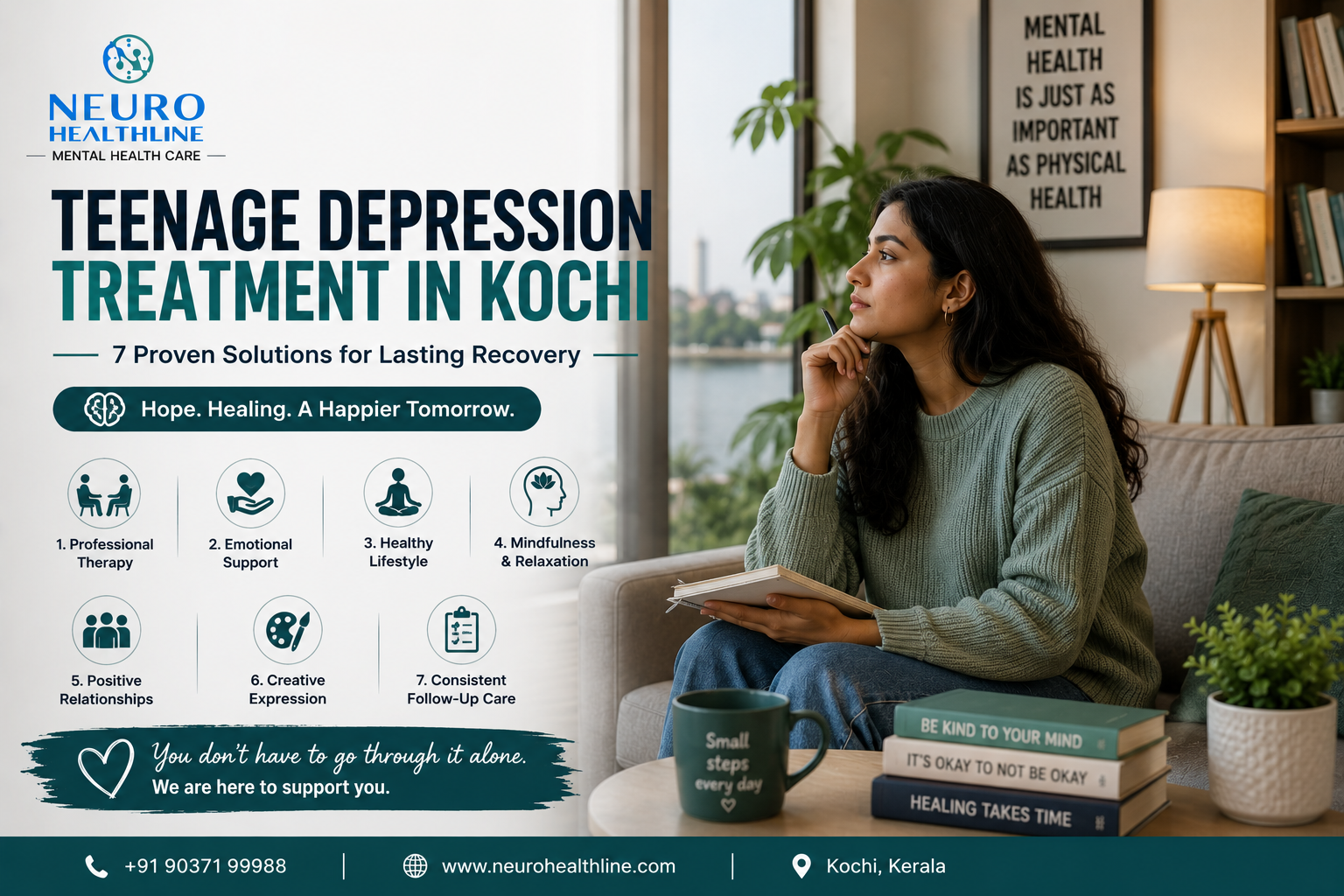
Depression in teenagers is one of the most misunderstood and most urgently underserved mental health challenges in Kochi today. It is frequently dismissed as moodiness, laziness, or a phase — particularly in a cultural context where academic performance is prioritised above emotional wellbeing, and where the expectation that young people should simply push through difficulty remains deeply embedded. But teenage depression is not a phase, and it is not a character flaw. It is a measurable neurological condition involving disrupted neurotransmitter systems, reduced prefrontal cortex activation, chronic neuroinflammation, and HPA axis dysregulation — all of which are fully addressable through appropriately targeted clinical intervention. Teenage depression treatment in Kochi at NeuroHealthline is designed to address these neurological and physiological realities with the clinical precision, developmental sensitivity, and genuine compassion that Kochi’s depressed teenagers and their families deserve.
Why Teenage Depression in Kochi Is a Growing Crisis
The scale of teenage depression in Kochi has grown sharply over the past several years — driven by a convergence of factors that are creating an unprecedented mental health burden for Kerala’s adolescent population. Academic pressure in Kerala’s intensely competitive educational environment places teenagers under sustained, high-stakes performance demands from increasingly early ages — with the competitive examination culture creating a social environment where self-worth is relentlessly measured against academic achievement. Social media saturation exposes teenagers to continuous social comparison, curated highlight reels that distort perceptions of peers’ happiness and success, and the chronic low-grade social threat of online evaluation and exclusion. The pandemic disrupted two to three years of critical social development — removing the face-to-face peer interaction, physical activity, and routine structure that buffer adolescent mental health — with consequences that are still significantly present in Kochi’s teenage population today.
The result is a generation of young people in Kochi navigating extraordinary psychological demands with developing nervous systems, limited access to stigma-free mental health support, and cultural frameworks that frequently pathologise help-seeking rather than normalising it. Teenage depression treatment in Kochi is therefore not simply a clinical priority — it is a social and educational one.
How Teenage Depression Presents Differently in Kochi
One of the most important reasons teenage depression in Kochi so frequently goes unrecognised and untreated is that it often presents very differently from the adult depression most people are familiar with. Rather than the prominent sadness and tearfulness that characterise classic adult depression, teenage depression in Kochi frequently presents as irritability and anger — making depressed teenagers appear difficult, oppositional, or disrespectful rather than distressed; academic performance decline that is interpreted as laziness or attitude problems rather than a symptom of neurological impairment; social withdrawal that appears as screen addiction — the teenager retreating into online environments that feel more controllable than demanding face-to-face social interactions; physical complaints including chronic fatigue, headaches, and digestive issues that generate medical investigations rather than mental health assessment; and a maintained social media presence that creates a misleading impression of social engagement and wellbeing that masks significant internal distress.
This presentation gap is one of the most significant barriers to timely teenage depression treatment in Kochi — and closing it requires both clinical vigilance and broader community psychoeducation about the age-specific ways depression manifests in adolescents.
The Neuroscience of Teenage Depression — Why It Requires Specialised Treatment
Teenage depression is not simply adult depression in a younger body — it involves distinct neurological and developmental dynamics that require age-specific treatment approaches. The adolescent brain is characterised by a neuroplasticity window — a period of heightened neural change during which experiences, both positive and negative, have disproportionately powerful and lasting effects on the brain’s developing architecture. This means that untreated depression during the teenage years does not simply cause distress in the present — it actively shapes the neural architecture of the adult brain in ways that increase long-term vulnerability to depression, anxiety, and stress-related conditions.
Conversely, this same neuroplasticity window makes the teenage brain highly responsive to appropriately targeted therapeutic intervention — meaning that teenage depression treatment in Kochi delivered during this developmental period has the potential not only to resolve current symptoms but to actively reshape neural architecture in directions that support long-term resilience and wellbeing. This is precisely why early, effective teenage depression treatment in Kochi is not simply important — it is one of the highest-impact clinical and preventive investments possible for a young person’s long-term mental health. According to NCBI PubMed, adolescent-onset depression is strongly associated with increased risk of recurrent depression in adulthood when left untreated — further supporting the urgency of early, targeted intervention.
7 Proven Solutions in Our Teenage Depression Treatment in Kochi Program
1. Adolescent QEEG Brain Mapping
Teenage depression treatment in Kochi begins with an age-appropriate QEEG brain mapping assessment, identifying the specific neural patterns driving each teenager’s depression — the particular combination of prefrontal hypoactivation, limbic dysregulation, and neuroinflammatory markers that characterise their individual presentation. This data-driven foundation ensures treatment is precisely targeted rather than applying a generic adult depression protocol to a developing adolescent brain.
2. HEG Neurofeedback for Prefrontal Restoration
HEG neurofeedback is the cornerstone of teenage depression treatment in Kochi — directly strengthening prefrontal cortex activation, the neural mechanism most consistently reduced in depression, while simultaneously supporting the healthy prefrontal development that is one of the primary tasks of the adolescent brain. As prefrontal activation improves, motivation, emotional regulation, and cognitive performance progressively recover alongside mood.
3. HRV Biofeedback
HRV biofeedback therapy addresses the autonomic nervous system dysregulation that contributes to teenage depression through its effects on HPA axis function and cortisol regulation — building a practical nervous system regulation skill that teenagers can apply in the real-world academic and social situations where depression most significantly impacts their functioning.
4. Photobiomodulation and Light Therapy
Light therapy and photobiomodulation play a specific and valuable role in teenage depression treatment in Kochi — particularly for teenagers whose depression is significantly influenced by circadian rhythm disruption, seasonal patterns, or the chronic indoor, screen-dominated lifestyle that characterises much of contemporary adolescent life in Kochi. These interventions directly support neurogenesis and circadian restoration without side effects.
5. Functional Nutrition for Adolescent Brain Recovery
Nutritional deficiencies are particularly prevalent among Kochi’s teenage population and significantly impair both neurotransmitter production and the neuroinflammatory regulation critical to depression recovery. Teenage depression treatment in Kochi at NeuroHealthline includes a comprehensive functional nutrition assessment targeting omega-3 fatty acids, vitamin D, B12, magnesium, zinc, and iron — nutrients most commonly deficient in adolescents and most directly implicated in depression neurobiology.
6. Sleep Restoration
Disrupted sleep is both a primary symptom and a significant driver of teenage depression — with sleep deprivation directly impairing the neurogenesis, emotional processing, and memory consolidation that depression recovery requires. Our teenage depression treatment in Kochi includes circadian realignment and CES-supported sleep restoration that addresses the specific sleep disruption patterns most common in Kochi’s depressed teenagers.
7. Adolescent Neuropsychotherapy
Our neuropsychotherapy approach to teenage depression treatment in Kochi is specifically developed for adolescent cognitive and emotional developmental stages — addressing the self-critical and hopeless thinking patterns of depression within a therapeutic relationship that respects teenagers’ developmental need for autonomy, identity exploration, and peer belonging. Crucially, this therapeutic work is conducted with the nervous system physiologically supported, making genuine cognitive and emotional engagement far more accessible than conventional talk therapy on a depressed brain alone.
The Role of Family in Teenage Depression Treatment in Kochi
Teenage depression does not occur in isolation — it exists within a family system whose dynamics can either significantly support or inadvertently complicate recovery. At NeuroHealthline, teenage depression treatment in Kochi explicitly includes the family as a collaborative partner in the recovery process — not because families cause teenage depression, but because the home environment’s response to a depressed teenager profoundly shapes the trajectory of recovery.
Key areas of family involvement in teenage depression treatment in Kochi include psychoeducation about the neurological nature of teenage depression — helping parents understand that what they may be interpreting as attitude, laziness, or ingratitude reflects genuine neurological impairment rather than deliberate choice; communication strategies that reduce the inadvertent pressure and invalidation that well-meaning parents can introduce; academic pressure management — collaboratively calibrating academic expectations to support rather than worsen the recovery process; and practical guidance on creating a home environment that supports the sleep, nutrition, physical activity, and reduced social media exposure that teenage depression treatment in Kochi requires.
Our broader depression treatment in Kochi program provides the clinical foundation within which teenage depression treatment sits, while our Gen Z mental health program addresses the broader generational context within which teenage depression in Kochi is occurring. The World Health Organization identifies depression as a leading cause of disability among adolescents globally — and identifies early, evidence-based intervention as the single most important factor in preventing long-term disability and recurrence.
Frequently Asked Questions About Teenage Depression Treatment in Kochi
How do I know if my teenager is depressed or simply going through a difficult phase?
Key indicators that distinguish teenage depression from typical adolescent mood variation include persistent low mood or irritability lasting more than two weeks; significant decline in academic performance, social engagement, or previously enjoyed activities; physical symptoms including chronic fatigue, disrupted sleep, and appetite changes; and expressions of hopelessness or worthlessness. If several of these are present, professional assessment for teenage depression treatment in Kochi is strongly recommended.
Will teenage depression treatment in Kochi require my child to take medication?
No. NeuroHealthline’s teenage depression treatment in Kochi relies entirely on non-pharmacological approaches including neurofeedback, biofeedback, functional nutrition, light therapy, and neuropsychotherapy — producing genuine neurological recovery without pharmaceutical dependency or the side effects that antidepressant medication can produce in developing brains.
How long does teenage depression treatment in Kochi typically take?
Most teenagers undergoing treatment at NeuroHealthline report meaningful improvements in mood, motivation, and social engagement within 4 to 8 weeks, with more comprehensive and lasting neural recovery typically consolidating over 3 to 6 months depending on severity and duration.
Can teenage depression treatment in Kochi be conducted alongside academic commitments?
Yes. Sessions are scheduled flexibly around school and examination timetables, and the improvements in focus, energy, and emotional regulation that accompany treatment typically produce a net positive effect on academic performance rather than competing with it.
Is teenage depression in Kochi related to social media use?
Frequently, yes. Social media use is a significant contributing factor to teenage depression in Kochi through its effects on social comparison, sleep disruption, and the distorted social reality it creates. Our teenage depression treatment in Kochi specifically addresses social media-related factors where they are contributing to the depression presentation