


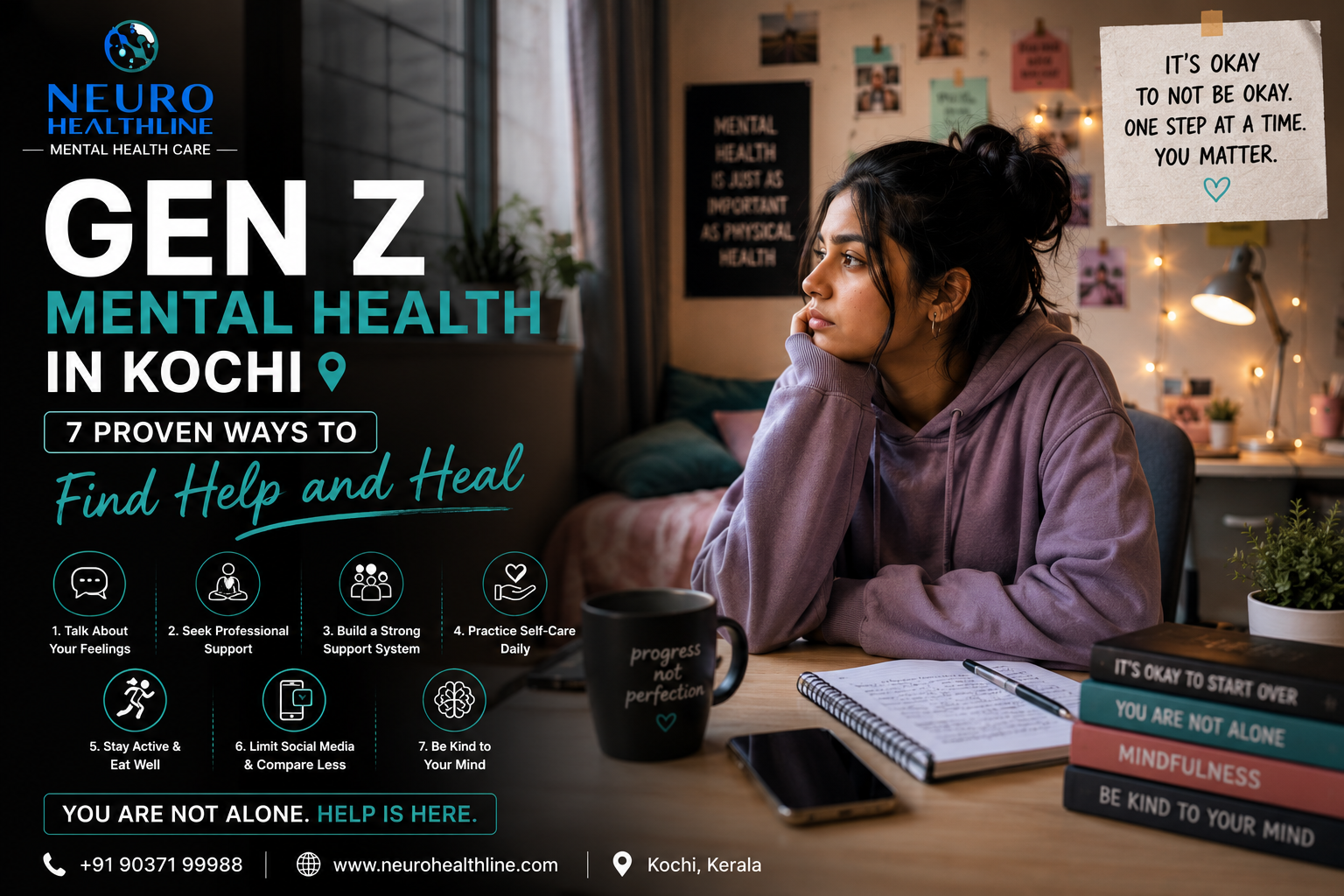
Generation Z — those born between 1997 and 2012 — is the first generation to have grown up entirely within the age of smartphones, social media, and always-on digital connectivity. In Kochi, this generation is navigating one of the most psychologically demanding environments in the city’s history — where the pressures of Kerala’s intensely competitive academic culture, the omnipresence of social media comparison, the economic uncertainty of a rapidly changing job market, and the lingering psychological aftermath of pandemic disruption converge simultaneously on a generation whose nervous systems are still completing their developmental trajectory. Gen Z mental health in Kochi is not a passing trend or a product of generational weakness — it is a genuine, clinically significant crisis that deserves serious, neuroscience-based attention rather than dismissal as oversensitivity or entitlement. At NeuroHealthline, we are committed to providing Kochi’s Gen Z population with the stigma-free, evidence-based mental health support they need and deserve.
Why Gen Z Mental Health in Kochi Is a Distinct Clinical Challenge
Gen Z mental health in Kochi presents a distinct clinical picture that differs meaningfully from previous generations’ mental health presentations — not because young people today are less resilient, but because the environment they are navigating is genuinely more complex and more neurologically demanding than anything previous generations faced at the same developmental stage.
The digital environment is the single most defining factor in Gen Z mental health in Kochi. Unlike millennials who grew up with the internet arriving during their teenage years, Gen Z has never known a social world without social media — making the comparison, validation-seeking, and threat-detection patterns that social media activates not an added layer but the foundational architecture of how this generation experiences social belonging and identity formation. The neurological impact of this is significant: a developing brain that experiences social comparison, social threat, and social validation primarily through the high-speed, high-volume, algorithmically amplified medium of social media is being shaped differently from any previous generation’s brains — with measurable consequences for anxiety sensitivity, attention regulation, and emotional resilience.
Beyond digital pressures, Gen Z mental health in Kochi is shaped by Kerala’s distinctive academic intensity — a culture in which examination results and professional credentials carry enormous social weight, creating a high-stakes performance environment that coincides precisely with the adolescent years when prefrontal regulatory capacity is still under construction. The combination of developmental vulnerability, academic pressure, digital anxiety amplification, and reduced access to the unstructured play, face-to-face social time, and nature exposure that previously buffered adolescent mental health creates a perfect storm for Gen Z mental health challenges in Kochi.
The Most Common Gen Z Mental Health Challenges in Kochi
At NeuroHealthline, the Gen Z mental health presentations we see most frequently in Kochi include anxiety disorders — particularly social anxiety, generalised anxiety, and examination anxiety — which represent the most prevalent mental health challenge in this age group across Kerala; depression, often presenting with a distinctive Gen Z flavour of functional impairment alongside maintained social media presence that can make it difficult for parents and teachers to recognise; burnout — not traditionally associated with teenagers but increasingly presenting in Kochi’s academically driven young people who have been in high-pressure performance environments since early childhood; social media-related anxiety and compulsive digital behaviour that amplify underlying anxiety and depression presentations; sleep disorders driven by late-night digital device use, circadian disruption, and anxiety-driven insomnia; identity-related distress including uncertainty about career direction, personal values, and self-concept in a rapidly changing world that offers fewer clear roadmaps than previous generations navigated; and attention and focus difficulties that reflect a combination of genuine ADHD, anxiety-driven cognitive interference, and the attention fragmentation produced by habitual high-speed digital media consumption.
Research published on NCBI PubMed consistently identifies Gen Z as experiencing significantly higher rates of anxiety, depression, and loneliness than any previous generation at the same age — with social media exposure, academic pressure, and economic uncertainty identified as the primary contributing factors globally, all of which are acutely present in Kochi’s young population.
Why Gen Z in Kochi Doesn’t Seek Help — And Why That Needs to Change
One of the most important and counterintuitive realities of Gen Z mental health in Kochi is that despite being the most psychologically informed generation in history — more aware of mental health language, more comfortable discussing emotional experiences, and more likely to advocate for mental health awareness than any previous generation — Gen Z individuals in Kochi are still frequently reluctant to seek professional help for their own mental health challenges. Several factors contribute to this paradox.
The stigma of seeking professional mental health support remains significant in Kerala’s social and family culture, where mental health difficulties are still frequently interpreted as personal weakness or family embarrassment rather than treatable neurological conditions. Many young people in Kochi fear that seeking help will confirm something is fundamentally wrong with them rather than recognising that experiencing mental health challenges in a genuinely demanding environment reflects a healthy nervous system responding to extraordinary pressure. Financial accessibility remains a barrier for students managing their own budgets. And the nature of anxiety itself — the avoidance that is one of its most defining features — means that the very act of seeking help requires overcoming the primary symptom of the condition seeking treatment.
At NeuroHealthline, our approach to Gen Z mental health in Kochi is built specifically around reducing these barriers — through a stigma-free, label-free clinical environment; accessible, flexible scheduling around academic and work commitments; and a neuroscience-based framing of mental health that resonates with the scientifically minded Gen Z preference for evidence-based explanations over pathologising diagnostic labels.
7 Proven Ways NeuroHealthline Supports Gen Z Mental Health in Kochi
1. QEEG Brain Mapping
Gen Z mental health in Kochi at NeuroHealthline begins with a QEEG brain map — providing objective, data-driven insight into the neural patterns underlying each young person’s specific mental health challenges. This approach resonates strongly with Gen Z’s preference for evidence-based, measurable explanations over purely subjective diagnostic assessments.
2. HEG Neurofeedback for Adolescent Brain Development
HEG neurofeedback directly supports prefrontal cortex development and regulatory capacity — the neural system most critically implicated in virtually every Gen Z mental health challenge, from anxiety and depression to attention difficulties and emotional dysregulation. Regular neurofeedback training builds the neural regulatory capacity that academic and social pressure, combined with digital overstimulation, has been consistently eroding.
3. HRV Biofeedback
HRV biofeedback therapy teaches a practical, measurable nervous system regulation skill that Gen Z clients can apply directly in the situations — examinations, social interactions, presentations — where their mental health challenges most acutely manifest. The real-time data feedback of HRV biofeedback aligns strongly with Gen Z’s data-literate, quantified self orientation.
4. Sleep Restoration
Sleep disruption is both one of the most prevalent and one of the most consequential Gen Z mental health challenges in Kochi — directly impairing emotional regulation, cognitive performance, and resilience in ways that amplify every other mental health challenge. Our sleep restoration protocols address the circadian disruption and anxiety-driven insomnia that are the primary drivers of sleep difficulties in this age group.
5. Anxiety and Depression Treatment
Our dedicated anxiety treatment in Kochi and depression treatment in Kochi programs are fully adapted for Gen Z presentations — addressing the specific triggers, cognitive patterns, and social contexts that characterise anxiety and depression in Kochi’s young population rather than applying generic adult treatment protocols.
6. Digital Behaviour and Social Media Support
Gen Z mental health in Kochi cannot be adequately addressed without specifically engaging with the digital behaviours and social media dynamics that are so central to this generation’s mental health landscape. Our programs include practical, developmentally appropriate digital behaviour restructuring that reduces anxiety-amplifying social media patterns while preserving the genuine social connection digital platforms provide.
7. Stigma-Free Neuropsychotherapy
Our neuropsychotherapy approach to Gen Z mental health in Kochi is explicitly framed in neuroscience-based language that resonates with young people’s preference for evidence-based understanding — repositioning mental health support as brain optimisation and nervous system training rather than deficit management, which significantly reduces the shame and reluctance that prevent so many young people in Kochi from seeking help. This aligns with our broader counseling centers in Kochi philosophy of stigma-free, label-free care.
A Message to Kochi’s Gen Z — You Are Not Broken
If you are a young person in Kochi reading this because you recognise yourself in these descriptions, there is something important we want you to understand. The anxiety, the exhaustion, the difficulty concentrating, the persistent low mood, the sense that everyone else is managing better than you — these are not signs that something is fundamentally wrong with you as a person. They are signs that a still-developing nervous system is under extraordinary pressure in an environment specifically designed to maximise engagement at the cost of wellbeing. Gen Z mental health challenges in Kochi are not a weakness — they are a rational neurological response to genuinely demanding circumstances. And they are treatable — not through willpower or positive thinking alone, but through targeted, evidence-based clinical support that addresses the brain and nervous system directly.
The World Health Organization identifies adolescent and young adult mental health as a global health priority — and recognises that most adult mental health conditions begin during adolescence, making early intervention one of the highest-return investments in long-term wellbeing available. NeuroHealthline’s approach to Gen Z mental health in Kochi is built on this recognition — providing the clinical quality that this generation’s mental health challenges genuinely deserve.
Frequently Asked Questions About Gen Z Mental Health in Kochi
What are the most common Gen Z mental health challenges seen in Kochi?
The most common Gen Z mental health challenges in Kochi include anxiety disorders — particularly social and examination anxiety — depression, burnout, social media-related compulsive behaviour, sleep disorders, and attention difficulties. These frequently co-occur and reinforce each other, making integrated assessment and treatment essential.
Is Gen Z mental health in Kochi worse than previous generations?
Research consistently shows Gen Z experiences significantly higher rates of anxiety and depression than previous generations at the same age. This reflects genuine environmental differences — social media saturation, academic pressure intensification, economic uncertainty — rather than generational weakness.
How does NeuroHealthline make mental health support accessible for Gen Z in Kochi?
Through flexible scheduling around academic and work commitments, a stigma-free and label-free clinical environment, neuroscience-based framing that resonates with evidence-oriented young people, and a non-pathologising approach that positions treatment as brain optimisation rather than deficit management.
Can parents access Gen Z mental health support at NeuroHealthline in Kochi?
Yes. We offer psychoeducation and practical guidance for parents of young people experiencing Gen Z mental health challenges — helping families create home environments that support rather than inadvertently amplify their child’s recovery process
Is Gen Z mental health support in Kochi only for teenagers or also for young adults?
Both. Our programs support Gen Z mental health in Kochi from early adolescence through the mid-twenties — recognising that the distinctive pressures shaping this generation’s mental health extend well beyond the teenage years into early adulthood.